



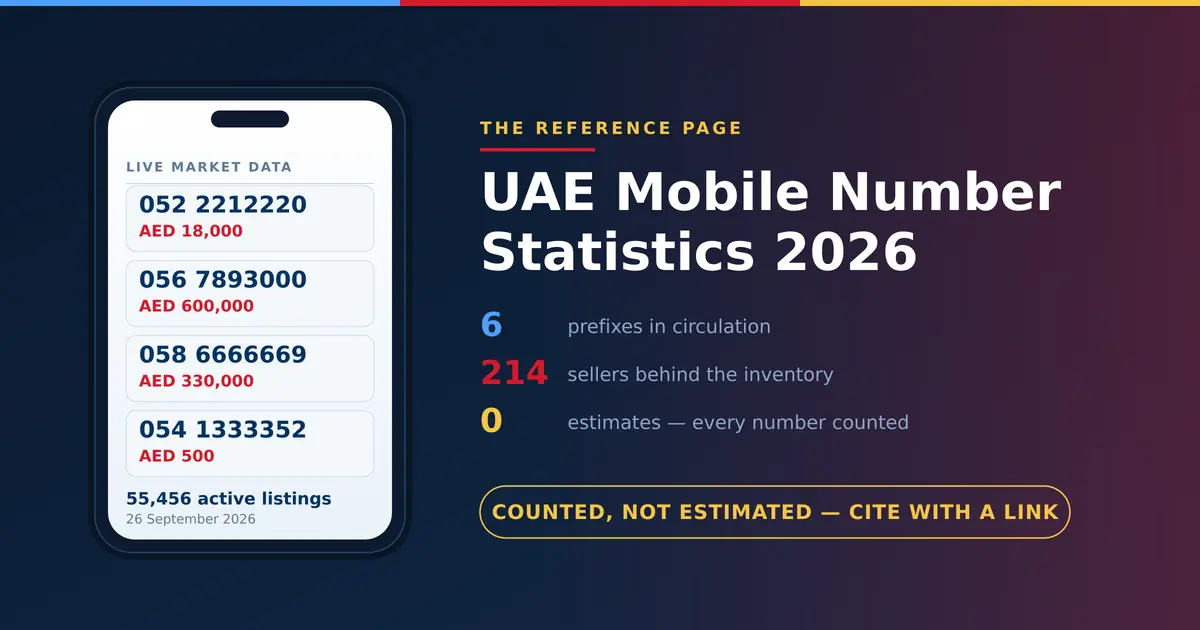
Every statistic on this page is counted, not estimated. Two dates govern it, and the difference matters if you are citing from it: inventory, scarcity and attention figures were recounted on 26 September 2026 across all 55,456 active listings on MobileNumber.ae. Price figures carry their original measurement date of 19 July 2026 and have not been recomputed — where a price appears below, that date travels with it.
This is the reference version: citable statistics about UAE mobile numbers, grouped in clusters, each with a line of context and a link to the study behind it. Journalists, researchers and fellow analysts are welcome to cite any figure here with attribution and a link.
How These Numbers Are Made
Method in three sentences. Inventory and scarcity figures are counted live across all active listings on the date shown; behavioural figures use the platform's cumulative view counters; price figures are asking prices among publicly priced listings, never estimates of closed sales. Comparative claims follow the house method rules — neutral-substring controls, degenerate-case exclusions and publish-day recomputes — documented in the 13-test, the rhythm study and the superstition-economy study.
One honest limitation. A single marketplace is not the whole country, and this one is not a neutral observer of it: a large share of the inventory is listed by the house account rather than by private sellers. Counts on this page describe what is listed here. They are the best public measurement of the UAE secondary number market that exists, and they are still a measurement of one marketplace.
Market Size & Structure
The shape of the market itself — how many numbers are for sale, how many show a price, and how much of the inventory hides from view. All counted 26 September 2026.
| Measure | 26 September 2026 | Share |
|---|---|---|
| Active listings | 55,456 | 100% |
| Listings with a public price | 45,995 | 82.9% |
| Listings marked POA (price on application) | 9,461 | 17.1% |
| Listings at or above AED 5,000 | 4,166 | 7.5% |
| Listings at or above AED 50,000 | 184 | 0.3% |
| Distinct sellers | 214 | — |
| Cumulative listing views | 6,115,087 | — |
The POA figure is the one most often misread, and the most important thing about it is who it belongs to. Hiding a price is not a habit of the UAE market — it is the habit of one large seller. Of the 24,650 listings that come from private sellers, exactly 9 hide their price. The other 9,452 hidden-price listings sit in a single bulk inventory. Anyone citing ‘17.1% of the market’ without that sentence will describe the wrong thing.
The share itself fell sharply — from 31% in July to 17.1% now — while the absolute number barely moved, from roughly 9,500 hidden-price listings to 9,461. The shadow inventory did not shrink; the visible market grew around it. The hidden-price study maps what sits inside it.
Prices, Tiers & Plans
Every figure in this section was measured on 19 July 2026 and has not been recomputed. Treat the date as the freshness stamp; the tier boundaries and the plan-state effect are structural and move slowly, but the averages belong to that day.
- AED 5,049 average ask across the 21,544 listings that carried a public price on 19 July 2026 — the baseline every premium below is measured against.
- AED 1,050,000: the record ask. An 058 number built on six zeros. The 058 range is allocated to du and Virgin Mobile — the ceiling of the record tier.
- Three commercial tiers structure the market: golden from AED 5,000, premium from AED 50,000, trophies to seven figures — the ladder from the premium-tier study.
- The prepaid premium is 1.87×. Transfer-ready prepaid listings averaged AED 8,142 against AED 4,343 for postpaid — the liquidity signal measured in the prepaid study.
- 68% of trophies above AED 50,000 sat on prepaid — the tier flip: everyday numbers live on contracts, assets live transfer-ready.
- Ownership transfers involve a small carrier fee and typically complete the same day at any carrier store — process in the transfer guide.
Patterns & Scarcity
Structure is the market's raw material. The counts below were recounted on 26 September 2026; the family averages beside them remain the 19 July measurement and are labelled as such.
| Family | Listings (26 Sep 2026) | Average ask (19 Jul 2026) |
|---|---|---|
| Contains a triple (three identical digits in a row) | 23,535 (42.4%) | — |
| Contains a quad (four in a row) | 1,646 | — |
| Mirror numbers (7-digit palindromes) | 676 | AED 16,199 (then 561 listings) |
| 786 numbers, duplicate listings removed | 118 | AED 7,670 (then 100 listings) |
| Six-deep runs (six identical digits in a row) | 24 | — |
| Echo (ABAB) tails | — | AED 3,734 |
| 000-family | 2,000 | AED 12,390 |
The six-deep tier is the rarest thing on the market and it is unevenly shaped: of the 24 alive today, eleven are 4s — the digit a large part of the buyer pool is said to avoid — three are 0s, three are 2s, two are 6s, two are 8s, and there is exactly one each of 1, 3 and 7. There is not a single six-deep 5 or 9 on the marketplace. The 999 case is covered in the forever number.
The Superstition Economy
What faith is worth in dirhams — and the famous fears that turned out to be free. All price effects in this section date from 19 July 2026.
- A 777 ending pays 2.8× a mid-number 777 (AED 14,380 against 5,201) — the largest positional premium measured: belief is performative.
- The avoid-4 premium is +31%: triple-8 numbers free of any 4 averaged AED 6,517 against 4,971 with one — the purest belief signal on the market.
- 786 carries a +52% premium — the strongest shared-belief effect, on the scarcest lucky family. Context in the 786 guide.
- 666 carries no Western-stigma discount: it priced within about 1% of celebrated 888 — the multicultural pool absorbs every taboo, per the 666 study.
- 13 carries no discount either: tested against six neutral controls, it priced dead mid-pack — the 13-test.
Attention & Behaviour
6.1 million listing views, decoded — where eyes actually go, and the one seller habit that costs three-quarters of the audience. Recounted 26 September 2026.
| Behaviour | Average views per listing | Against market |
|---|---|---|
| Listings with a public price | 126.3 | 1.15× |
| Listings marked POA | 32.4 | 0.29× |
| Priced AED 5,000–50,000 (the golden band) | 282.0 | 2.56× |
| Mirror numbers | 231.8 | 2.10× |
| Whole marketplace | 110.3 | 1.00× |
- Hiding the price costs about 88% of the audience. Across the whole marketplace POA listings average 32.4 views against 126.3 for priced ones, but that mixes two very different kinds of seller. Measured like-for-like inside the inventory of the one seller who actually uses POA, hidden-price listings draw 32.3 views against 260.9 for priced ones — an 88% penalty, and the cheapest mistake on this list to reverse.
- The most-viewed listing has 1,491 views — and asks AED 18,000, not a million. Attention lives mid-market.
- The AED 1,050,000 record has collected 183 views — eight times fewer than the most-viewed listing, at fifty-eight times its price.
- Attention peaks in the golden band: the 3,999 listings priced between AED 5,000 and 50,000 draw 282 views each — where covetable meets attainable.
- Mirrors are the most-stared-at family at 2.10× the market rate — the only family that tops both the price and the attention table.
What the UAE Actually Asks
Inventory tells you what is for sale. It does not tell you what people want to know. This section is the one figure set no competitor can publish: the shape of Google demand reaching this marketplace over a three-month window, measured in impressions — how often a question was put to Google and this site was shown as a possible answer.
It reorders the market's own assumptions.
| What people ask | Share of measured demand | Example |
|---|---|---|
| Which network does this prefix belong to? | Largest single cluster | "054 du or Etisalat" |
| Who called me from this number? | Comparable in size | "who called me from this number uae" |
| What is a number worth / what does it cost? | A small minority | "vip mobile number price" |
The most-asked question about UAE mobile numbers is not what they cost. It is which of the three operating carriers a prefix belongs to — a question with a factual answer that a large part of the internet still gets wrong. Roughly 19,900 impressions over three months arrived on that question across thirty different phrasings, and a comparable volume arrived on identifying an unknown caller. Price and valuation questions, the thing a marketplace assumes everybody wants, are a small minority of the demand.
Two further shapes are worth recording. About 89% of this demand originates inside the UAE — this is a domestic market, not an export one, whatever the international interest in record asking prices suggests. And Arabic speakers ask the same questions in Arabic, in the same proportions: the prefix question appears as 054 دو ولا اتصالات and the numbering question as بداية رقم الامارات.
For sellers there is a practical reading. The audience arriving at this market is, in the majority, not yet shopping — it is orienting. The prefix lookup answers the first question and the unknown-caller guide the second; both are upstream of any purchase.
Rules, Transfers & History
The regulatory floor under every trade — age rules, transfer mechanics, and the numbering structure that explains today's prefixes.
- SIM ownership requires age 18 or over under TDRA rules; children's lines stay registered under a parent until then — details in the family-transfer guide.
- Transfers need both parties in person with original Emirates IDs, or a notarised power of attorney — and the number keeps working throughout: WhatsApp and bank OTPs never break.
- 999 is the UAE police emergency code (998 ambulance, 997 civil defence) — yet owning a 999-pattern number is fully legal, with no misdial risk.
- Six mobile prefixes are in circulation today — 050, 052, 054, 055, 056 and 058. A prefix records which carrier was allocated that range, not who operates the line now: number portability lets a number move between carriers while its prefix stays put. The full timeline is in the history of UAE numbers.
| Prefix | Allocated to | Listings (26 Sep 2026) |
|---|---|---|
| 050 | Etisalat (e&) | 18,186 |
| 052 | du | 306 |
| 054 | Etisalat (e&) | 21,307 |
| 055 | du | 528 |
| 056 | Etisalat (e&) | 14,790 |
| 058 | du and Virgin Mobile | 336 |
The UAE has had four mobile carriers in its history; three operate today — Etisalat (e&), du and Virgin Mobile. The fourth, DOMC, held the 057 range and has been discontinued; 057 numbers are no longer issued and none are listed here.
What Makes This Market Unlike Any Other
Context for anyone citing these figures abroad. Roughly 88% of UAE residents are expatriates, so several numerological traditions — Chinese homophones, Indian digit-lore, Islamic Abjad values and Western superstition — bid on the same seven digits, which is why premiums exist and taboo discounts do not (the three laws). A famous plate-auction culture normalised paying six figures for registration numbers, and the habit spilled over to SIM cards — the crossover has its own comparison guide. And a strict, biometric transfer regime makes ownership genuinely provable, which is what lets a phone number behave like an asset at all. Import a UAE statistic into another market's story without this paragraph and it will mislead.
The Drift Log
Live data drifts, and this page tracks it rather than freezing history. This is the first full recount since publication.
| Measure | 19 July 2026 | 26 September 2026 | Movement |
|---|---|---|---|
| Active listings | ~31,000 | 55,456 | +79% |
| POA listings | ~9,500 | 9,461 | unchanged |
| POA share of market | 31% | 17.1% | −45% |
| Hidden-price audience penalty | −92% | −74% | weakened |
| Cumulative views | 5.2M | 6.12M | +18% |
| Most-viewed listing | 1,303 views | 1,491 views | +14% |
| Views on the record listing | 89 | 183 | +106% |
| Listings containing a triple | 41% | 42.4% | +1.4pp |
| Mirror numbers | 561 | 676 | +20% |
| 786 numbers | 100 | 118 | +18% |
| Six-deep numbers | 22 | 24 | +2 |
Two movements deserve comment rather than a row. The whole-market hidden-price penalty moved from −92% to −74% — a real change, not rounding. Both figures compare every POA listing against every priced one, which mixes bulk and private sellers; the like-for-like figure inside a single seller's inventory is −88%, and that is the number this edition leads with. Anyone who cited −92% should update it. And the POA count held almost exactly steady while the market grew by 79%, which is the more interesting finding: hidden-price listings are not a growing habit, they are a fixed population of sellers who behave differently.
The price figures in this edition were not recomputed and are marked throughout with their 19 July 2026 measurement date.
Citing These Statistics
You are welcome to cite any statistic on this page with attribution to MobileNumber.ae and a link. Each figure carries the date it was measured — use that date, not the publication date, as the freshness stamp. Where a figure is marked 19 July 2026 it has not been recomputed since.
Ready-made line: "According to MobileNumber.ae's live market data, the UAE's secondary mobile number market held 55,456 active listings in September 2026 — and hiding a listing's price costs it roughly 88% of its audience."
Frequently Asked Questions
How many mobile numbers are for sale in the UAE?
55,456 active listings on MobileNumber.ae as of 26 September 2026, held by 214 sellers, of which 45,995 carry a public asking price. The remaining 9,461 listings are marked POA with no public price — 17.1% of the market.
What is the most expensive mobile number in the UAE?
The highest asking price is AED 1,050,000 for an 058 number built on six zeros; the 058 range is allocated to du and Virgin Mobile. The tier above AED 50,000 holds 184 listings as of 26 September 2026.
What do UAE buyers most often ask about mobile numbers?
Not price. The largest cluster of search demand reaching this marketplace asks which carrier a prefix belongs to — questions phrased like "054 du or Etisalat" — followed closely by people trying to identify an unknown caller. Valuation and price questions are a small minority of the measured demand.
What is the average price of a VIP number in the UAE?
Measured on 19 July 2026, the whole-market average was AED 5,049 among priced listings, and averages differed sharply by family: Echo rhythm tails AED 3,734, 786 numbers AED 7,670, triple-zeros AED 12,390 and mirrors AED 16,199. These price figures have not been recomputed since that date.
Which number pattern is the most valuable in the UAE?
By family average on 19 July 2026, mirrors (palindromes) led at AED 16,199, followed by the triple-zero family at AED 12,390. By single listing, the record belongs to a six-zero number at AED 1,050,000.
Do lucky numbers really cost more in the UAE?
Measurably yes, where belief is shared and supply is scarce: 786 numbers carried a +52% premium, 777 endings paid 2.8× mid-number placements, and 8-heavy numbers free of any 4 averaged +31%. Feared numbers, by contrast, showed no discount at all. All measured 19 July 2026.
Are unlucky numbers cheaper in the UAE?
No. 666 priced within about 1% of celebrated 888, and 13 sat mid-pack among neutral controls. The market's multicultural buyer pool means every feared digit has another community that prizes or ignores it, so taboos never turn into discounts.
How much does it cost to transfer a mobile number in the UAE?
for a small carrier fee at the carrier store, typically completed the same day. Both parties attend with original Emirates IDs, or a notarised power of attorney, the buyer must be 18 or older, and postpaid balances and instalments must be settled first.
What share of UAE number listings hide their price?
17.1% as of 26 September 2026 — 9,461 listings — but the headline share is misleading on its own. Almost all of them belong to one large bulk seller; among the 24,650 listings from private sellers, exactly 9 hide their price. Where POA is used, the cost is severe: measured like-for-like within a single seller's inventory, hidden-price listings draw 32.3 views against 260.9 for priced ones, an 88% audience penalty, while also vanishing from every price-filtered search.
Why do prepaid numbers cost more than postpaid ones?
Selection, not magic: prepaid transfers same-day with no credit checks or instalment locks, so owners of valuable numbers park them there. Measured on 19 July 2026 the result was a 1.87× average gap — AED 8,142 against 4,343 — and a 68% prepaid share among trophies above AED 50,000.
What is the rarest number type on the UAE market?
Six-deep runs: only 24 numbers with six identical consecutive digits exist across the entire inventory as of 26 September 2026. Eleven of them are 4s, and there is not a single six-deep 5 or 9. Among lucky families, 786 is scarcest at 118 listings once duplicates are removed.
How many mobile prefixes does the UAE have?
Six are in circulation today: 050, 052, 054, 055, 056 and 058. A prefix records which carrier was originally allocated that range, not which carrier operates the line today — number portability lets a number move while its prefix stays put. A seventh, 057, was held by the discontinued operator DOMC and is no longer issued.
How were these statistics collected?
By direct measurement of all active listings on MobileNumber.ae on the stated date — counts, asking prices and cumulative view counters — following the site's published method rules: neutral controls for substring claims, exclusion of degenerate regex cases, and fresh recomputes on publish day. Figures are asking prices, not closed sales.
Can I use these statistics in an article or report?
Yes — cite MobileNumber.ae with a link to this page, which serves as the reference copy. Each figure carries its own measurement date; use that date as the freshness stamp, and note that price figures marked 19 July 2026 have not been recomputed since.