



Browse any page of UAE number listings and you will meet it within seconds: POA — Price on Application — sitting where a number should be. Nearly one in three listings on this marketplace hides its price (9,456 of 30,998 active listings, measured this morning). And almost every buyer reads those three letters the same way: “if you have to ask, you can’t afford it.”
We tested that folklore against the entire live market — and it fails spectacularly. The most valuable pattern families on the site are the ones that show their prices most proudly, while the heaviest POA users are the bulk shelves worth the least. Hidden prices signal uncertainty and dealer inventory far more often than treasure. This study measures who hides, who shows, and exactly how to turn a POA listing into the best negotiation on the marketplace. All figures from 15 July 2026.
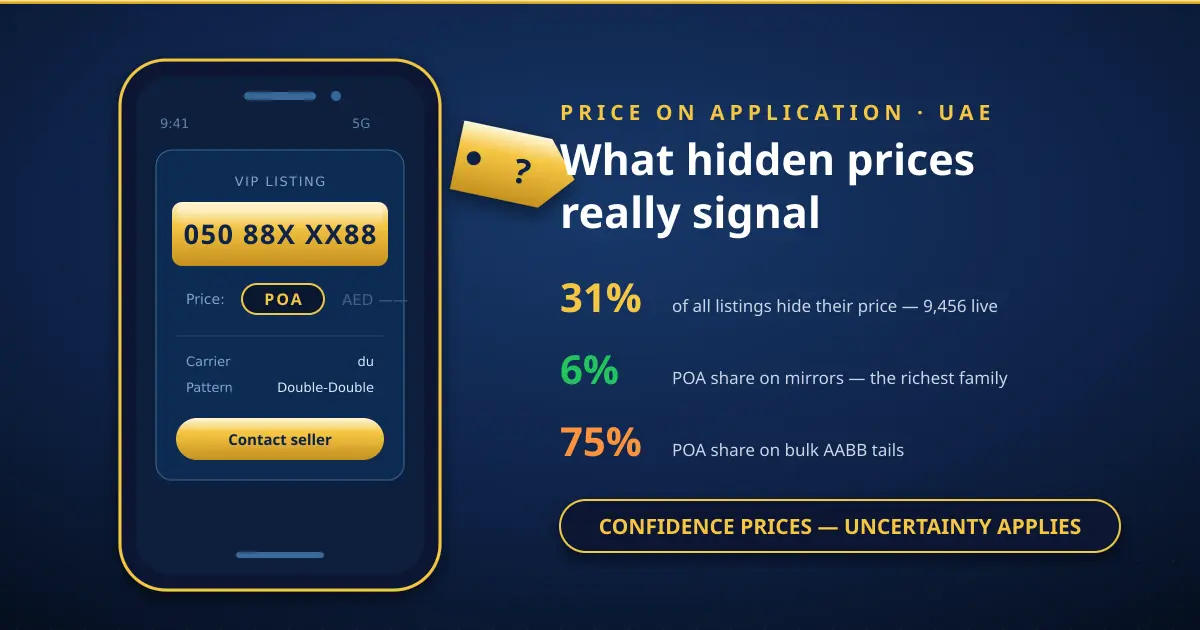
What Does POA Mean on a Number Listing?
POA — Price on Application — means the seller has chosen not to publish an asking price; interested buyers contact them directly for a quote. On this marketplace it appears on 9,456 of 30,998 active listings (31%), making the hidden-price segment larger than every pattern family we track. It is one of the two POAs in the market’s vocabulary — not to be confused with the Power of Attorney used in ownership transfers.
The Folklore: “If You Have to Ask…”
The luxury-market instinct runs deep: yachts, penthouses and rare watches hide prices to signal exclusivity, so buyers assume number listings do the same. The instinct is not crazy — a seller of something priceless might prefer conversations to price tags. But numbers are not yachts: the market is public, comparables are everywhere (we publish family averages monthly), and a hidden price on a comparable good mostly hides information, not grandeur. Whether the folklore survives contact with data is an empirical question — so we measured it.
The Test: Who Hides Prices, Who Shows Them
For every major pattern family, we computed the POA share — the percentage of live listings without a public price — and set it against the family’s average ask among priced listings:
| Family | Live listings | POA share | Avg ask (priced) |
|---|---|---|---|
| Mirror (palindrome) | 561 | 6% — most transparent | AED 16,199 |
| Repeating (4+) | 779 | 9% | AED 28,530 |
| Chorus (ABCABC) | 386 | 9% | AED 7,436 |
| 000 triples | 972 | 17% | AED 12,392 |
| Echo (ABAB) | 2,849 | 19% | AED 3,734 |
| 786 family | 100 | 20% | AED 7,670 |
| 777 triples | 1,515 | 22% | AED 6,371 |
| Whole market | 30,998 | 31% | AED 5,049 |
| 999 triples | 766 | 35% | AED 6,540 |
| Sequential runs | 532 | 62% | AED 4,221 |
| AABB tails | 3,387 | 75% — most hidden | AED 4,379 |
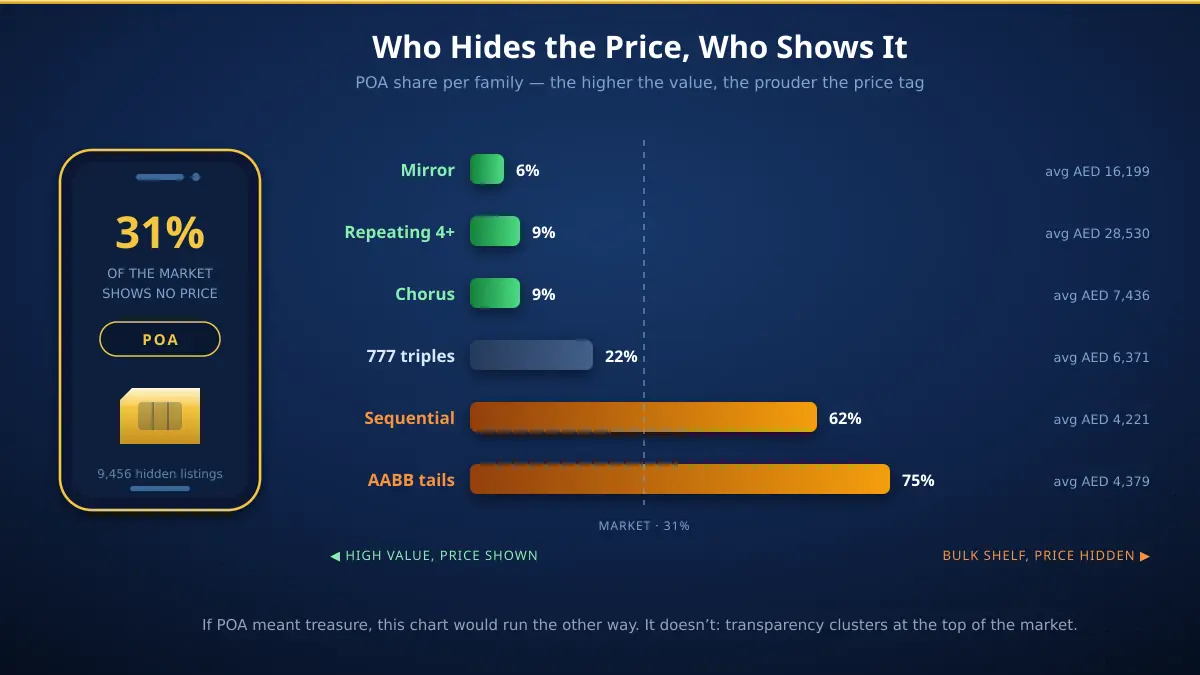
Read the two ends. The most transparent families are the most valuable: mirrors and deep repeats — the shelves where records live — publish their asks 91–94% of the time. The most secretive families are bulk shelves: three-quarters of AABB tails and nearly two-thirds of sequential runs carry no price at all, at averages below the whole-market baseline. If POA signalled treasure, this table would run the other way.
Confidence Pricing: Reading the Inversion
The pattern has a clean behavioural explanation: a public price is a statement of knowledge. The owner of 050 266 2662 knows exactly what class of asset they hold — the comparables are famous, the family is small, the number speaks for itself — so they print AED 350,000 and wait. The holder of an ordinary AABB tail faces the opposite problem: thousands of near-identical listings, a family average nobody memorises, and — frequently — a dealer’s portfolio of dozens of such numbers listed in bulk, where typing individual prices is work that a “call me” label avoids. POA is not a velvet rope; most of the time it is a shrug.
On this market, a printed price says “I know what this is worth.” POA usually says “make me think about it.” The buyer who arrives with a benchmark supplies the thinking — and often sets the anchor.
Why Sellers Actually Choose POA
- Bulk listing economics (the big one). Dealers with 50+ numbers skip per-listing pricing; the AABB and sequential shelves — classic bulk inventory — carry the highest POA shares. See how volume sellers operate in the dealer guide.
- Genuine uncertainty. Owners who inherited or accumulated numbers without following the market often cannot name a fair ask — POA outsources the first move to the buyer. (The fix is ten minutes with the value calculator.)
- Negotiation preference. Some sellers simply prefer to size up each buyer — quoting higher to a corporate enquiry than to a student. POA preserves that flexibility, at a cost the filter section quantifies.
- The trophy exception. A small, real category: owners of unambiguous trophies who want serious enquiries only — covered next, because it is the only case where the folklore holds.
The One POA That Does Mean Money
When a listing in a famously transparent family hides its price, take it seriously. The base rates flip the interpretation: only 6% of mirrors and 9% of deep repeats are POA — so a palindrome or a six-deep run listed as POA is unusual behaviour by a confident class of seller, and usually means “the ask would scare casual browsers” or “price depends on who you are.” That is the yacht case. It is rare — a few hundred listings across the whole market — but if you are hunting at the premium tier, these quiet listings are exactly where unlisted trophies hide. Base rates first, folklore second.
The Buyer’s POA Playbook
- Benchmark before you message. Find the number’s family in the triple ranking, the rhythm guide or the lucky hub, and note the family average. That number is your anchor — and statistically, the POA seller may not know it.
- Run the five pillars. Position, length, stacking, prefix: the valuation framework turns “nice number” into a defensible figure in minutes.
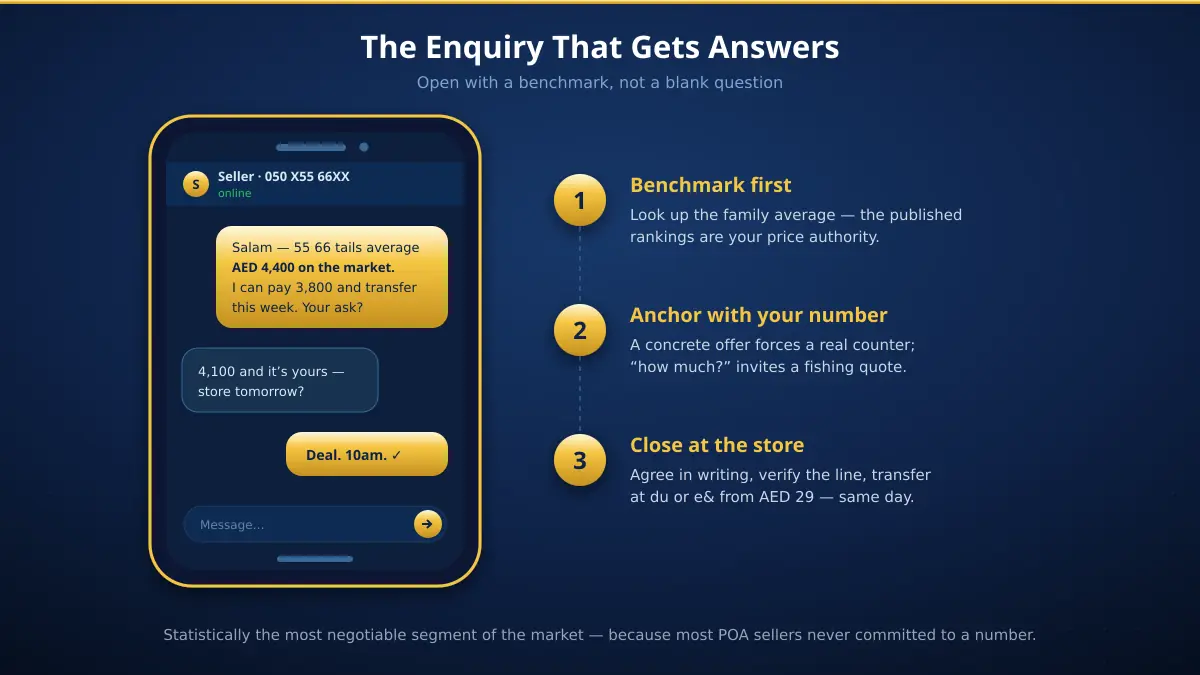
- Open with a number, not a question. “How much?” invites a fishing quote. “Comparable 55 66 tails average AED 4,400 — I’d pay AED 3,800 today” forces a real negotiation from your anchor. Scripts in the negotiation guide.
- Let silence work. POA sellers self-selected into effortful selling; a concrete offer they must counter does the heavy lifting. If the counter lands wildly above family average without a named stack, walk — 9,455 other hidden doors remain.
How to Ask: the Enquiry That Gets Answers
The three-line message that converts POA listings into quotes, field-tested logic from the negotiation guide:
“Salam — interested in 05X XXX XXXX. I know similar [family] numbers list around AED [family average]; if your price is in that range I can complete the transfer this week. What’s your ask?” — It names a benchmark, signals a ready buyer, and asks for their number after anchoring yours.
Two small execution details raise the reply rate further. Timing: message during UAE business hours — bulk sellers process enquiries in batches, and a benchmark-anchored message at 10am sits at the top of the morning pile rather than drowning in an evening backlog. Tone: keep it transactional and warm, never apologetic — you are not asking permission to know a price, you are opening a trade between equals, and sellers consistently quote straighter to buyers who sound like they have bought before.
The Seller’s Side: When to Hide, When to Show
- Own a clear pattern? Print the price. The market’s most successful families are its most transparent; a published ask near the family average converts browsers the moment they compare. Price it properly, then list it free.
- Unsure what you hold? POA is not the answer — a wrong guess of “call me” costs more than a wrong price. Ten minutes with the calculator and the family tables beats months of silence.
- Selling in bulk? POA on the long tail is defensible economics — but price your five best numbers individually. Dealers who surface their anchors sell the shelf behind them; the dealer guide covers the mechanics.
- Genuine trophy, serious-buyers-only? POA is legitimate — you are the 6%. Expect benchmark-armed buyers anyway; this article just trained them.
The Invisible Cost of POA: Filters
One mechanical fact sellers underweight: price filters cannot find a listing that has no price. A buyer browsing the under-5,000 tier or the golden tier is walking through priced inventory only — every POA listing is invisible to that journey by definition. Hiding a price does not just filter out unserious buyers; it filters out every buyer who shops by budget, which — on the evidence of the budget tiers’ depth — is most of them. The 31% of the market sitting in POA is, functionally, a shadow inventory reachable only by browsing and asking.
POA and Safety
Nothing about a hidden price changes the transaction rules: agree the final figure in writing before meeting, verify the line is active and unblocked, exchange money only around the official ownership transfer, and apply the full safe-buying checklist — especially at trophy level, where the “serious enquiries” POAs live and where escrow above AED 100,000 is standard practice. A seller who resists writing the agreed price down after quoting it privately is a red flag, whatever the listing said.
The POA Economy in Numbers
| Metric | Value (15 July 2026) |
|---|---|
| Active listings, whole market | 30,998 |
| Listings with no public price (POA) | 9,456 — 31% |
| Most transparent family | Mirrors — 6% POA at AED 16,199 avg |
| Most hidden family | AABB tails — 75% POA at AED 4,379 avg |
| Direction of the correlation | Inverse: higher family value → lower POA share |
| The exception class | Trophy POAs inside transparent families (≈6–9% of mirrors/repeats) |
Frequently Asked Questions
What does POA mean on a UAE mobile number listing?
POA stands for Price on Application: the seller has not published an asking price, and buyers must contact them for a quote. On MobileNumber.ae it currently applies to 9,456 of 30,998 active listings — 31% of the whole market.
Does POA mean a number is very expensive?
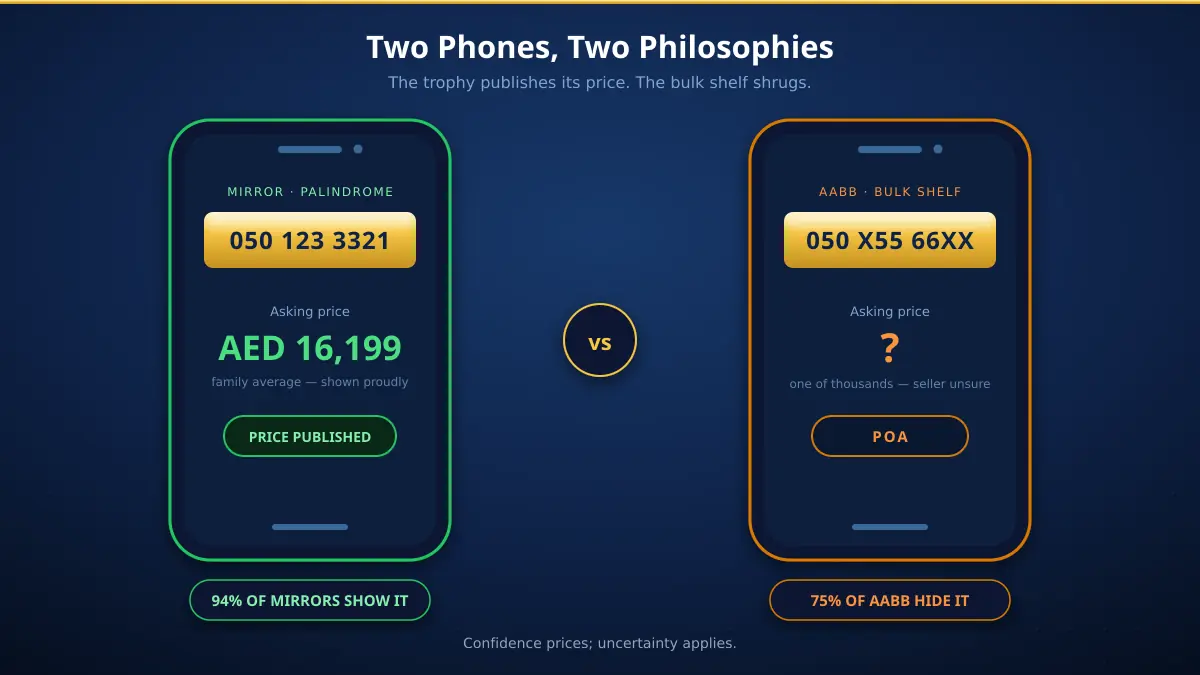
Usually not. The data shows the opposite pattern: the most valuable families publish prices most (mirrors are 94% priced at AED 16,199 average) while the heaviest POA use sits on bulk shelves averaging below the market baseline. POA more often signals dealer inventory or seller uncertainty than a hidden trophy.
Why do sellers hide the price of a mobile number?
Four reasons, in order of frequency: bulk-listing dealers skip per-number pricing; owners genuinely unsure of value let buyers open; some prefer to size up each enquirer before quoting; and a small trophy class wants serious enquiries only. The first two dominate — which is why POA usually invites negotiation.
How do I ask for the price of a POA number?
Open with a benchmark, not a blank question: name the family average from the site's published rankings, state that you can complete the transfer promptly, then ask for their figure. Anchoring first typically produces a realistic quote instead of an opportunistic one.
Can I negotiate a POA listing?
Almost always — statistically it is the most negotiable segment of the market, because most POA sellers have not committed to a number in their own minds. Arrive with the family average and a concrete offer; if the counter far exceeds the benchmark without a named second pattern, move on.
Which number families use POA the most?
AABB pair-tails (75% hidden) and sequential runs (62%) — both high-volume shelves with below-market averages, heavily stocked by dealers. The least POA-prone families are mirrors (6%), deep repeating runs (9%) and ABCABC choruses (9%): the confident, high-value end of the market.
When does POA actually signal a trophy number?
When it appears where it is rare: a palindrome, six-deep run or similar flagship listed without a price is unusual behaviour for that seller class and typically means "serious enquiries only." Base rates make that the exception — a few hundred listings market-wide — but at premium-tier hunting it is worth every enquiry.
Do POA listings appear in price filters?
No — a listing without a price cannot match a price filter, so all 9,456 POA numbers are invisible to anyone browsing the under-1,000, under-5,000, golden or premium tiers. They are reachable only by direct browsing and enquiry, which is the hidden cost sellers accept when choosing POA.
Is buying a POA number riskier than a priced one?
The listing style changes nothing about safe process: agree the final price in writing, verify the line is active, pay only around the official carrier-store ownership transfer, and use escrow above roughly AED 100,000. The one extra caution: a seller who quotes privately but resists writing the figure down is a red flag.
Should I list my own number as POA?
Only if you are a bulk dealer pricing a long tail, or a genuine trophy holder screening for serious buyers. For everyone else the data is unambiguous: transparent families dominate the market's value, a published ask near your family average converts comparison shoppers, and POA removes you from every budget filter.
What share of the UAE number market has no public price?
31% — 9,456 of 30,998 active listings as of 15 July 2026. That shadow inventory is larger than any single pattern family on the marketplace, which is why understanding POA behaviour matters for both sides of the trade.
Where can I browse priced listings instead?
Every price-tier page shows priced inventory only: the under-1,000 and under-5,000 tiers for budget patterns, golden numbers from AED 5,000, and the premium tier above AED 50,000. For hidden-price hunting, browse the pattern categories directly and enquire with a benchmark in hand.