



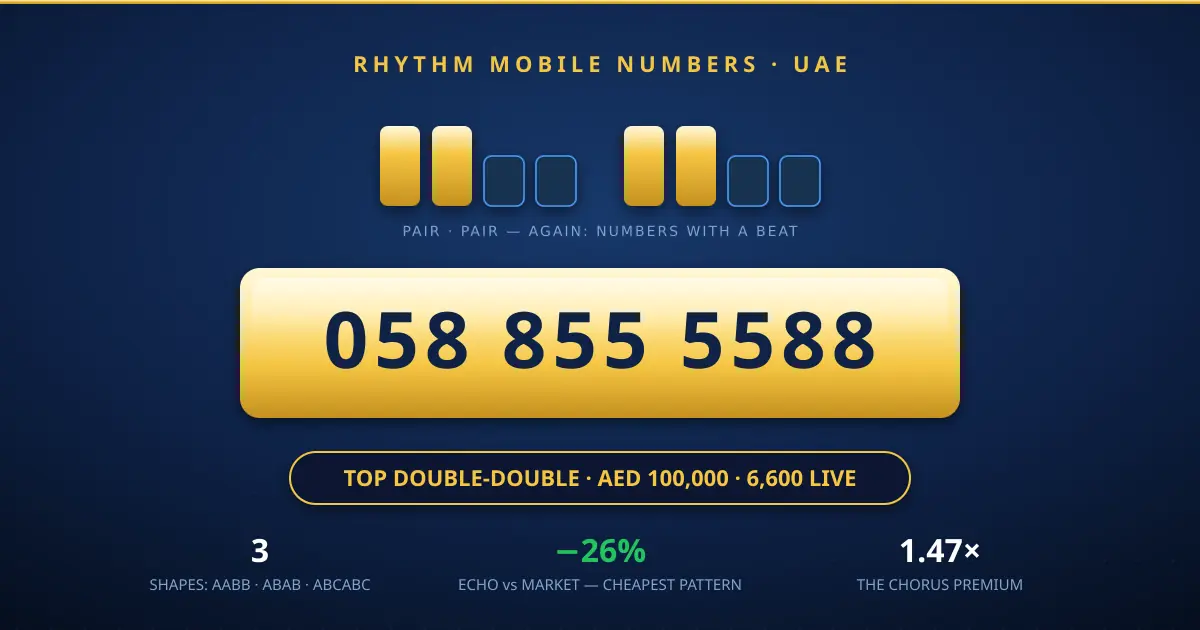
Say 058 855 5588 out loud. Now say a random number. Feel the difference? The first one has a beat — digits arriving in pairs and returns, the way a chorus comes back around. The UAE market has priced repeats, mirrors, sequences and triples for years, and this site has measured all of them. But the largest structural family on the marketplace has somehow never had a name: rhythm numbers — the AABBs, ABABs and ABCABCs whose value comes not from a lucky digit or a straight run, but from cadence.
This guide names the family, measures all ~6,600 live rhythm-tail listings, and delivers two findings that matter for your wallet: the Echo (ABAB) is the cheapest true pattern money can buy in the Emirates — priced below the market average — while the rare Chorus (ABCABC) quietly trades at 1.47× market with a top ask of AED 350,000. Every figure comes from a live analysis on 14 July 2026, including one measurement trap we had to defuse on the way.
What Is a Rhythm Number?
A rhythm number is a UAE mobile number whose tail repeats a multi-digit unit rather than a single digit — two digits doubled (AABB: 5566), two digits alternating (ABAB: 5757), or a three-digit block repeated whole (ABCABC: 123123). The repeating unit is what separates rhythm from its famous cousins: a repeating number drums one digit (5555), a mirror reflects around a centre, a sequence climbs a staircase. A rhythm number loops.
Where Rhythm Sits in the Pattern Family Tree
| Family | Rule | Example tail | Guide |
|---|---|---|---|
| Repeating | One digit, four+ times | 5555 | Guide |
| Triple | One digit, three times | x555 | All 10 ranked |
| Mirror | Reads both ways | 2662 | Guide |
| Sequential | Digits climb or fall | 1234 | Guide |
| Rhythm ← this guide | A multi-digit unit loops | 5566 · 5757 · 123123 | You are here |
The five families overlap constantly — 058 885 8858’s cousins stack rhythm on repeats, and the top Chorus listing is also nearly a mirror. As always, the stacking rule applies: value a number by its strongest pattern. What rhythm adds to the taxonomy is the affordable wing — as the data shows next.
The Rhythm Market in Numbers (2026)
Measured across all active listings on 14 July 2026, against a market baseline of AED 5,047:
| Shape | Live tails | Priced | Average ask | vs market | Top ask |
|---|---|---|---|---|---|
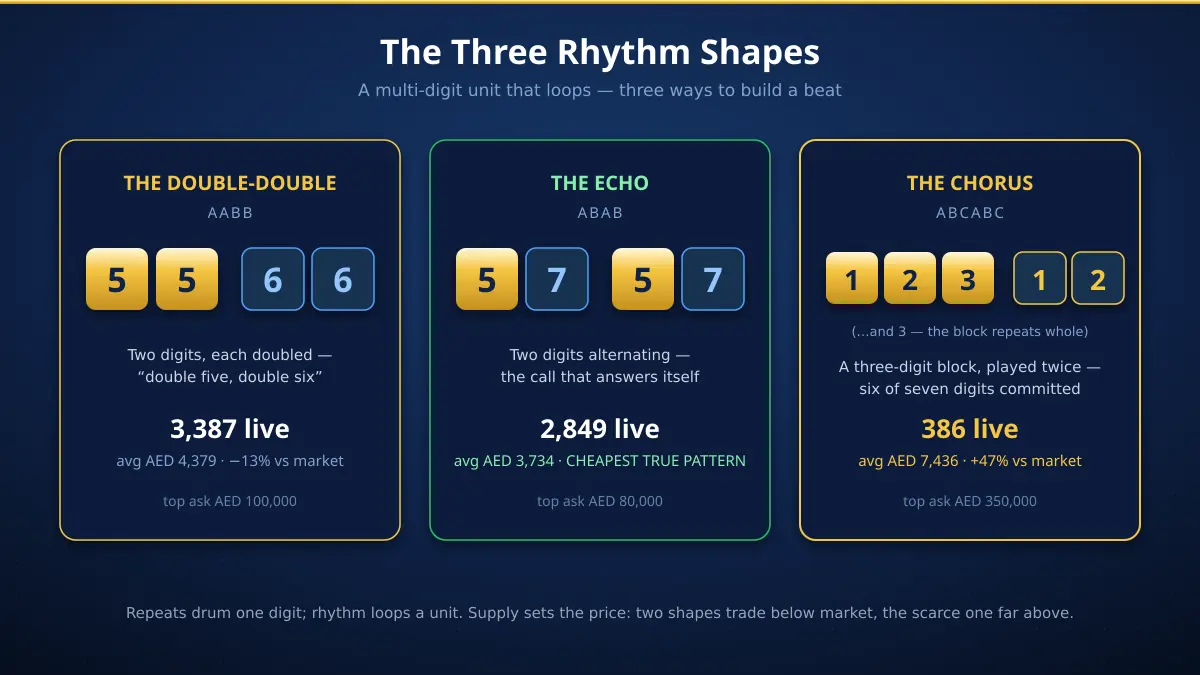
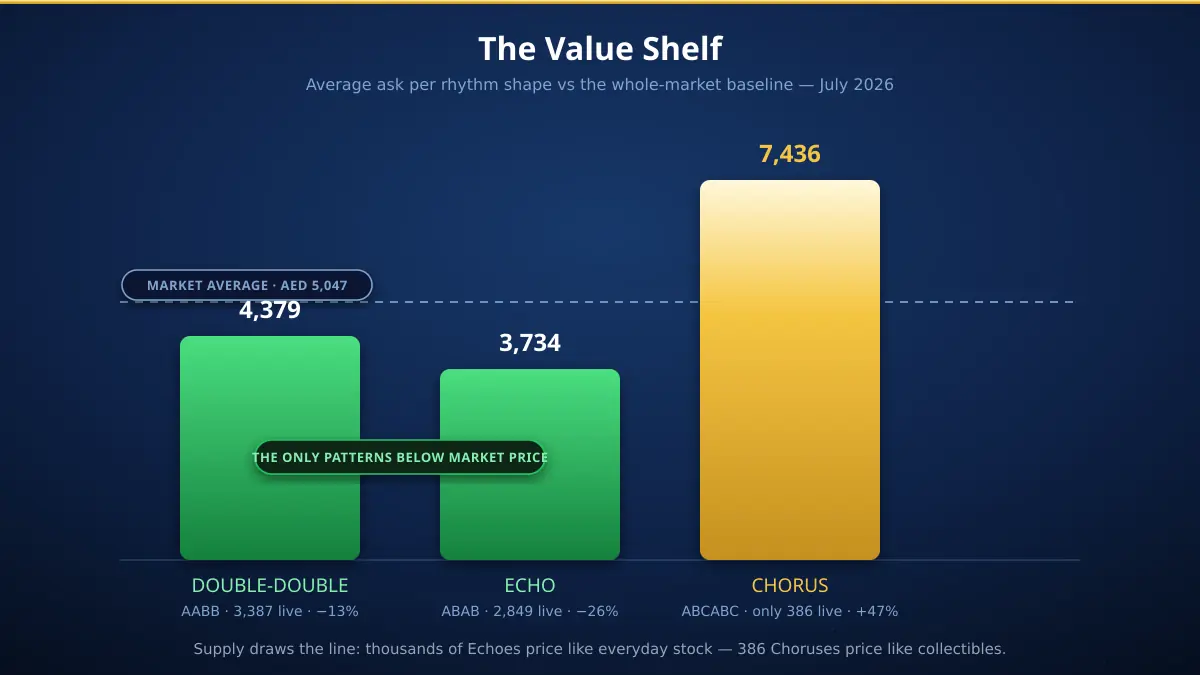
| Double-Double (AABB) | 3,387 | 861 | AED 4,379 | −13% | AED 100,000 |
| Echo (ABAB) | 2,849 | 2,306 | AED 3,734 | −26% | AED 80,000 |
| Chorus (ABCABC) | 386 | 352 | AED 7,436 | +47% | AED 350,000 |
Read the two stories in one table. Supply-rich shapes price below market: the Double-Double and Echo are genuine patterns — instantly hearable, easily remembered — yet they cost less than the average random-looking listing, because thousands of them exist. The scarce shape prices like a collectible: the Chorus, with barely one listing for every seventeen Echoes, carries a 47% premium and a ceiling three and a half times higher. Scarcity, not beauty, draws the price line — the same law that runs the superstition economy.
The Measurement Trap We Had to Defuse
A transparency note in the tradition of our 13-test: the naive database query for “AABB tails” returns 3,548 listings averaging AED 9,795 — more than double what we published above. Why? Because AABB with A = B is just AAAA: the pattern definition silently swallows every quad, penta and the AED 1,050,000 site-record zeros, inflating the family with repeating-number trophies that already have their own market. Enforce A ≠ B — true two-digit rhythm — and the honest averages drop to the figures above. We publish the corrected numbers; anyone re-running the naive query will see the inflated ones, and now you know why. Method rules, as ever: controls before claims.
The Double-Double (AABB)
The largest rhythm shape — 3,387 live tails like 55 66, 77 00, 22 99 — and the one businesses discover first: two pairs read beautifully on a shopfront and dictate their own cadence over the phone (“double five, double six”). The current top ask is 058 855 5588 at AED 100,000 — note the stacking: a Double-Double tail (55 88) wrapped around a triple-5 core, plus near-mirror symmetry. Pure, unstacked Double-Doubles live mostly in three and four figures — which is the point: real structure, entry pricing. Browse them inside the fancy category.
The Echo (ABAB): the Cheapest True Pattern
At an average of AED 3,734 — 26% below the market baseline — the Echo is the most affordable genuine pattern on the UAE marketplace. 2,849 live tails alternate two digits (57 57, 20 20, 69 69), and 81% of them carry public prices — the highest priced-ratio of any pattern family we track, a sign sellers treat them as movable stock rather than trophies. The top Echoes show what stacking does: 050 533 5353 and 050 411 4141 (both AED 80,000) extend the alternation into a five-digit wave. And one Echo deserves its own footnote: 052 320 2020 — an Echo tail that is also the year 2020 — asking AED 60,000. For budget buyers, the Echo shelf is the strongest answer to “how do I get a real pattern under AED 1,000?” — the same territory as our budget VIP guide.
The Chorus (ABCABC): the Collector Tier
Repeat a full three-digit block — 123 123, 266 266, 858 858 — and you have the rhythm family’s aristocracy: just 386 live Choruses, averaging AED 7,436 (1.47× market). The mathematics explains the scarcity: a Chorus consumes six of the seven subscriber digits, leaving no room for error and few candidates in any number range. The crown is 050 266 2662 at AED 350,000 — a Chorus that doubles as a near-mirror, stacking two families in one string — followed by the twin 885 8858s on 058 and 055 at AED 185,000 each. This is the shape the marketplace’s own buyer-request board asks for by structure (“XX-YY-XX-YY collector’s interest”), and the shape most likely to hold value the way mirrors do: scarce, self-evident, and independent of any single culture’s luck.
The Most Expensive Rhythm Numbers Right Now
| # | Number | Shape | Carrier | Ask |
|---|---|---|---|---|
| 1 | 050 266 2662 | Chorus + near-mirror | e& | AED 350,000 |
| 2= | 058 885 8858 | Chorus, 8-heavy | du | AED 185,000 |
| 2= | 055 885 8858 | Chorus, 8-heavy | du | AED 185,000 |
| 4 | 058 855 5588 | Double-Double + triple | du | AED 100,000 |
| 5 | 050 000 9900 | Double-Double on zero runway | e& | AED 95,000 |
| 6= | 050 533 5353 | Echo, extended wave | e& | AED 80,000 |
| 6= | 050 411 4141 | Echo, extended wave | e& | AED 80,000 |
Every entry above the Echo tier stacks a second pattern — the rhythm supplies the cadence, the stack supplies the price. The valuation logic is the standard five-pillar framework, with rhythm scoring under pattern strength.
Why Rhythm Works: the Cognitive Case
Rhythm numbers convert a seven-digit string into two or three chunks — and chunking is how human short-term memory actually works. A random subscriber number is seven items to hold; 855 5588 is three (“eight · triple-five · double-eight”); 123 123 is one item played twice. That is why rhythm patterns dominate radio jingles and why they read aloud so well in every language of the UAE — a pair or a repeated block survives translation between Arabic, English, Hindi and Tagalog with its shape intact. It is the same mechanism behind the final-digit ladder’s core finding: the market pays for what strangers can repeat after one hearing. Rhythm is memorability’s cheapest packaging — which brings us to the trade.
The Value Play: Structure Below Market Price
The Echo and Double-Double are the only pattern families on this marketplace that price below the market average — a structural bargain created by supply, not by defect. For a first VIP number, a business line on a budget, or a gift that sounds premium without premium money, the rhythm shelf is the highest memorability-per-dirham on the site. The catch is equally honest: abundant supply means slower resale appreciation — buy rhythm to use, buy scarcity (Chorus, premium tier) to hold.
Choosing Your Rhythm
- For a storefront or service line: Double-Double — “double two, double nine” is the easiest structure to dictate over a phone call, and signage loves symmetry.
- For a first pattern on a budget: Echo — the under-AED-1,000 shelf is deep, and the under-1,000 tier carries plenty of them.
- For a collector or an investment lean: Chorus only — scarcity is the whole thesis; check every candidate for a stacked mirror or triple, which multiplies the case.
- For meaning plus rhythm: pick the digits inside the shape from your tradition — an 88 99 Double-Double reads “wealth-forever” in the Chinese system; a 77 00 pairs the universal lucky seven with corporate zeros.
- Check the year bonus: Echoes ending 20 20 or Double-Doubles like 19 99 moonlight as birth-year and anniversary numbers — a second buyer pool at resale time, as 052 320 2020’s AED 60,000 ask shows.
How to Buy a Rhythm Number
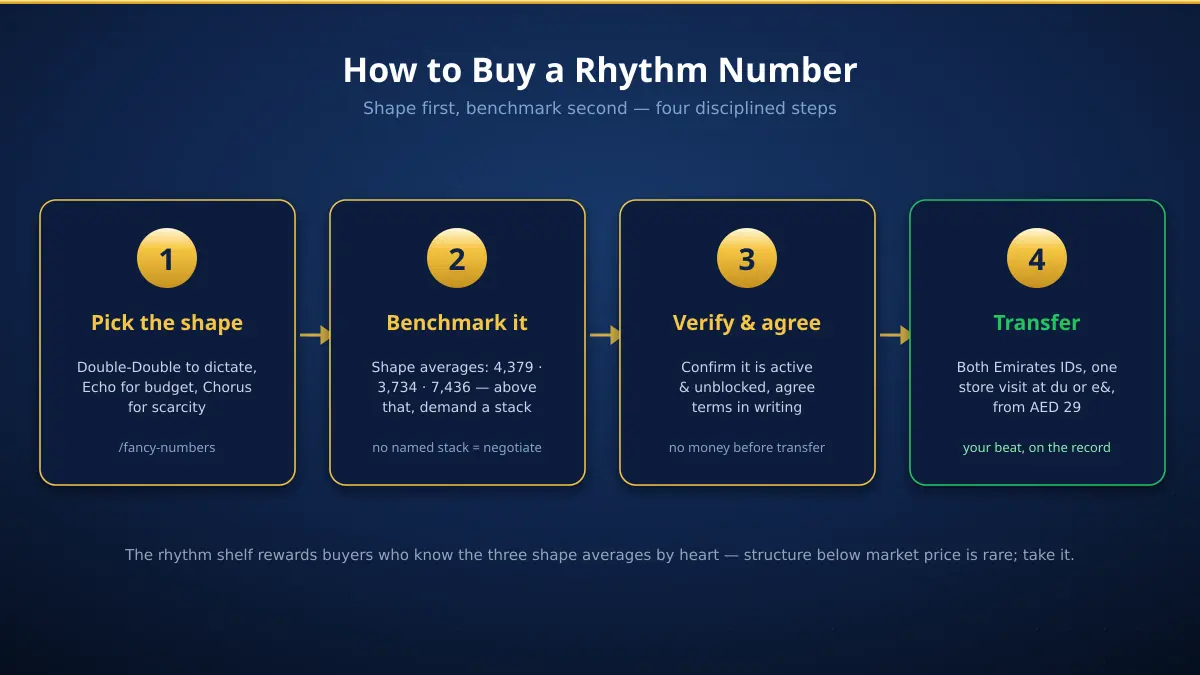
- Pick your shape first — Double-Double for dictation, Echo for budget, Chorus for scarcity — then hunt inside the fancy category and special numbers page, where rhythm listings live unlabelled.
- Benchmark against the shape averages: AED 4,379 (Double-Double), AED 3,734 (Echo), AED 7,436 (Chorus). An ask far above them needs a named second pattern — apply the stacking rule and negotiate from the data.
- Verify and agree in writing — active line, no blocks, terms on paper, per the safe-buying checklist.
- Transfer ownership properly — both parties, original Emirates IDs, one carrier-store visit plus a small carrier fee; full steps in the transfer guide.
Selling a rhythm number? Name the shape in your listing title — “Double-Double 55 66 tail” tells a buyer in three words what “nice number” never will — and if your rhythm stacks a mirror or triple, lead with the stack. Price it properly, then list it free.
Frequently Asked Questions
What is a rhythm mobile number?
A rhythm number repeats a multi-digit unit in its tail rather than a single digit: two digits doubled (AABB, like 5566), two digits alternating (ABAB, like 5757), or a whole three-digit block repeated (ABCABC, like 123123). Around 6,600 such tails are live on the UAE marketplace.
What is the difference between AABB, ABAB and ABCABC numbers?
AABB doubles two digits in sequence (55 then 66) — the Double-Double. ABAB alternates the same two digits (5757) — the Echo. ABCABC repeats a full three-digit block (123123) — the Chorus, which uses six of the seven subscriber digits and is by far the rarest of the three shapes.
How much does a rhythm number cost in the UAE?
Less than most patterns: Echo (ABAB) tails average AED 3,734 and Double-Doubles (AABB) AED 4,379 — both below the AED 5,047 market baseline — while the scarce Chorus (ABCABC) averages AED 7,436. Trophy asks run from AED 80,000 for extended Echoes to AED 350,000 for the top Chorus.
Why are Echo numbers so cheap if they look special?
Supply: nearly 2,849 ABAB tails are live at once, and sellers price them as movable stock — 81% carry public prices, the highest ratio of any pattern family. The pattern is real and memorable; it is simply not scarce, so it prices as everyday structure rather than as a collectible.
What is the most expensive rhythm number for sale in the UAE?
050 266 2662 at AED 350,000 — a Chorus (266 repeated) that is also a near-mirror, stacking two pattern families. Behind it sit the twin 8-heavy Choruses 058 and 055 885 8858 at AED 185,000 each.
Are rhythm numbers a good investment?
The Chorus tier has an investment case — only 386 exist, and scarcity plus self-evident structure travels across cultures. Double-Doubles and Echoes are better bought for use than appreciation: their supply is deep, so they hold value but rarely outrun the market. Buy rhythm to use, buy scarcity to hold.
Is a rhythm number the same as a repeating number?
No. The marketplace defines repeating numbers as four or more of the same digit in a row (5555), while rhythm numbers loop a multi-digit unit with at least two different digits (5566, 5757, 123123). The distinction matters for pricing: repeats scale with run depth, rhythm with shape scarcity.
Why do rhythm numbers feel easier to remember?
Chunking: human short-term memory holds items, not digits, and a rhythm tail collapses four to six digits into one or two spoken chunks — "double five, double six" or "123 twice." The shape also survives translation between Arabic, English, Hindi and Tagalog intact, which matters in a market this multicultural.
Where can I browse rhythm numbers on MobileNumber.ae?
They live unlabelled inside the fancy numbers and special numbers categories — search visually for paired tails like 5566 or 5757, or contact sellers of listings whose last four digits alternate. The under-1,000 tier is the richest hunting ground for budget Echoes.
Do rhythm patterns stack with lucky digits?
Yes, and the stack sets the price: an 8899 Double-Double reads as wealth-plus-forever to Chinese-influenced buyers, a 7700 pairs the lucky seven with corporate zeros, and the top Chorus asks all involve a second family — a mirror, a triple or heavy 8s — on top of the rhythm.
Can a rhythm number double as a year number?
Some do: Echo tails ending 2020 or Double-Doubles like 1999 read simultaneously as pattern and as year, adding a birthday-and-anniversary buyer pool. The marketplace's standout example is 052 320 2020 — an Echo that is also the year 2020 — asking AED 60,000.
How do I know if a rhythm ask is overpriced?
Benchmark against the shape averages — AED 4,379 for AABB, AED 3,734 for ABAB, AED 7,436 for ABCABC. An ask several times the average is justified only by a named second pattern (a mirror, triple or zero runway); if the seller cannot name it, the premium is storytelling, and the data is your counter-offer.