



The UAE mobile number market is the world’s most honest laboratory for a question philosophers argue about and economists rarely get to measure: what is belief worth, in dirhams? Nowhere else do Chinese prosperity eights, Islamic 786s, Indian nines, Western unlucky thirteens and the devil’s own 666 compete for the same seven digits, priced in public, every single day.
So we measured it. Across 21,539 priced listings on this marketplace, we tested every major superstition against live asking prices — with proper controls, family baselines and a willingness to publish whatever the data said. The result is three laws that explain almost everything about how faith, fear and memory set the price of a phone number in the Emirates. Some beliefs command a 52% premium. Others — famous ones — move prices not one fil. This is the full study, published 13 July 2026.
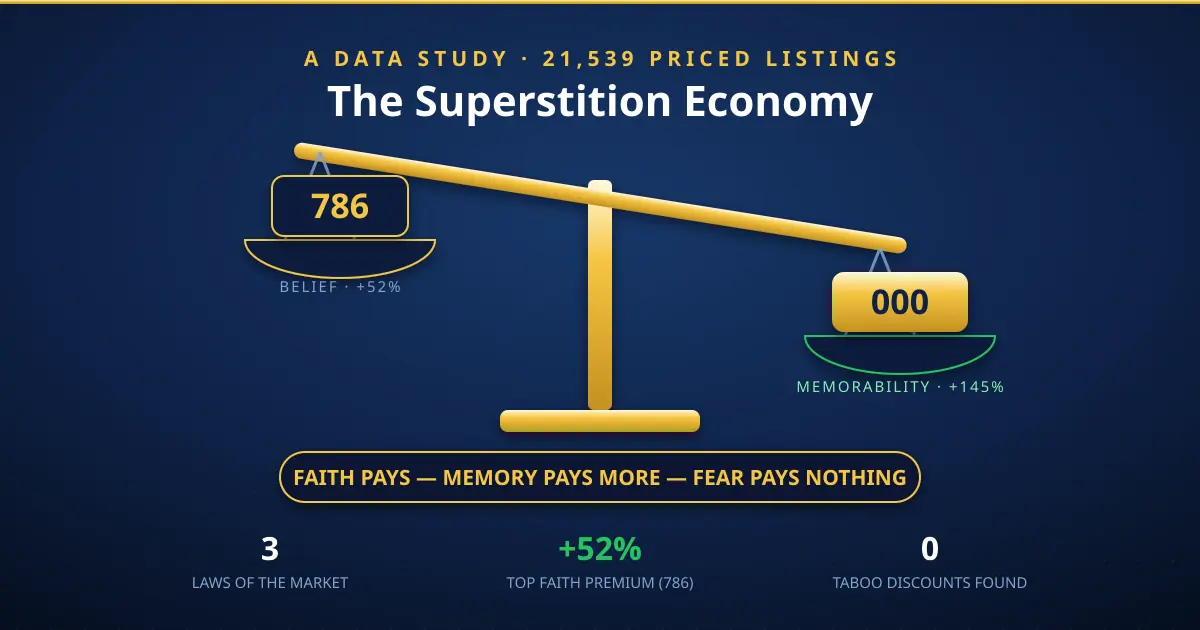
The Question: Does Belief Move Prices?
Yes — but far more selectively than the folklore claims. Cultural belief adds a measurable premium to UAE mobile numbers only when a large buyer pool shares the belief and the pattern is scarce; feared “unlucky” digits carry no discount at all; and simple memorability out-prices every faith premium on the board. Those three findings — the three laws — repeat across every family, prefix and price band we tested.
How We Measured It
Transparency first — every figure in this study comes from the same, reproducible method:
- Dataset: all 21,539 active listings with a public asking price on MobileNumber.ae, measured 13 July 2026. Market baseline average: AED 5,041. Price-on-application listings are excluded throughout.
- Family definitions: digit families use three-or-more consecutive digits (the triple standard); 786 counts any occurrence, per the 786 category.
- Controls: substring claims are tested against neutral neighbours — the method that killed the “13 discount” myth. A number containing 13 must be compared with numbers containing 12, 14 or 23, not with the whole market, because any fixed substring marks a number as ordinary.
- Asking prices, not sales: like every study of live marketplaces, we measure what sellers believe buyers will pay — the market’s stated expectations. Averages, not ceilings, carry the argument; trophy asks are usually stacked patterns.
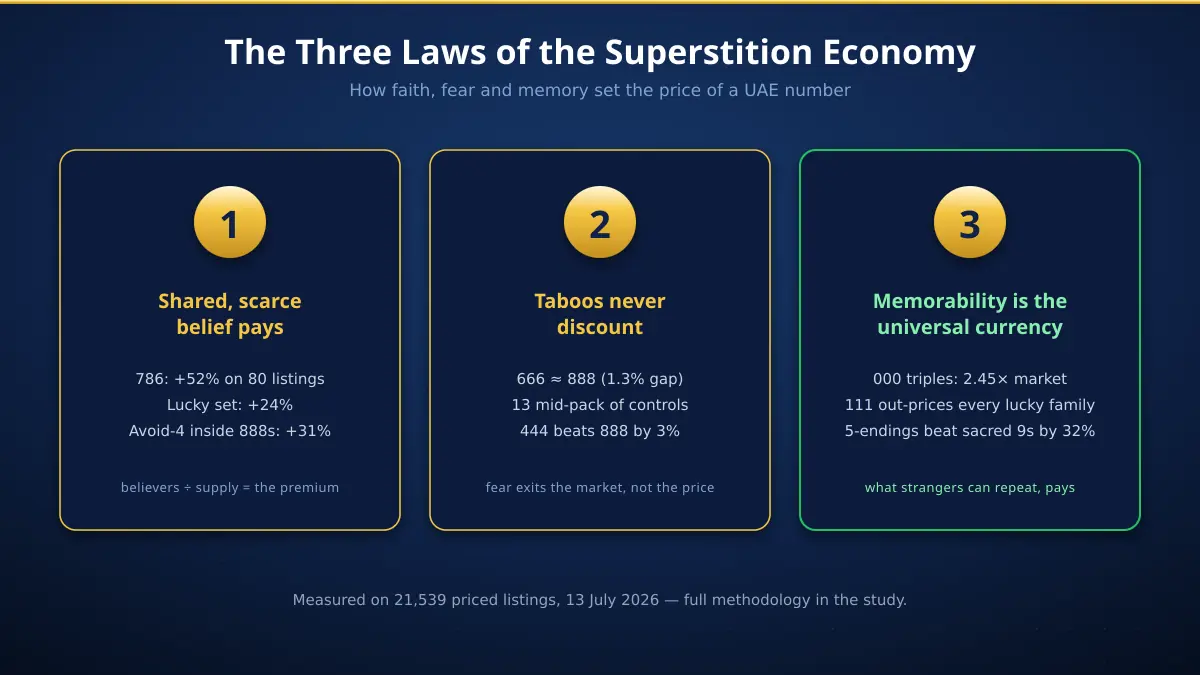
Law 1: Shared, Scarce Belief Pays
Where a belief is held by a large buyer pool and the matching numbers are rare, the premium is real and substantial:
| Belief asset | Priced listings | Average ask | vs market (AED 5,041) |
|---|---|---|---|
| 786 — the Bismillah sequence | 80 | AED 7,670 | +52% |
| The lucky set (777/888/999 triples + 786) | 2,757 | AED 6,246 | +24% |
| 888 free of any 4 | 636 | AED 6,517 | +29% |
Notice what drives the ranking: 786 has the fewest listings and the biggest premium. Its believers — hundreds of thousands of South Asian Muslims — outnumber its 80 priced listings by four orders of magnitude. That ratio, believers per available number, is the engine of every faith premium: the 786 guide and the lucky numbers hub unpack each family’s version of it. Scarcity converts sentiment into dirhams; sentiment alone converts into nothing, as Law 2 shows.
The Purest Signal: the Avoid-4 Premium
The cleanest belief measurement on the marketplace hides inside a family. Take only triple-8 numbers — same pattern, same digit, same buyer pool — and split them by whether a 4 appears anywhere in the number:
| Triple-8 numbers… | Priced listings | Average ask | Gap |
|---|---|---|---|
| …containing no 4 at all | 636 | AED 6,517 | +31% |
| …containing at least one 4 | 381 | AED 4,971 |
This is belief with everything else held constant: the buyers of prosperity-eights are precisely the community for whom 4 sounds like death — and they pay nearly a third more to keep their eights unpolluted. It is the inverse of a taboo discount: the premium lives inside the believing pool, where the marginal buyer shares the fear. Outside that pool, as Law 2 shows, the same digit 4 carries no penalty at all.
Belief Has a Shape: the 2.8× Tail Effect
Faith premiums are not spread evenly through a number — they concentrate where the digits are seen and said. The same triple-7 is worth radically different amounts by position: numbers ending in 777 average AED 14,380 against AED 5,201 for a mid-number 777 — a 2.8× multiplier for placement alone. The effect weakens down the lucky ladder (1.3× for 888, 1.16× for 999) in line with each digit’s “display value.” Belief, it turns out, is performative: buyers pay most for the digits other people will notice. The full positional dataset is in the lucky numbers study.
Law 2: Taboos Never Discount
Now the counterintuitive half of the economy. Every famous “unlucky” number we tested — three curses from three different civilisations — failed to move prices downward:
| The curse | The test | The result | Verdict |
|---|---|---|---|
| 666 — the beast (West) | vs celebrated 888, same structure | AED 5,859 vs 5,938 — a 1.3% gap | No stigma discount |
| 13 — bilang Hudas (Catholic-West) | vs six neutral substring controls | AED 3,962 — dead centre of the 3,501–4,462 control band | No malas discount |
| 444 — triple death (East Asia) | vs 888, the anti-4 pool’s favourite | AED 6,122 vs 5,938 — 444 wins by 3% | No death penalty |
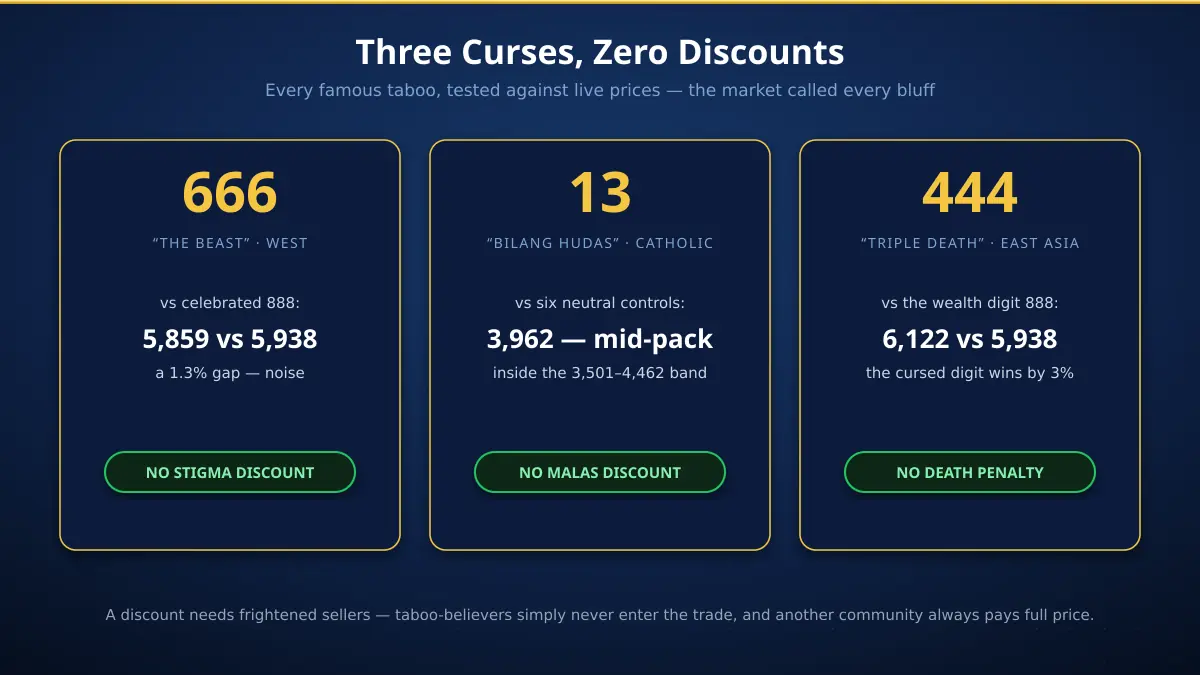
Individually, each finding has its own story — 666’s East-West duality, the 13 test, 444’s contrarian rank. Together they form a law: in this market, fear does not create bargains.
Why Curses Fail in the Emirates
The asymmetry has a clean mechanism. A premium needs only willing buyers; a discount needs frightened sellers — and taboo-believers are not sellers of the numbers they fear. They simply never enter the trade. Meanwhile the UAE’s buyer pool is the most multicultural on earth: for every community that dreads a digit, another prizes it (666 smooth in Chinese, 444 an angel number in the West) and a third is indifferent (Arabic tradition is neutral on all three). Someone always steps in at full price. A taboo can only dent prices in a monoculture — and the Emirates, 88% expatriate, is the opposite of one. It is the same pluralism that shows up in the digit symbolism decoder: no digit means one thing here, so no fear clears the room.
A superstition premium requires believers on one side of the trade. A superstition discount requires them on both. The UAE has enough faiths that neither side is ever empty — so premiums survive and curses starve.
Law 3: Memorability Is the Universal Currency
The final law dwarfs the other two. The most valuable repeated digit on this marketplace carries no luck tradition in any culture:
- Triple-zero numbers average AED 12,352 — 2.45× the market baseline — nearly five times the premium of the entire lucky set, on 806 priced listings. No scripture, no homophone, no numerology: just roundness, institutional sound and instant recall. The triple ranking crowned it #1 of all ten digits.
- 111 — equally belief-free — is #2 at AED 6,452, out-pricing every lucky family including 777.
- Endings tell the same story: numbers ending in 5 (no tradition) average AED 5,835, while numbers ending in the culturally beloved 9 average AED 4,434 — the sayable digit beats the sacred one by 32%.
Belief premiums are real, but they are the seasoning. The meal is memorability — what a stranger can repeat after hearing your number once. That has been this site’s consistent finding since the final-digit ladder first showed 5 and 0 beating every lucky digit, and it is why the five-pillar framework weights pattern strength at 40% and cultural resonance at 20% — the market’s own proportions.
The Faith Premium Index
Everything above, on one ruler — each asset’s average ask divided by the AED 5,041 market baseline:
| Asset | Belief content | Index (× market) |
|---|---|---|
| 000 triples | None — pure memorability | 2.45× |
| 786 numbers | Islamic — shared & scarce | 1.52× |
| 111 triples | None — identity & cleanliness | 1.28× |
| The lucky set | Multi-faith | 1.24× |
| 444 triples | “Cursed” (East) / angelic (West) | 1.21× |
| 888 triples | Chinese prosperity | 1.18× |
| 666 triples | “Damned” (West) / smooth (East) | 1.16× |
| Numbers ending in 9 | Beloved in two faiths | 0.88× |
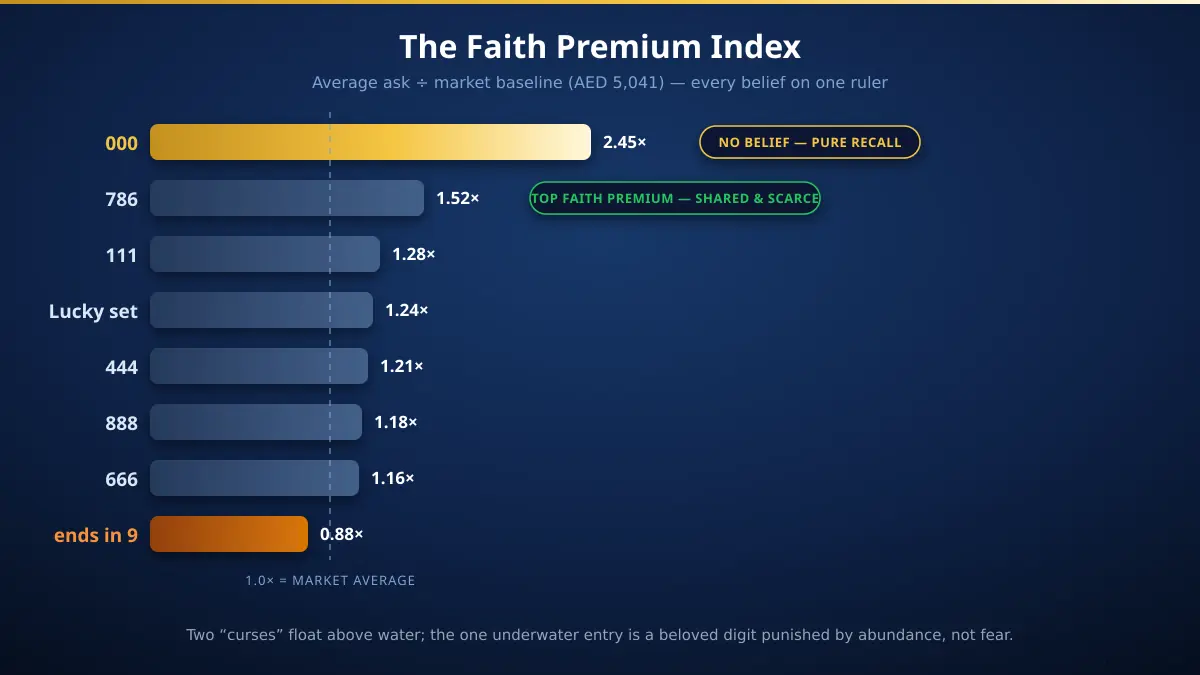
Read as one system, the index is the whole study in miniature: memorability at the top, shared-and-scarce faith in the middle, failed curses floating unharmed — and the one genuinely underwater entry is a beloved digit, the 9-ending, punished not by fear but by abundance and a soft final sound. The market’s message could not be clearer:
What This Means If You Are Buying
- Pay for shared belief, not personal belief. A 786 or a clean-of-4 eight holds value because a huge pool agrees; a digit only you find lucky adds joy, not resale. Match your budget to the family averages before falling in love.
- Never wait for a taboo bargain. There is no discounted shelf of 13s and 666s — Law 2 closed it. If a “cursed” number suits you, you will pay pattern price; budget accordingly.
- Buy the tail, not the middle, when belief matters to you — the premium concentrates where digits are displayed (2.8× on 777). If display doesn’t matter, mid-number placements are the value shelf.
- When in doubt, buy memorability. Zeros and clean structures out-earn faith across every band — and they sell to everyone later, not just to co-believers. Start at the VIP hub or the repeating tier.
What This Means If You Are Selling
- Price to the believing pool, write for it too: lead the listing with the digits that carry shared meaning (8s, 7s, 786) — the seller’s guide shows the copy patterns that work.
- Never apologise for a “cursed” digit — and never discount for one. The data above is your negotiating warrant: 444 out-prices 888; 13 trades mid-pack. Print this study if a buyer claims otherwise, and negotiate from the numbers.
- Zeros are your hidden equity. A 000 run in an otherwise ordinary number may be its most valuable feature — check the calculator before you set an ask, then list it free.
For Researchers & Journalists
This study is part of an ongoing data series measuring cultural pricing on the UAE secondary number market — previous instalments include the all-ten triple ranking, the 999 paradox and the 13-malas test. Methodology in brief: live asking prices across 21,539 priced listings on MobileNumber.ae (13 July 2026); family averages against a whole-market baseline of AED 5,041; substring claims tested against neutral controls; asks, not closed sales. You are welcome to cite these findings with attribution and a link to this page — and media enquiries about the underlying data are answered via the contact page. Key citable line: “On the UAE’s largest number marketplace, the Islamic 786 sequence commands a 52% price premium — while numbers containing the ‘unlucky’ 13 trade at no discount at all.”
Frequently Asked Questions
Do lucky numbers actually cost more in the UAE?
Yes, measurably: the lucky set of 777, 888 and 999 triples plus 786 numbers averages AED 6,246 against a market baseline of AED 5,041 — a 24% premium — and the scarcest belief asset, 786, carries +52%. The premium scales with how many buyers share the belief and how few matching numbers exist.
Are unlucky numbers like 13 or 666 cheaper in the UAE?
No. Numbers containing 13 price dead-centre among neutral control substrings, 666 triples sit within 1.3% of celebrated 888s, and “death digit” 444 triples actually average 3% above 888. Across three civilisations’ worth of taboos, the market shows no discount anywhere.
Why do taboo numbers not get discounted?
Because a discount needs frightened sellers meeting reluctant buyers — and people who fear a digit simply avoid the trade rather than dumping stock. In the UAE’s multicultural pool, every feared digit has another community that prizes it or is indifferent, so someone always pays full pattern price.
What is the most valuable digit in a UAE mobile number?
The zero — and it carries no luck tradition at all. Triple-zero numbers average AED 12,352, which is 2.45 times the market baseline and roughly double any lucky family’s average. Roundness, institutional sound and instant memorability out-price every superstition.
What is the biggest belief premium ever measured on the site?
The 786 premium: numbers containing the Bismillah sequence average AED 7,670, 52% above the market baseline, on just 80 priced listings. It is the purest case of Law 1 — a belief shared by an enormous buyer pool chasing a tiny supply.
What is the avoid-4 premium?
Within triple-8 numbers, listings containing no digit 4 anywhere average AED 6,517 versus AED 4,971 for those with at least one 4 — a 31% gap. It is the cleanest belief signal in the data because everything else about the numbers is identical; only the feared digit differs.
Does the position of lucky digits change the price?
Dramatically. Numbers ending in 777 average AED 14,380 against AED 5,201 for the same triple mid-number — a 2.8× multiplier for placement alone. The effect exists across families (1.3× for 888, 1.16× for 999): buyers pay most for digits other people will see and say.
Is this study based on sale prices or asking prices?
Asking prices — the stated expectations of sellers across 21,539 priced listings on 13 July 2026, measured against a whole-market baseline of AED 5,041. Averages carry the analysis rather than ceilings, since trophy asks usually reflect stacked patterns rather than a single belief.
Which matters more when buying: luck or memorability?
Memorability, by the data: belief-free 000 and 111 triples rank first and second among all digit families, and 5-endings out-price the culturally sacred 9-endings by 32%. Shared belief is a real but secondary premium — the five-pillar framework’s 40% pattern / 20% culture weighting mirrors the market.
Should I avoid buying a number with 4 or 13 in it?
Only if the belief matters to you or to the people who will dial you. Financially the data is clear: you pay no premium for containing them and receive no discount either — with one exception: if you may later resell to Chinese-facing buyers, a 4 inside an 8-heavy number does reduce its value to that pool.
Can journalists or researchers cite this study?
Yes, with attribution and a link to this page. The methodology is summarised in the researchers’ section above: live asking prices, family averages against the market baseline, and neutral-substring controls for all containment claims, measured on 13 July 2026.
Where can I browse the numbers behind these findings?
The lucky tier holds the 7, 8, 9 and 786 families; the repeating category holds the deep-run patterns; and the golden and premium tiers hold the price bands from AED 5,000 and AED 50,000 upward. Every listing is direct from the seller with no commission, transferred at a du or e& store for a small carrier fee. Browse the lucky-number listings themselves.