



It is one of the most common questions telecom staff hear in the UAE, and one of the least written about: “The number is in my name — can I move it to my son? My wife? My father?” Families here share everything from cars to trade licences, and mobile numbers are no different. A line opened years ago under one relative’s Emirates ID quietly becomes someone else’s daily number — until a re-registration SMS, a visa change or a line-expiry rule suddenly makes the paperwork matter very much.
This guide covers the family transfer specifically: moving a mobile number between relatives in the UAE — parent to child, husband to wife, brother to sister — with the 2026 rules, the exact documents, the fees, and the traps (minors, absent parties, postpaid debts) that catch people out. For the general buyer-to-seller process, our complete ownership-transfer guide remains the pillar reference; this page handles the questions that only families ask.
The Short Answer
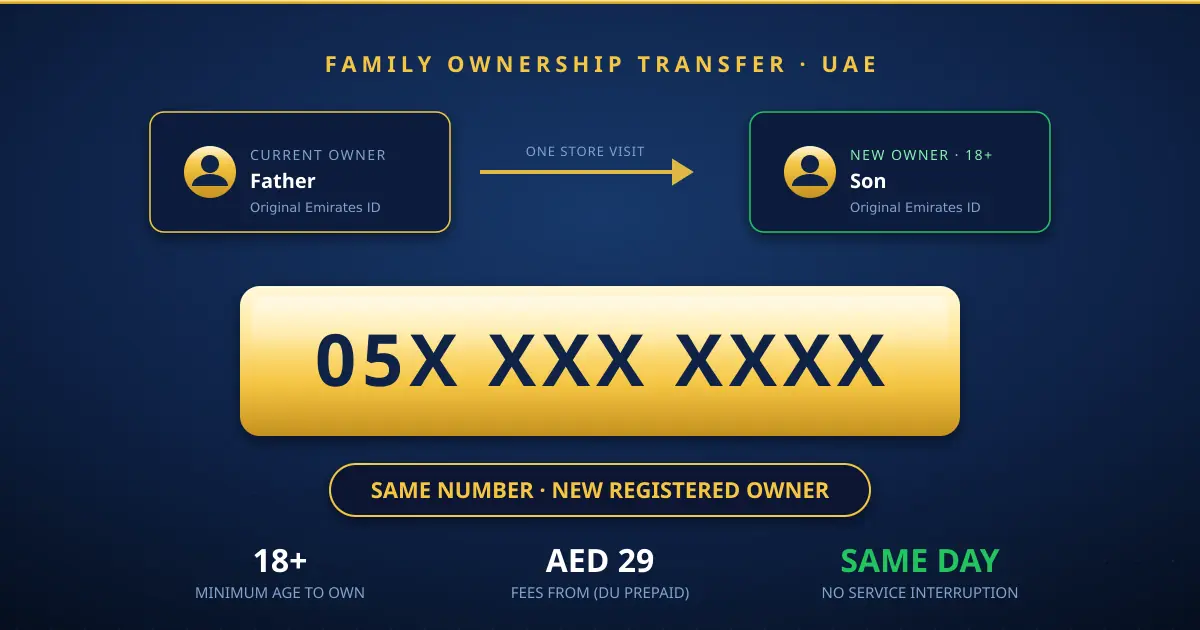
Yes — you can transfer a UAE mobile number to a family member, and the process is simple: both of you visit an e& or du service centre together with your original Emirates IDs, sign the ownership-transfer form, pay a small fee (set by the carrier), and the number is re-registered to your relative the same day. The receiving family member must be 18 or older and within their personal SIM allowance. The number, its credit and its pattern stay exactly as they are — only the name behind it changes.
Why Families Transfer Numbers
These are the situations that actually bring families to the transfer counter — each with its own wrinkle:
- Parent to adult child. The classic case: a line opened for a teenager under a parent’s ID, now used by an adult who wants — or needs — it in their own name for banking, employment or simply independence.
- Between spouses. Often triggered by account consolidation, a family plan reshuffle, or one spouse leaving employment that sponsored their old accounts.
- Child to elderly parent. Adult children registering a line for a parent’s use — note the ownership still sits with whoever’s Emirates ID is on file.
- The departing relative. A brother or cousin leaves the UAE for good and hands their long-held number to family staying behind. Do the paperwork before they fly out — our leaving-the-UAE guide explains why a lapsed visa can take the line down with it.
- The inherited-in-practice number. A number everyone in the family knows, kept alive under a relative’s name for years. Formalising it protects it — re-registration campaigns disconnect lines whose registered owner no longer matches reality.
- The gift. A memorable or lucky number given for a wedding, graduation or new business — increasingly popular, as our VIP number gifting guide covers in detail.
Leaving a line registered under a relative who has left the country — or passed away — feels harmless because the SIM keeps working. It isn’t. When the carrier next runs an Emirates ID re-registration check, a line whose owner has no valid ID gets suspended, and recovering it from abroad (or from an estate) is far harder than a 30-minute store visit would have been. For the estate case, see the inheritance guide.
The TDRA Ground Rules
Four regulatory facts shape every family transfer in the UAE:
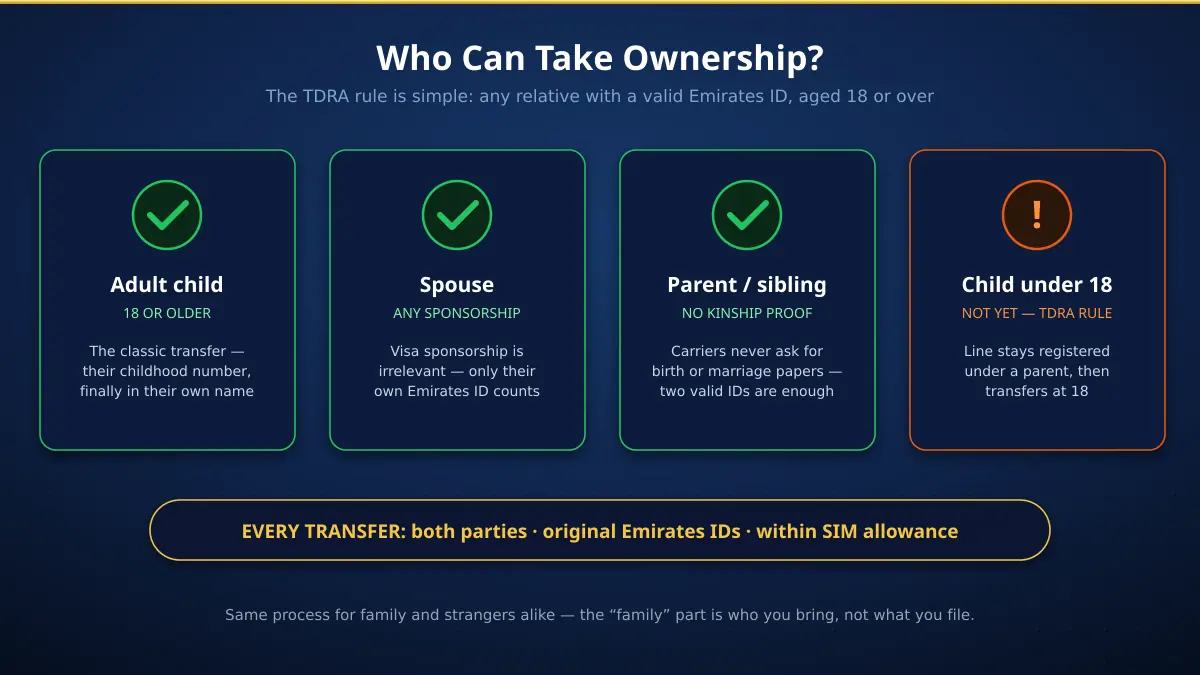
- Registered ownership is personal. Every active SIM must be registered to a specific individual’s Emirates ID (or a company trade licence). There is no “family ownership” — one name per line, whoever actually carries the phone.
- The receiver must be 18 or older. TDRA rules set the minimum age for SIM registration at 18. This is the rule behind the entire minors section below.
- Both parties consent in person — or via approved channels. The standard is both of you at the counter with original Emirates IDs. TDRA also permits transfers through digital channels where the carrier offers them, but for family transfers treat the store visit as the reliable route in 2026.
- SIM allowances still apply. The receiving relative must have room within their personal SIM limit across carriers — if they are already at their cap, the transfer is refused until they release a line. Check the current limits in our SIM-allowance guide.
One more distinction saves confusion at the counter: an ownership transfer is not number portability. Porting (MNP) moves your number to a different carrier under the same owner; an ownership transfer changes the owner under the same carrier. If your relative also wants to switch networks afterwards, do the ownership transfer first, then port — the MNP guide covers step two.
Transferring to a Child: The Minor Rule
You cannot register a SIM in the name of anyone under 18 in the UAE. That is the direct answer to the most common family-transfer question — “can I put my son’s number in his own name?” — when the son is still a minor. The practical pattern every UAE family uses:
- Until 18: the child’s line stays registered under a parent’s Emirates ID. The child uses the phone freely; you remain the legal owner, responsible for the account and any postpaid charges.
- At 18: once your child holds their own Emirates ID as an adult, book the transfer. Many families treat it as a small rite of passage — the number they have used since school finally becomes legally theirs.
- Keep records meanwhile. If the “child’s number” matters — a memorable pattern, a number tied to their identity — note it in your family records the way you would any asset, so nothing is lost if something happens to the registered parent. The estate-planning guide shows how UAE families document number ownership.
Ownership and usage are separate things in UAE telecom law. A number can be used by your 14-year-old daughter for years while being owned by you — that is not a workaround, it is the intended design. The transfer at 18 is a five-minute formality precisely because the system expects it.
The Document Checklist
Family transfers fail at the counter for exactly one reason: missing documents. The complete list:
| Document | Who brings it | Notes |
|---|---|---|
| Original Emirates ID | Current owner | Physical card, valid (not expired). Copies and photos are rejected. |
| Original Emirates ID | New owner (your relative) | Must be their own valid ID; receiver aged 18+. |
| The active SIM card | Current owner | Some branches ask to see the SIM or the number live on a phone. |
| Cleared final bill | Current owner (postpaid only) | Outstanding balance = transfer rejected on the spot. |
| Notarised power of attorney | Only if one party is absent | See the absent-party section; call the branch first. |
| No relationship proof needed | — | Carriers do not ask you to prove kinship — a family transfer is legally just a transfer. |
That last row surprises people: there is no “family discount” and no family documentation requirement. The upside is simplicity — no marriage or birth certificates, no Arabic translations, no typing centre. The same checklist that works for father-to-son works for any two consenting adults, which is why this process is also the backbone of every VIP number purchase in the country.
The Store Visit, Step by Step
The in-store process is identical in spirit at every carrier — here is the full sequence so nothing surprises you:
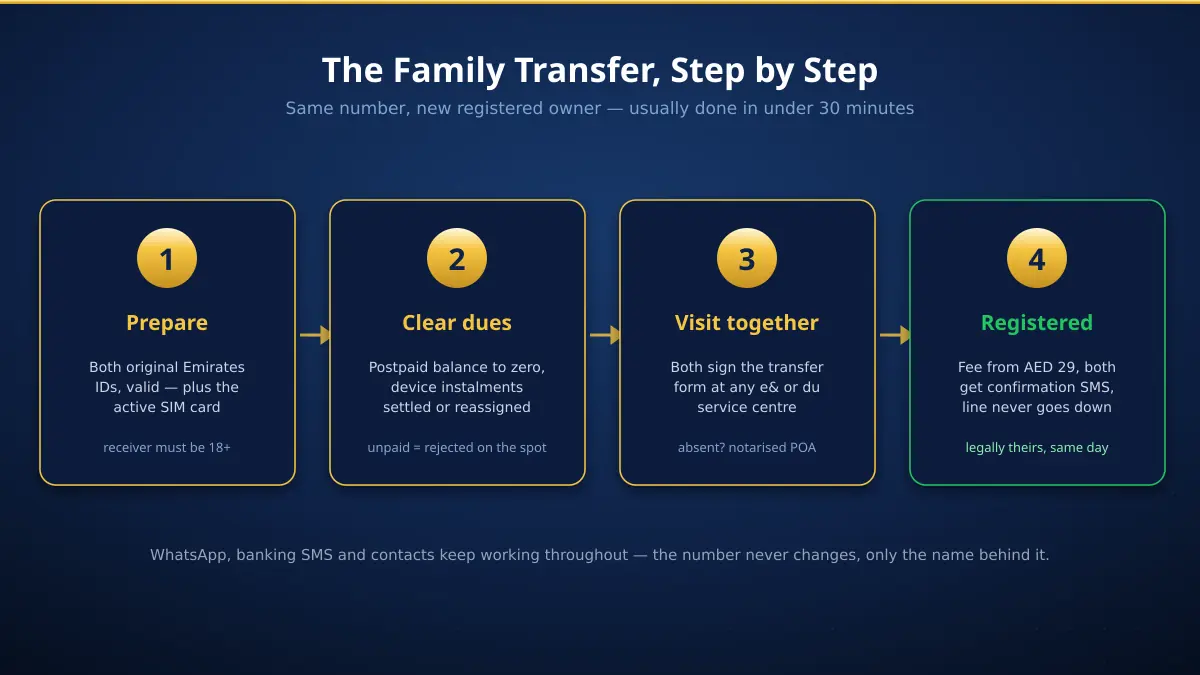
- Check the account is clean. Prepaid: confirm the line is active and unblocked. Postpaid: pay the balance to zero, and settle any device instalments tied to the account (see the postpaid section).
- Pick the branch and go together. Any full-service e& or du centre handles ownership transfers; kiosk counters in supermarkets sometimes don’t — a main branch avoids a wasted trip.
- Take a ticket for “account services”, not sales. Tell the agent you want an ownership transfer / change of ownership to a family member.
- Both sign the transfer form. The current owner signs the release section, the new owner signs the acceptance section; the agent scans both Emirates IDs.
- New owner chooses the plan. The number can usually stay on its existing prepaid plan; postpaid lines are re-underwritten in the new owner’s name (salary/credit checks apply, exactly as for a new postpaid signup — our prepaid vs postpaid guide explains the trade-offs).
- Pay the fee and confirm. for a small carrier fee (du prepaid) — the transfer typically completes while you wait; both of you get confirmation SMS.
Total time: usually under 30 minutes plus queue. The line keeps working throughout — there is no service interruption during a same-network ownership change.
e& vs du vs Virgin: Where They Differ
The rules are TDRA-wide; the execution differs slightly by carrier:
| Carrier | Where it happens | Typical fee | Family-relevant notes |
|---|---|---|---|
| e& (Etisalat) | Any e& service centre; both parties sign the transfer form | ~AED 30 range (confirm at counter) | Largest branch network — easiest when relatives live in different emirates; postpaid re-underwriting is strict but fast. |
| du | du shop, both parties present | AED 29 (prepaid) | Cheapest published transfer fee; du can restore a number to the original registered owner within TDRA timelines if a dispute is raised — paperwork protects both sides. |
| Virgin Mobile | App-first brand; ownership changes route through support + du network processes | AED 30 | Fully digital onboarding for the new owner once released; allow an extra day vs the big two. |
Fees as published in September 2026. Carriers set these amounts and can change them — confirm the current fee at the counter before you go.
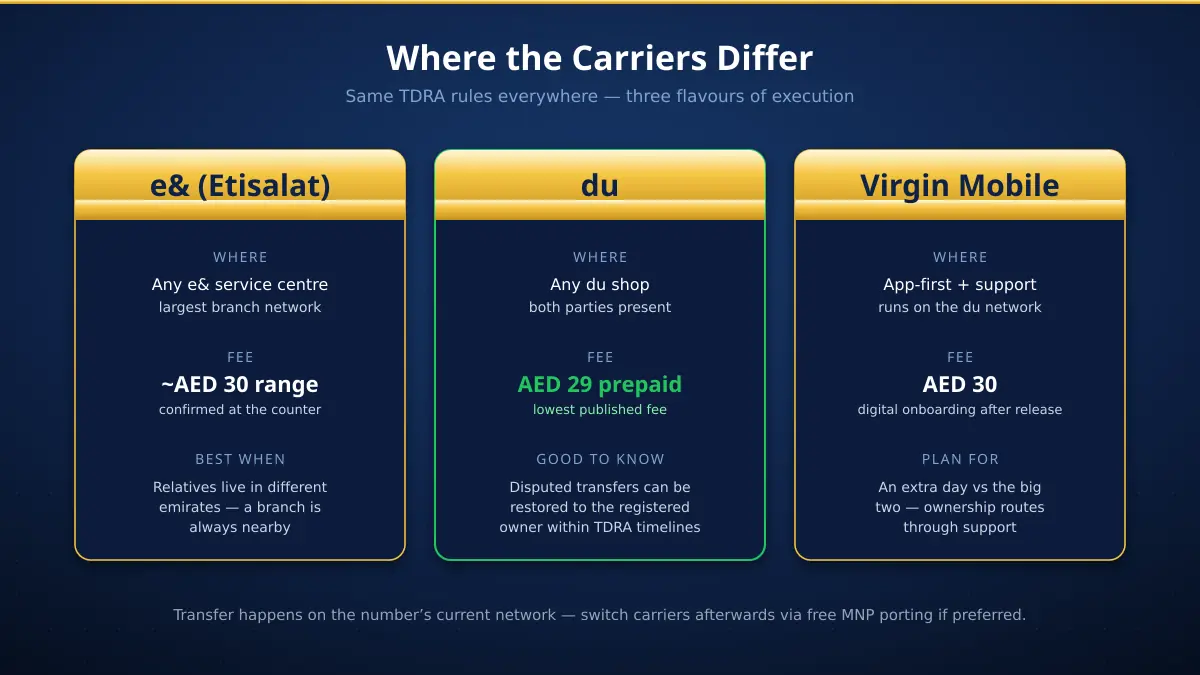
Whichever network the number is on today is where the transfer happens — you cannot combine an ownership change and a carrier switch in one step. Transfer first, then port if your relative prefers the other network; the port itself is free and takes under a working day.
Fees & Timing
The costs are deliberately low — the UAE wants registrations accurate, so the barrier is kept minimal:
| Item | Cost / time |
|---|---|
| Ownership transfer fee (du, prepaid) | AED 29 |
| Ownership transfer fee (Virgin Mobile) | AED 30 |
| Ownership transfer fee (e&) | Similar low range — confirmed at the counter |
| Notarised power of attorney (only if needed) | ~AED 100–300 at a notary, plus time |
| In-store processing | Usually under 30 minutes |
| Service interruption | None — the line stays live throughout |
Fees as published in September 2026. Carriers set these amounts and can change them — confirm the current fee at the counter before you go.
Budget realistically for one thing only: the postpaid settlement. If the line carries a device instalment plan, the remaining handset balance falls due before release — on a flagship phone that can be thousands of dirhams, dwarfing the transfer fee.
If One of You Cannot Attend
The both-parties rule is the one families most often need to bend — a father working offshore rotations, a mother abroad for the summer, an owner who has already left the UAE. The recognised solutions, in order of reliability:
- Notarised power of attorney (POA). The absent party grants a POA covering telecom account actions to someone who attends in their place. UAE-notarised POAs are the gold standard; POAs issued abroad generally need attestation. Call the specific branch first — acceptance practices vary, and ten minutes on the phone beats a wasted visit.
- Carrier digital channels. TDRA permits ownership transfers through digital channels where the carrier offers them, and the apps have been adding identity-verified account actions steadily. Treat this as a bonus if offered, not a plan — in 2026 the in-person route remains the one you can rely on.
- Before departure, not after. If the current owner is leaving the UAE permanently, do the transfer while their Emirates ID is still valid. Once the ID lapses, the clean options shrink fast — the departure guide walks through the timing.
Do not “transfer” a number informally by just handing over the SIM and sharing the account app login. The registered owner stays legally responsible for everything the line does, the user has no rights to the number, and a lost or stolen SIM becomes unrecoverable by the person actually using it. Twenty-nine dirhams fixes all of that permanently.
Postpaid Lines, Debts & Device Contracts
Prepaid family transfers are near-instant. Postpaid adds three checkpoints:
- The balance must be zero. Any outstanding amount blocks the transfer on the spot — pay the final bill first, including current-cycle usage the agent can see.
- Device instalments must be settled or reassigned. A phone bought on a 12–24 month plan is a loan attached to the account. Most branches require settling the remaining device balance before releasing the number; some allow the new owner to formally take over the instalments if their credit profile passes.
- The new owner is re-underwritten. Postpaid is credit — your relative goes through the standard eligibility check (Emirates ID, sometimes salary evidence) as if opening a new postpaid account. If they prefer to avoid that, convert the line to prepaid during the transfer and upgrade later.
Deposits follow the account holder: any international-calling or roaming deposit paid by the original owner is refunded to them at transfer, and the new owner posts their own if needed. Small amounts, but worth asking about at the counter so nothing is silently absorbed.
What Changes After the Transfer — and What Doesn’t
The beauty of a family transfer is how little the outside world notices:
| Item | After the transfer |
|---|---|
| The number itself | Unchanged — same digits, same pattern, same value |
| Keeps working — tied to the number, not the owner | |
| Bank SMS & OTPs | Keep arriving — but see the note below |
| Stored credit (prepaid) | Stays on the line in practice — confirm at the counter |
| Legal responsibility | Moves entirely to the new owner from day one |
| Plan & perks | Prepaid usually carries over; postpaid re-contracts in the new name |
| Account app access | Old owner’s app unlinks; new owner registers the line in their own app |
The OTP note: banks verify the number, not the telecom registration — so nothing breaks on transfer day. But if the previous owner’s name was on file with the bank for that number, updating bank records keeps everything aligned, and the UAE’s tightening SMS-security regime makes clean records increasingly valuable — context in our OTP security guide.
When the Number Is Valuable: Gift, Keep or Sell
Family transfers turn serious when the number itself is an asset. A line ending in a clean pattern — a quad run, a mirror, a lucky tail — can be worth more than everything else in the drawer it lives in. Three principles for families holding one:
- Know what you are giving. Before gifting grandfather’s old number to a grandson, spend ten minutes on a proper valuation. Families have gifted five-figure numbers as casually as hand-me-down phones.
- Formal ownership = protected asset. A valuable number registered to the person who actually uses it survives re-registration sweeps, estate complications and family disputes. One store visit is cheap insurance on a market where records run to seven figures.
- If the family would rather sell, the same clean paperwork that enables a family transfer is what buyers pay premiums for. The seller’s guide covers pricing, and listing is free — recent demand data shows pattern numbers are the most-searched on the marketplace.
And if the transfer is part of a bigger moment — a wedding, a graduation, a business launch — a memorable number makes a genuinely original gift; browse live VIP listings or the lucky tier for inspiration, and the wedding numbers guide for the tradition behind it.
Frequently Asked Questions
Can I transfer my mobile number to my son or daughter in the UAE?
Yes, if they are 18 or older: both of you visit an e& or du store with original Emirates IDs, sign the ownership-transfer form and pay a small fee (set by the carrier) — the number is re-registered to them the same day. If they are under 18, the line must stay registered under a parent until their 18th birthday, because TDRA rules do not allow minors to own SIM registrations.
Do both parties need to be present to transfer a mobile number in the UAE?
Yes, the standard process requires both the current owner and the new owner at the carrier store together, each with their original Emirates ID. If one party genuinely cannot attend, a notarised power of attorney authorising a representative is the accepted workaround, and carriers are progressively adding identity-verified digital channels — call the branch ahead to confirm what they accept.
Can a minor own a SIM card in the UAE?
No. TDRA rules set 18 as the minimum age for SIM registration, so a child cannot be the registered owner of a mobile number. Children use lines registered under a parent’s Emirates ID; ownership is transferred to them once they turn 18 and hold their own valid ID.
How much does it cost to transfer a number to a family member?
The ownership-transfer fee is small and set by the carrier — the counter confirms the current amount for your plan type. The only significant cost arises on postpaid lines with unpaid balances or device instalment plans, which must be settled before the number is released.
Do I need to prove we are related for a family transfer?
No. UAE carriers do not ask for marriage or birth certificates — a family transfer is processed as a standard ownership transfer between two consenting adults with valid Emirates IDs. The process, documents and fee are identical whether you transfer to your son or to a stranger.
Will WhatsApp stop working after the ownership transfer?
No. WhatsApp is tied to the phone number itself, which does not change during an ownership transfer — the app keeps working without re-registration. The same applies to bank SMS and OTP messages, since banks verify the number rather than the telecom registration record.
Can I transfer a postpaid number with an unpaid device instalment?
Not until the device balance is dealt with. Most branches require the remaining instalments to be settled before the number is released; some allow the new owner to formally take over the plan if they pass the credit check. Pay the final bill to zero as well — any outstanding balance blocks the transfer on the spot.
Can I transfer a number to my wife who is on my sponsorship?
Yes — sponsorship is irrelevant to SIM ownership. As long as your wife holds her own valid Emirates ID, is 18 or older and has room within her personal SIM allowance, the standard both-parties store visit transfers the number to her name regardless of who sponsors her visa.
What happens to the prepaid credit on the line during a family transfer?
In practice the credit stays on the line, since the account and number continue unchanged under the new owner — but confirm at the counter before signing, as handling can vary by plan. For postpaid, deposits paid by the original owner are refunded to them and the new owner posts their own if required.
Can I change the carrier at the same time as the family transfer?
No — the ownership transfer happens at the carrier the number is currently on. If your relative wants a different network, complete the ownership transfer first, then port the number under its new owner; porting is free and completes within a working day.
What if the registered family member has already left the UAE?
It becomes harder but not always impossible: a notarised and attested power of attorney executed abroad can authorise a representative, or the owner can handle it on a return visit while their Emirates ID remains valid. The clean answer is prevention — always transfer ownership before a permanent departure, while the ID is still active.
Is a family transfer different from transferring a number I sold?
Legally no — both use the identical TDRA ownership-transfer process: both parties, original Emirates IDs, small fee. The only practical difference is that a sale adds payment-safety steps, like exchanging funds only at the store once staff confirm the transfer is processing.