



Every UAE mobile number is a small piece of telecom history. The 050 in a fifty-year-old trader’s phone predates the internet in this country; the 058 in a new arrival’s pocket was born into the 5G era. Between those two prefixes lies a fifty-year story — a state monopoly, the region’s first GSM call, the arrival of competition, the day numbers outlived their carriers, and the slow transformation of ten digits from a utility into an asset that has traded for over a million dirhams.
This is the first complete timeline of UAE mobile numbers — every milestone dated, every prefix placed in its era, and the through-line explained: how each chapter of network history created the market that prices numbers today. If you have ever wondered why 050 carries prestige, when 055 appeared, or what made a phone number worth seven figures, the answers are all below, in order.
The 60-Second Timeline
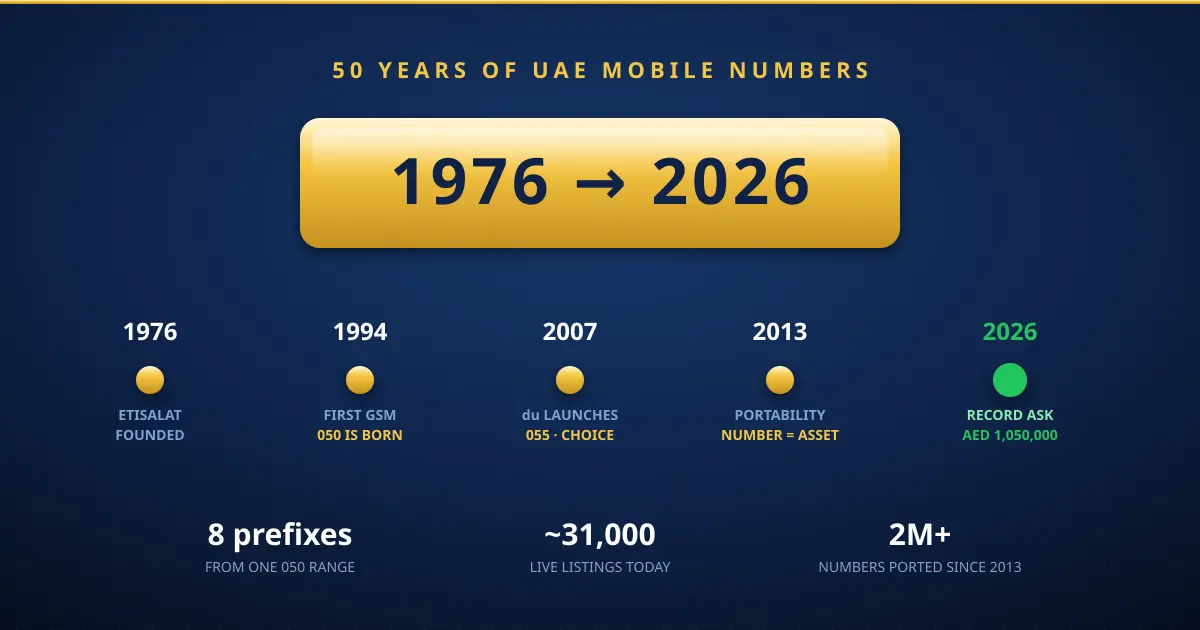
UAE mobile numbers began with Etisalat’s founding in 1976, gained SIM cards with the region’s first GSM network in 1994, gained competition when du launched in February 2007, became portable assets with Mobile Number Portability on 30 December 2013, and matured into today’s trading market where roughly 31,000 numbers are listed and the top ask is AED 1,050,000. The full chronology:
| Year | Milestone | What it meant for numbers |
|---|---|---|
| 1976 | Etisalat founded as Emirates Telecommunications Corporation | One operator, one future numbering plan |
| 1982 | Middle East’s first mobile network launches in the UAE | Mobility arrives — before personal numbers |
| 1994 | First GSM network in the region goes live | SIM cards — the 050 era begins |
| 2003 | Middle East’s first 3G network; telecom regulator (TRA) established | Data era opens; a referee for what follows |
| Feb 2007 | du launches commercial service | 055 is born — the first choice of prefix |
| 30 Dec 2013 | Mobile Number Portability goes live | Your number survives a carrier switch — it becomes yours |
| 2019 | Commercial 5G launches on both networks | The network fades into the background; the number is the identity |
| Feb 2022 | Etisalat Group rebrands as e& | 050/054/056 become “e& numbers” overnight |
| Dec 2022 | 2G network switched off after 28 years | The network that birthed 050 retires; the prefix thrives |
| 2026 | ~31,000 live listings; record ask AED 1,050,000 | The number is a traded asset class |
1976–1993: The Monopoly Years
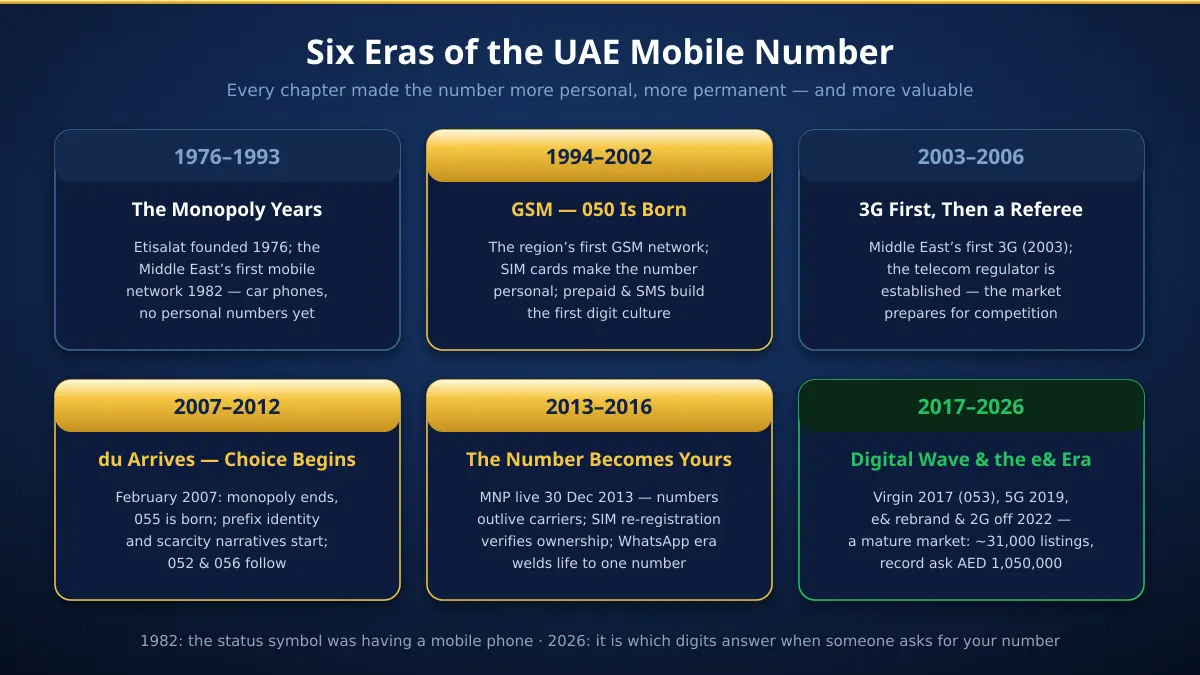
The story starts before mobile numbers existed. Etisalat was founded in 1976 as the young federation’s telecommunications company, and for nearly three decades it would be the only game in town. In 1982 it launched the Middle East’s first mobile network — analogue technology, heavy handsets bolted into Mercedes dashboards, and numbers that were closer to radio channel assignments than personal identities.
Owning any mobile line in 1980s UAE was itself the status symbol; the digits were irrelevant. There was no prefix identity because there was nothing to compare against — no second operator, no SIM cards, no secondary market. But this era planted the seed that still shapes the market: in the UAE, mobile connectivity arrived early and became a marker of standing almost immediately. The country that had the region’s first mobile network in 1982 would, four decades later, host some of its highest recorded number sales.
1994–2002: GSM and the Birth of 050
The pivotal year is 1994, when Etisalat switched on the first GSM network in the region. GSM changed everything, for one deceptively simple reason: the SIM card. Identity moved from the handset to a removable chip — and with it came the personal, permanent mobile number in the format the UAE still uses: a 050 prefix followed by seven digits (the full structure is in our number format guide).
Through the late 1990s the mobile number became a mass-market possession. Prepaid packages brought lines to every income level, SMS created the first digit-culture (a number you could text was a number worth remembering), and the seven-digit space under a single prefix began to fill. Crucially, this is when the first collectible instinct appeared: business owners started asking retailers for “easy” numbers — doubles, round endings, memorable runs — the exact patterns that anchor valuations today.
Every 050 number is drawn from the range opened in 1994 — the UAE’s original GSM stock. That is the factual basis of the “vintage 050” premium: short of a corporate special release, no new prefix will ever be older. Three decades later, 050 remains the single largest prefix on the resale market, as the prefix table below shows.
2003–2006: 3G First, Then a Referee
Two 2003 events set up the modern market. First, Etisalat deployed the Middle East’s first 3G network, keeping the UAE at the front of the data curve. Second — and more important for numbers — the federal government established the telecom regulator (TRA, today’s TDRA), the body that would referee competition, own the national numbering plan, and eventually write the rules for registering, transferring and trading numbers.
A regulator only matters if there is something to regulate, and by 2005–2006 the decision had been taken: the monopoly would end. A second operator was licensed, network build-out began, and the UAE prepared for a word its mobile market had never used — choice.
2007–2012: du Arrives — and Choice Begins
In February 2007, du launched commercial service, ending three decades of monopoly — and introducing the 055 prefix. For the first time, a UAE resident choosing a mobile number was also choosing an allegiance: the established 050 or the newcomer 055. Prefix identity — the tribal shorthand that still splits opinion today — was born in that moment.
Competition did something subtler too: it created scarcity narratives. The freshly opened 055 range was full of clean, low, pattern-rich numbers — and early adopters who grabbed them were, knowingly or not, building portfolios. As du grew through the early 2010s, additional ranges followed (052 on the du side, 056 answering demand at Etisalat), each new prefix younger — and initially cheaper — than the last. The era’s pricing ladder survives intact in 2026: on today’s marketplace, equivalent patterns still price by prefix age.
2013–2016: The Number Outgrows the Carrier
If 1994 made the number personal and 2007 made it a choice, 30 December 2013 made it property. That is the day Mobile Number Portability (MNP) went live, letting any UAE number move between operators without changing a digit — over two million numbers have ported since. The full mechanics are in our MNP guide, but the historical significance is bigger than the process:
- Before MNP: your number was a feature of your carrier contract. Leave the carrier, lose the number — so its long-term value was capped by your patience with one operator.
- After MNP: the number became a durable personal identifier that outlives any commercial relationship. An asset needs permanence before it can hold value; MNP delivered exactly that.
The same era brought the national SIM re-registration campaigns — every line matched to a verified Emirates ID — which hardened ownership records, and the WhatsApp-and-banking boom that welded daily life to a single number. By 2016, changing your mobile number in the UAE meant re-authenticating your existence; keeping it forever became the default. Permanence, verified ownership, portability: the three legal pillars of today’s number-trading market were all in place.
2017–2021: The Digital Wave
On 5 September 2017, Virgin Mobile launched in the UAE as the region’s first fully digital operator — SIM ordered in an app, delivered to your door, running on du’s network on the 058 prefix. Choosing your exact number from an on-screen list became a mainstream experience; an entire generation’s first UAE number was picked, not assigned. The choose-your-own-number habit that fuels today’s marketplace demand went native in this window.
The range map also filled out: 054 opened on the Etisalat side and 058 on the du side as older ranges saturated. eSIM support arrived ahead of most markets (today’s state of play is in the eSIM guide), commercial 5G launched on both networks in 2019 — a regional first — and in 2021 the regulator itself was renamed TDRA, reflecting a mandate now covering the digital state. The number’s journey to pure software was nearly complete: no store, no plastic, sometimes no physical SIM at all — just the digits.
2022–2026: The e& Era and the Million-Dirham Market
The current chapter opened with symbols. In February 2022 Etisalat Group rebranded as e& (the UAE operator trading as “etisalat by e&” from June 2022) — and in December 2022 the UAE switched off its 2G network, retiring the technology that had carried the first 050 call 28 years earlier. The prefixes born on those networks did not retire with them; they simply moved up the stack, from GSM to 5G, gaining value the whole way.
Meanwhile the resale market matured in the open. Auction culture — long established for car plates — normalised six- and seven-figure bids for special digits; official number auctions put price discovery on the public record; and dedicated marketplaces gave private owners a listing venue. The 2026 snapshot, from this platform’s live database: roughly 31,000 active listings, about 21,500 of them publicly priced, an average ask around AED 5,000 — and a record ask of AED 1,050,000 for a repeating-pattern du number, chronicled in our repeating numbers guide.
Fifty years, one arc: the 1982 status symbol was having a mobile phone. The 2026 status symbol is which digits answer when someone asks for your number. The hardware democratised; the numbers aristocratised.
Prefix by Prefix: Birth Order and Today’s Standing
Every UAE prefix carries its birth era in its price. Here is the full set in order of appearance, with each prefix’s share of today’s live resale inventory:
| Prefix | Born | Operator today | Share of live listings (2026) | Top live ask |
|---|---|---|---|---|
| 050 | 1994 — the original GSM range | e& | 37.1% (11,503 listings) | AED 600,000 |
| 055 | 2007 — du’s launch prefix | du | 1.6% | AED 1,000,000 |
| 052 | early 2010s — du’s second range | du | 0.9% | AED 750,000 |
| 056 | early 2010s — Etisalat’s second range | e& | 26.5% | AED 600,000 |
| 054 | mid-2010s — Etisalat’s third range | e& | 32.9% | AED 380,000 |
| 058 | late 2010s — du’s newest range | du + Virgin | 1.0% | AED 1,050,000 — site record |
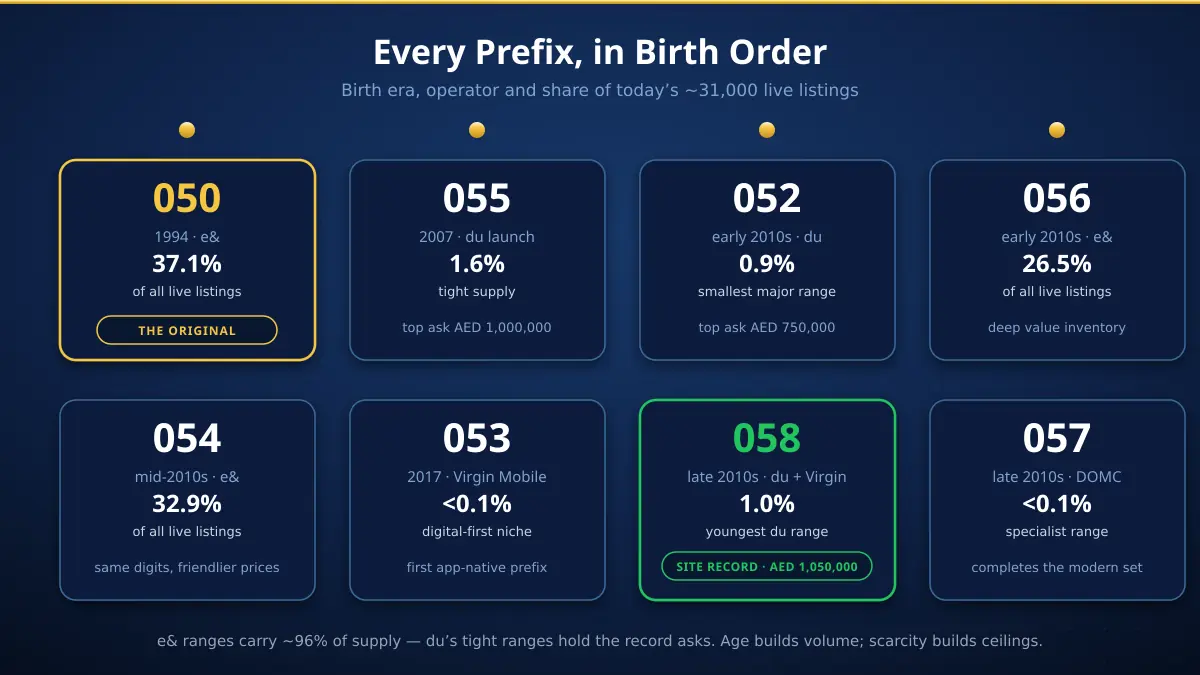
Read the table’s two surprises together and the market’s structure snaps into focus. e& ranges dominate supply (050 + 054 + 056 ≈ 96% of listings) because they are older, larger and longer-circulated. du ranges own the price ceiling (055/052/058 hold the three highest asks) because their tighter circulation left more pristine patterns intact — scarcity concentrated in fewer hands. Deeper dives per prefix: 050, 055, 052, 056, 054, 058.
Why the Oldest Prefix Still Rules
Thirty-two years after its range opened, 050 remains the marketplace’s centre of gravity — over a third of all live listings, and the default prefix in every Emirati’s mental map. The reasons are historical, and they compound:
- First-mover identity. For thirteen years (1994–2007), a UAE mobile number was an 050 number. That monopoly of memory does not fade; it gets inherited.
- The establishment signal. An 050 line signals continuity — a number old enough to predate the competition suggests a holder who was here before the boom. Businesses pay for that subtext, as the corporate numbers guide details.
- Depth of inventory. The biggest range produces the most pattern supply — from lucky digits to mirrors — making 050 the liquid blue-chip of the market rather than its speculative frontier.
None of this makes younger prefixes lesser buys — it makes them different buys: 054/056 deliver the same operator at friendlier prices, while low-circulation du ranges are where records get set. History explains the menu; your use case picks from it (the buyer’s guide takes it from here).
From Utility to Asset: How Numbers Learned to Cost a Million
Line up the milestones and the value story tells itself — each era added one ingredient an asset class requires:
- 1994 — Identity. GSM binds a permanent number to a person. Nothing can be valuable until it is yours.
- 2007 — Comparison. Competition creates prefix identity and preference — the raw material of pricing.
- 2013 — Permanence. MNP guarantees the number survives carrier changes; verified registration guarantees clean title. Property, in the practical sense.
- 2017 — Selection culture. Digital onboarding normalises choosing digits — and paying for better ones.
- 2022–2026 — Market infrastructure. Auctions, marketplaces and public records complete price discovery. The result: ~21,500 priced listings, patterns valued by a stable framework, and a seven-figure ceiling.
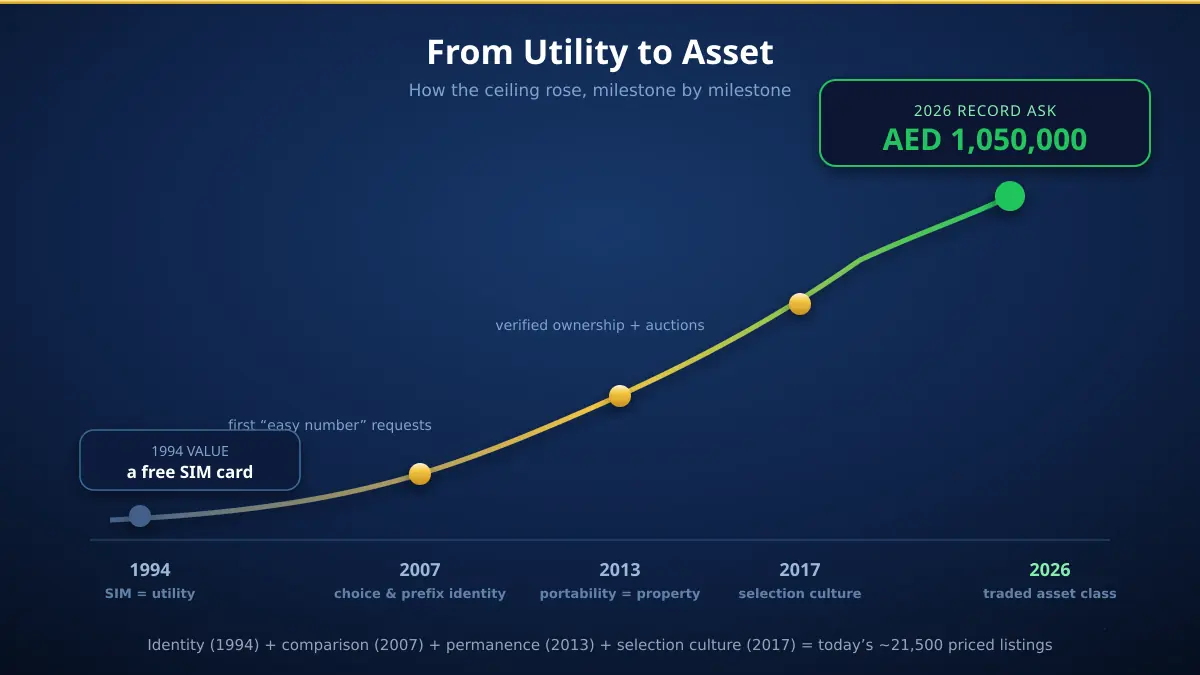
Understanding this arc is practical, not academic: the forces that built the premium — scarcity by era, verified transferability, culture-driven demand — are the same ones that will set tomorrow’s prices. That is the analytical core of our investment guide and the reason numbers are expensive here in the first place.
What Comes Next
The next chapter is already sketched. eSIM-first onboarding keeps shrinking the gap between wanting a number and owning it; digital ownership transfers are extending to more account actions each year (the current state is in our transfer guide); and the numbering plan has headroom — when today’s ranges saturate, new prefixes will open exactly as 052, 054 and 058 did, each starting young and cheap, each ageing into its own premium.
Two safe predictions follow from fifty years of pattern. First, no future range dilutes the old ones — a new prefix has never lowered 050’s standing; it has raised it by contrast. Second, the culture deepens rather than fades: every era so far has made the mobile number more personal, more permanent and more visible. In a country that auctions its car plates and treasures its digits, the mobile number’s trajectory from utility to heirloom looks less like a trend than a tradition — one you can browse live any time on the VIP listings, or join from the other side by listing a number of your own.
Frequently Asked Questions
When did mobile phones first come to the UAE?
In 1982, when Etisalat launched the Middle East’s first mobile network — an analogue system used mainly for car phones. Etisalat itself had been founded six years earlier, in 1976, as the Emirates Telecommunications Corporation.
When did the 050 prefix start?
The 050 era began in 1994, when Etisalat launched the region’s first GSM network and SIM-based personal numbers arrived in the UAE. Every 050 number traces back to that original GSM range, which is why 050 is treated as the country’s vintage prefix.
When did du launch in the UAE?
du launched commercial mobile service in February 2007, ending Etisalat’s three-decade monopoly and introducing the 055 prefix. It was the first time UAE residents could choose between competing mobile operators.
When did Mobile Number Portability start in the UAE?
MNP went live on 30 December 2013, allowing any UAE mobile number to move between operators unchanged. Over two million numbers have been ported since — the milestone that turned numbers into durable personal assets independent of any carrier.
When did Virgin Mobile launch in the UAE?
Virgin Mobile launched on 5 September 2017 as the region’s first fully digital mobile operator, running on du’s network. Its app-based, choose-your-own-number onboarding helped normalise paying for preferred digits.
When did Etisalat become e&?
Etisalat Group rebranded as e& in February 2022, with the UAE telecom arm trading as “etisalat by e&” from June 2022. The prefixes 050, 054 and 056 remained unchanged — only the brand behind them evolved.
When was the UAE 2G network switched off?
In December 2022, twenty-eight years after the first GSM network launched in 1994. The retirement freed spectrum for 5G; the numbers born on 2G — including every original 050 — continued on modern networks without change.
Which UAE mobile prefix is the oldest?
050 is the oldest, dating to the 1994 GSM launch. It is followed by 055 (du’s 2007 launch), then 052 and 056 in the early 2010s, 054 in the mid-2010s, and the youngest range — 058 — from the late 2010s.
Which prefix is the newest in the UAE?
The newest mainstream ranges are 058 (du, also used by Virgin Mobile) and, both from the late 2010s. True to the market’s pattern, the young 058 range already holds the highest live asking price — AED 1,050,000 — because tight circulation preserved its rarest patterns.
What is the most expensive UAE mobile number today?
The highest live asking price on the marketplace is AED 1,050,000 for a repeating-pattern 058 du number. Historic auction results for officially sold numbers have also reached seven figures — the record list is maintained in our most-expensive-numbers guide.
How big is the UAE mobile number market in 2026?
On this marketplace alone, roughly 31,000 numbers are actively listed, about 21,500 of them with public prices, averaging around AED 5,000 per listing. The inventory spans every prefix and both major carriers, from AED 50 starter patterns to the AED 1,050,000 record ask.
Why are older UAE prefixes more prestigious?
Because age equals story: 050 numbers date to the 1994 GSM launch and signal continuity that newer ranges cannot replicate. First-mover memory, establishment subtext and the deepest pattern inventory keep the oldest prefix the market’s blue chip — while younger, tightly circulated ranges set the record prices.