



Every number study this site has published looked at patterns — triples, mirrors, tails. This one goes a level deeper and counts the raw material itself: every single visible digit across all 31,004 active listings on the marketplace. That is 215,976 digits, tallied one by one on the day of writing, and the census answers questions no pattern study can: which digit is actually the most common in UAE mobile numbers, which is the rarest, what your number most likely ends in — and whether simply containing a lucky digit is worth anything at all.
Two findings up front, because they cut against the market’s favourite beliefs: the rarest digit on the marketplace is 9 — the “forever” digit whose 999 family commands premium prices — and merely containing any given digit, lucky or not, is worth almost exactly nothing. Where the money hides is in dominance, and the spread there is 2×.
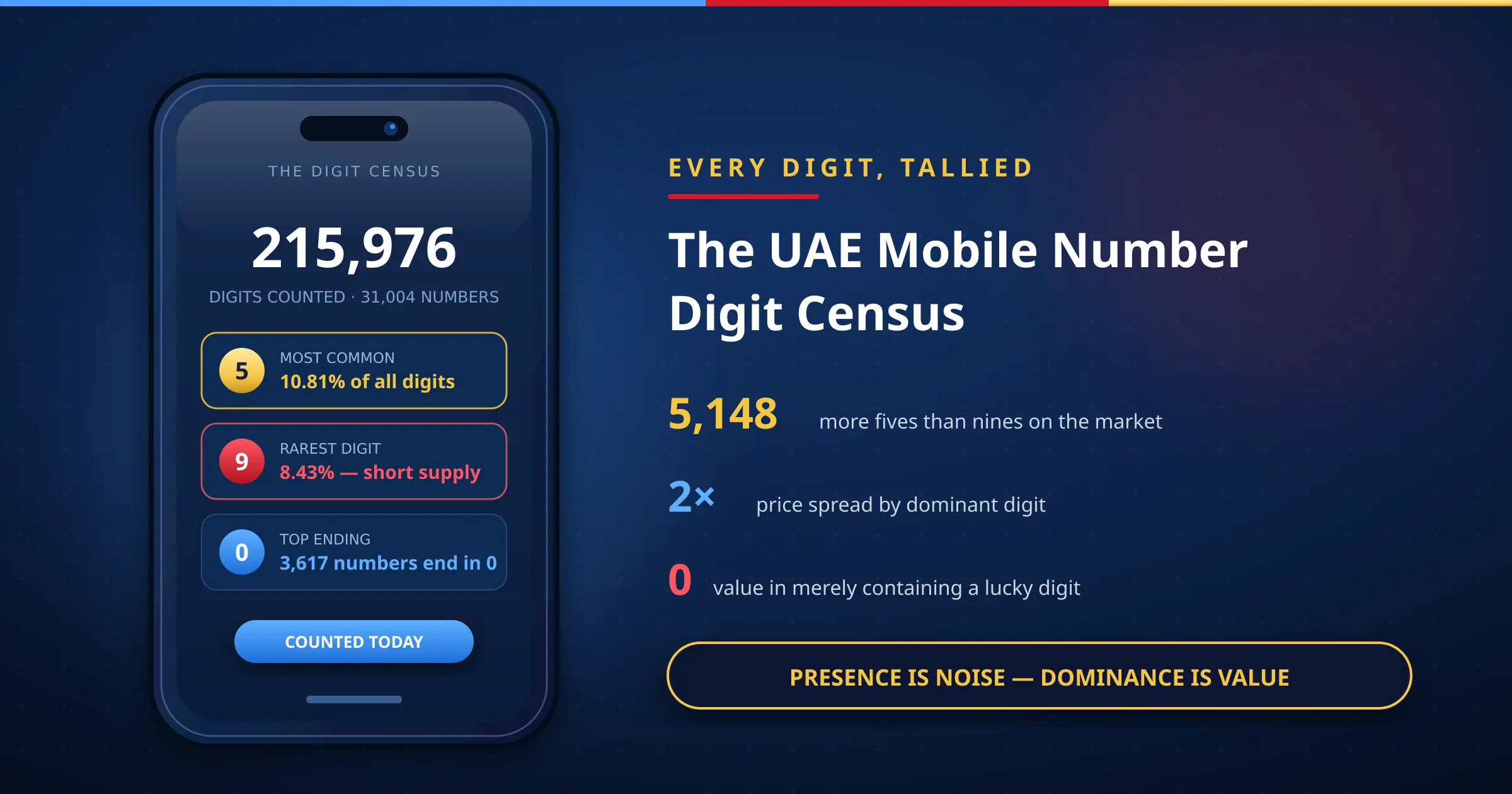
How the Census Was Counted
Method in three sentences: every active listing’s local number string was scanned character by character on the day of publication, tallying digits 0–9 across all 31,004 listings — 215,976 visible digits in total. Sellers mask part of some numbers for privacy (an X in place of a digit); those 901 masked positions are excluded from every count and disclosed here rather than guessed. Price comparisons use asking prices among the 21,548 publicly priced listings (market average AED 5,057 on census day), following the same all-ten-shown, no-cherry-picking rule as the triple ranking and the 13-test.
The Full Ranking: All Ten Digits
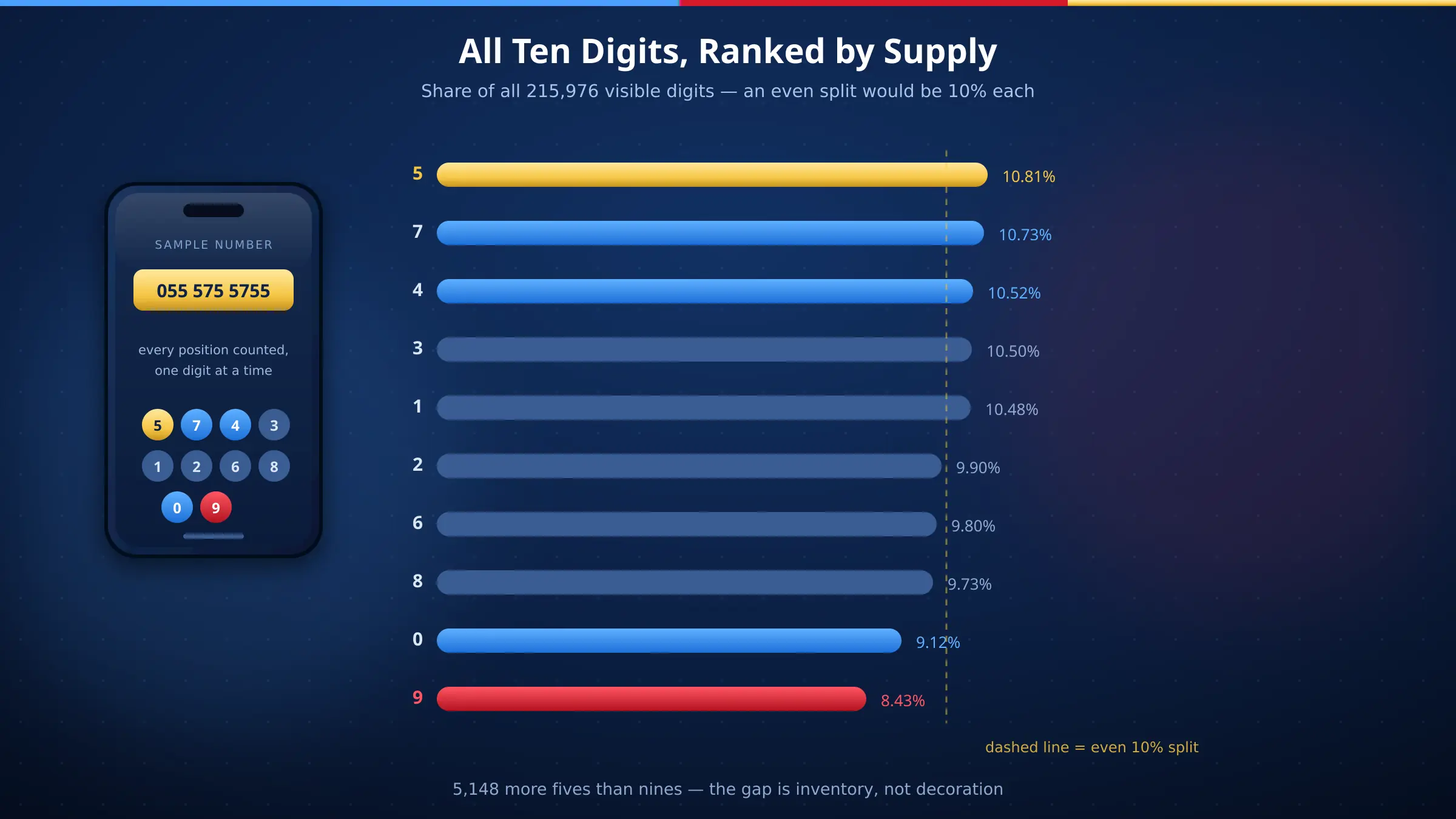
Counted across every visible digit on the marketplace, this is what UAE mobile numbers are actually made of:
| Rank | Digit | Count | Share of all digits | Numbers containing it |
|---|---|---|---|---|
| 1 | 5 | 23,348 | 10.81% | 13,760 |
| 2 | 7 | 23,165 | 10.73% | 14,040 |
| 3 | 4 | 22,718 | 10.52% | 13,623 |
| 4 | 3 | 22,673 | 10.50% | 13,239 |
| 5 | 1 | 22,625 | 10.48% | 13,855 |
| 6 | 2 | 21,376 | 9.90% | 12,483 |
| 7 | 6 | 21,160 | 9.80% | 13,033 |
| 8 | 8 | 21,009 | 9.73% | 12,732 |
| 9 | 0 | 19,702 | 9.12% | 10,893 |
| 10 | 9 | 18,200 | 8.43% | 11,626 |
If digits were distributed evenly, each would hold 10%. The spread — 8.43% to 10.81% — looks small until you translate it into supply: there are 5,148 more fives than nines on the marketplace. In a market where the statistics page shows scarcity driving every premium, that gap is not decoration. It is inventory.
5, the Quiet Majority
No belief system celebrates 5. It appears in no lucky-number guide on this site, carries no religious weight in the superstition economy, and yet it is the single most common digit in UAE mobile numbers — and the 555 family is the largest triple shelf on the marketplace. The likely reason is structural, not mystical: 055 is du’s flagship prefix and 5 sits in millions of allocated blocks, so fives flow into the resale market with every listing. The most ordinary digit in the UAE is also its most abundant — the census baseline every rarity claim should be measured against. For the digits that do carry a premium, see the lucky-digit shelf.
9, the Manufactured Rarity
Here is the finding that should reprice a few beliefs: 9 — the “forever” digit, the highest-averaging lucky digit in the 999 study — is the rarest digit on the entire marketplace. Only 18,200 nines exist across all listings, 8.43% of the digit pool. It is scarcer than zero, scarcer than the feared 4, scarcer than everything.
The 999 study measured the family’s premium and credited the digit’s meaning — “tisaa,” eternity, the top of the single-digit scale. The census adds the supply side of that price: whatever the belief contributes, raw scarcity is doing quiet work underneath. Carriers simply seed fewer nines into circulation, so every 999 tail, every nine-run, starts from the thinnest raw material in the market. Belief sets the demand; the census shows the supply was short before belief ever entered the room.
The pattern studies saw this from the other side without knowing it: zero of the marketplace’s 22 six-deep numbers use 9, and 999 is one of the smallest triple families (115 priced listings). The census explains why — you cannot build long nine-runs from the market’s scarcest digit.
Containing a Digit Is Worth Nothing
Now the myth-bust. If sevens were valuable as such, numbers containing a 7 should out-price numbers that do not. They do not — and the census shows it across all ten digits at once, no cherry-picking:
| Digit contained | Avg ask (priced listings) | vs market avg AED 5,057 |
|---|---|---|
| 0 | AED 5,047 | −0.2% |
| 5 | AED 4,863 | −3.8% |
| 8 | AED 4,604 | −9.0% |
| 7 | AED 4,518 | −10.7% |
| 9 | AED 4,502 | −11.0% |
| 2 | AED 4,487 | −11.3% |
| 6 | AED 4,436 | −12.3% |
| 4 | AED 4,372 | −13.5% |
| 3 | AED 4,345 | −14.1% |
| 1 | AED 4,308 | −14.8% |
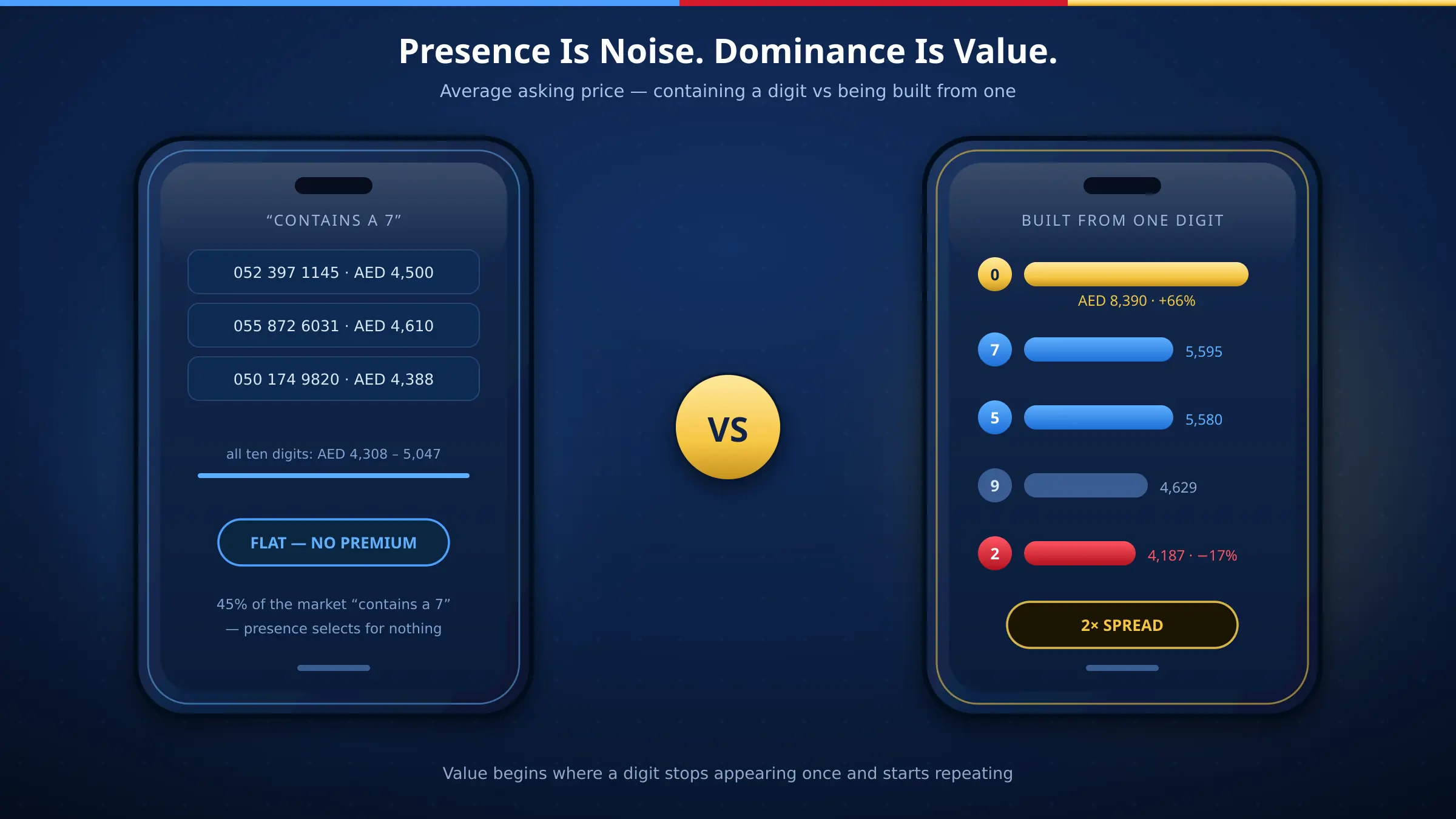
Every “contains” average sits at or below the market mean, in a narrow band — because almost every number contains almost every common digit somewhere, so “contains a 7” describes nearly half the market and selects for nothing. A single 7 in the third position of an otherwise random number is noise. This is the census’s version of the 13-test’s neutral-control lesson: presence claims need controls, and under controls, presence evaporates.
Dominance Is Worth Everything
Concentration is a different story. Classify each number by its dominant digit — the digit that appears more often than any other in the string — and the flat line bends into a real hierarchy:
| Dominant digit | Numbers (unique dominant) | Avg ask | vs market avg |
|---|---|---|---|
| 0 | 2,072 | AED 8,390 | +65.9% |
| 7 | 2,310 | AED 5,595 | +10.6% |
| 5 | 2,464 | AED 5,580 | +10.3% |
| 8 | 2,013 | AED 5,364 | +6.1% |
| 4 | 2,292 | AED 5,126 | +1.4% |
| 1 | 2,232 | AED 5,111 | +1.1% |
| 6 | 2,014 | AED 4,860 | −3.9% |
| 9 | 1,408 | AED 4,629 | −8.5% |
| 3 | 2,335 | AED 4,548 | −10.1% |
| 2 | 2,266 | AED 4,187 | −17.2% |
The spread from dominant-2 to dominant-0 is 2×. One occurrence of a digit tells the market nothing; a number visibly built from a digit is a pattern, and patterns are what the pattern guide and every study since have shown buyers pay for. The census puts a number on the boundary: value begins where a digit stops appearing and starts repeating.
Zero, Confirmed Again
Dominant-zero’s AED 8,390 average — 66% above market, 50% clear of second-place 7 — is the census arriving at the Zero Paradox from a completely different direction. The 000 study measured trailing-triple families; the census classifies by overall composition and finds the same digit on top, belief-free as ever. Note the double distinction: zero is the market’s second-rarest digit (9.12%) and its most valuable to be dominated by. Scarce raw material, maximum legibility when concentrated — roundness needs no folklore.
The Tail Census: What Numbers End In
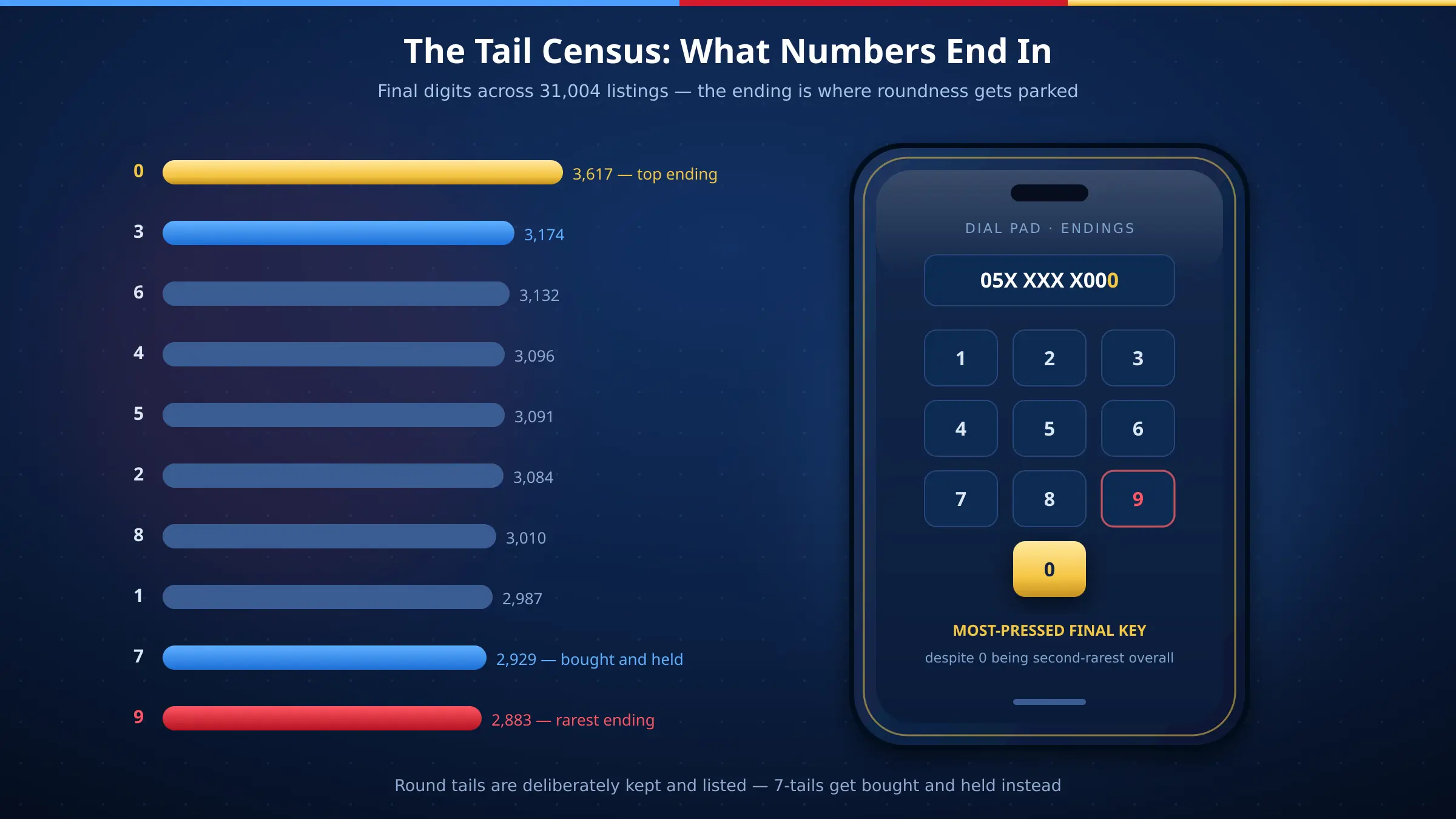
The last digit is the one people remember, the one the rhythm study found carrying the display premium — and the tail census shows sellers know it:
- 0 is the most common ending — 3,617 listings finish on zero, despite zero being the second-rarest digit overall. Round tails (X00, X000) are deliberately kept and listed; the ending is where roundness gets parked.
- 9 is the rarest ending (2,883 listings) — consistent with its overall scarcity; a clean “forever” tail is genuinely hard to find.
- 7 endings are scarcer than the digit’s abundance suggests (2,929) — the second-most-common digit ranks near the bottom as an ending, hinting that 7-tails get bought and held rather than relisted, exactly what the 777 study’s 2.8× ending premium would predict.
The Head Census: What Numbers Start With
The first digit after the prefix is the least glamorous position, but it has the census’s starkest skew: 5,533 numbers start with 1, while just 166 start with 0 — a 33× gap. This is carrier numbering policy made visible: local numbers almost never begin with zero (it collides with dialling conventions), while 1-blocks were allocated in bulk. For buyers it means head digits are a carrier fingerprint, not a choice — which is why every valuation framework on this site, from the five pillars down, prices tails and patterns, not first digits.
Supply Is Not Random — What That Means for Buyers
The census’s deepest lesson: the digit pool your dream number is drawn from was shaped by carrier allocation long before any seller priced anything. Nines are structurally short; fives are structurally abundant; zeros rarely lead but love to end. Practical consequences:
- Nine-heavy wishes need patience or budget. The scarcest digit means fewest candidates — if you want a 999 tail, the Wanted Board beats waiting for a listing.
- Five-heavy numbers are the value shelf. Maximum supply keeps the 555 family the cheapest big triple — the same logic that makes Echo tails the rhythm study’s bargain.
- Zero-dominated numbers are the census’s trophy tier — scarce, legible and 66% above market before any luck story is told.
The Census Playbook for Buyers and Sellers
- Buyers: ignore “contains” claims. A listing advertising “lucky 7 inside” is describing 45% of the market. Pay for concentration — dominance, runs, tails — never presence.
- Buyers: hunt the supply gaps. 9-heavy and 0-heavy numbers are drawn from the two thinnest pools; fair asks there hold value best. Benchmark with the value calculator before you commit.
- Sellers: name your dominant digit in the title. “Five sevens” is a census-backed scarcity claim; the Listing Score already rewards named patterns — the census tells you which name carries weight.
- Sellers: round tails are your safest keep. Zero endings are the market’s most-listed ending because they sell — if your number ends 000, price it against the 000 family, not the market average.
Honest Limits of This Count
The census counts the resale marketplace, not every number in the UAE — carrier-held inventory and numbers never listed are invisible to it, so digit shares describe what is for sale, not what exists. 901 seller-masked digits (0.4% of positions) are excluded; they cannot bias any digit’s count by more than a rounding error, but they are why totals do not divide perfectly by seven. Price figures are asking prices among 21,548 priced listings — the same asks-not-sales caveat every study on the statistics page carries. And dominance classifies only numbers with a unique most-frequent digit; ties (about 31% of listings) are set aside rather than double-counted. All figures were recomputed on the date of publication.
Frequently Asked Questions
What is the most common digit in UAE mobile numbers?
5, with 23,348 occurrences — 10.81% of all 215,976 visible digits counted across the marketplace’s 31,004 active listings. 7 follows closely at 10.73%.
What is the rarest digit in UAE mobile numbers?
9, at just 8.43% of all counted digits (18,200 occurrences) — scarcer than zero. The “forever” digit of Arabic numerology is also the market’s shortest supply.
Does containing a lucky digit make a number more valuable?
No. Numbers containing any given digit average between AED 4,308 and 5,047 — at or slightly below the AED 5,057 market mean for all ten digits. Nearly every number contains most common digits somewhere, so presence selects for nothing.
What actually makes a digit valuable in a number?
Concentration. Numbers dominated by one digit range from AED 4,187 (dominant 2) to AED 8,390 (dominant 0) on average — a 2× spread. Value begins where a digit stops appearing once and starts repeating.
Which dominant digit commands the highest prices?
Zero: numbers built mostly from 0 average AED 8,390 — 66% above the market mean and 50% clear of second-place 7 (AED 5,595). It confirms the Zero Paradox from a new angle: no superstition, top price.
What do most UAE mobile numbers end in?
Zero — 3,617 active listings end on 0, making it the most common final digit despite being the second-rarest digit overall. Round endings are deliberately kept and listed. The rarest ending is 9 (2,883 listings).
Why do so few UAE numbers start with 0 or 9?
Carrier allocation. Only 166 local numbers start with 0 (dialling conventions) versus 5,533 starting with 1 — a 33× gap set by numbering policy, not by sellers. First digits are a carrier fingerprint, which is why valuation frameworks price tails and patterns instead.
Is 9 rare because it is lucky, or lucky because it is rare?
The census cannot read minds, but it shows supply was short before belief entered: carriers seed fewer nines, so every 999 tail starts from the market’s thinnest digit pool. The 999 premium likely stacks genuine scarcity and cultural meaning on top of each other.
How many digits were counted for this census?
215,976 visible digits across 31,004 active listings, tallied character by character on the day of publication. 901 seller-masked positions (0.4%) were excluded rather than guessed.
Does the census include numbers not listed for sale?
No — it counts the resale marketplace only. Carrier-held inventory and never-listed private numbers are invisible to it, so the shares describe what is for sale in the UAE, not every number in existence.
Should I pay more for a number with many repeated digits?
The market does: dominance premiums are real, and long runs (triples, quads, six-deep) sit further up the same curve. Benchmark against the family averages in the triple ranking and the statistics page rather than paying for a “contains” claim.
How often is this census updated?
Counts reflect the publication date and shift daily as listings come and go. For continuously refreshed headline figures, the statistics reference page is recomputed against the live database on its own date stamp.