



Two listings. The same mirror-pattern number, the same asking price, the same carrier. One sells in nine days; the other sits for nine months. The difference is never luck — it is a handful of listing decisions this site has now measured, one study at a time: hiding a price costs 92% of your audience. A transfer-ready plan puts you on the 1.87× shelf. A named pattern wins the half-second glance that browsers actually give you.
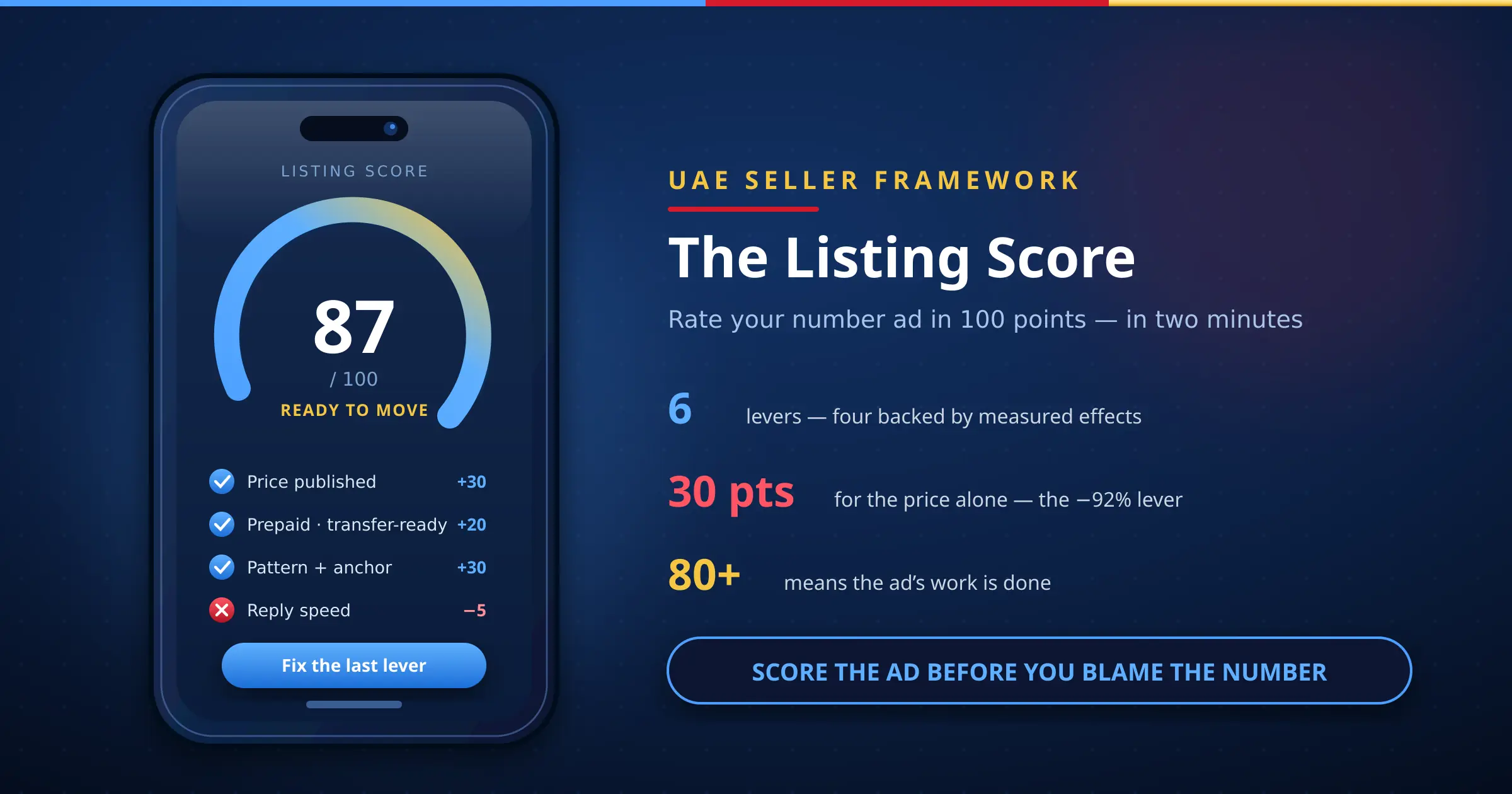
This guide compresses everything the data series has learned into one tool: the Listing Score — a 100-point framework that rates any UAE number ad in two minutes. It is the seller-side sibling of our five-pillar valuation framework: five pillars judge the number; the Listing Score judges the ad wrapped around it. Score your listing below — and if it lands under 60, you will know exactly which lever to pull first.
What Is the Listing Score?
The Listing Score is a 100-point self-assessment for UAE mobile number ads, built from the levers this marketplace’s own data series has measured: price visibility, plan state, price anchoring, pattern naming, tier positioning and listing completeness. It does not judge your number — that is the five pillars’ job. It judges everything you control after the number is fixed: the ad. A weak number in a 95-point listing still sells at a weak-number price; a strong number in a 40-point listing often does not sell at all.
Where the Weights Come From
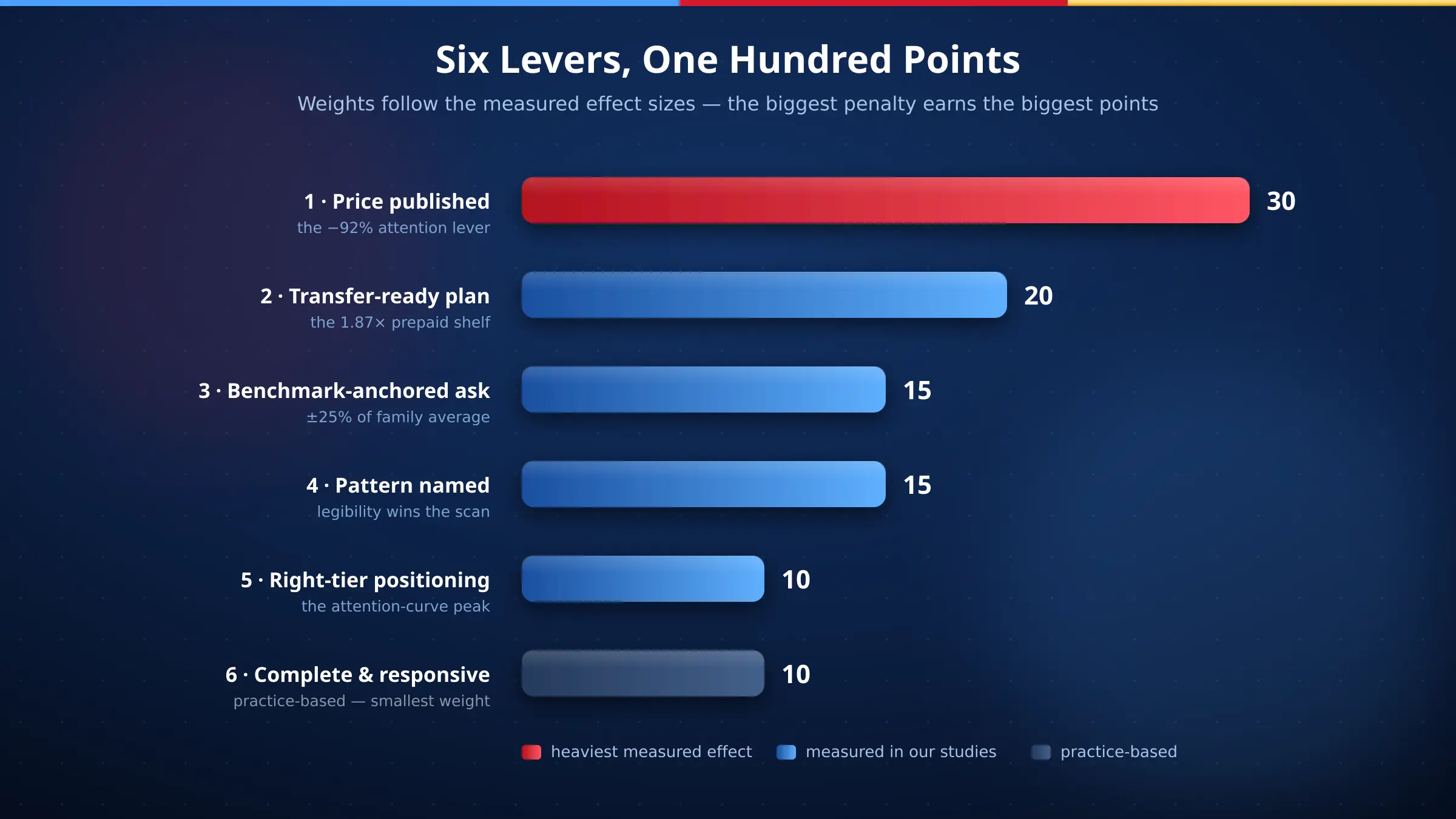
A framework is only as honest as its weighting, so here is the derivation. Where this site has measured an effect, the lever’s weight follows its size; where best practice is unmeasured, the weight is small and labelled as such. The −92% audience penalty for hidden prices is the largest effect in the entire data series — so price visibility carries 30 points, nearly a third of the score. The prepaid shelf’s 1.87× average and +12% attention edge earn plan state 20. Anchoring and pattern naming — both grounded in the family-average tables and the legibility findings — carry 15 each. Tier positioning follows the attention curve’s golden-band peak at 10. The final 10 covers completeness and responsiveness: standard marketplace craft, honestly labelled as practice-based rather than measured. Full sourcing sits in each lever’s section.
Lever 1: Publish the Price — 30 Points
Score 30 if your listing shows a number. Score 0 if it says POA. No partial credit — because the data allows none: hidden-price listings average 18.6 views against 203–248 for priced bands, a −92% audience penalty measured across 5.15 million views, on top of vanishing from every price filter as the POA study showed. The single exception — a genuine trophy deliberately courting serious-enquiries-only — applies to a few hundred listings market-wide; if you are unsure whether you are that exception, you are not. Publishing a defensible price is the highest-paying two minutes in UAE number selling.
Lever 2: Transfer-Ready Plan — 20 Points
Prepaid with validity current: 20 points. Postpaid fully settled (zero balance, no instalments) and stated as such: 10. Postpaid with open obligations: 0. The prepaid-premium study found the transfer-ready shelf averages 1.87× postpaid asks and draws 12% more views — and two-thirds of trophies above AED 50,000 already live there. The mechanism is buyer logistics: a prepaid number moves the same afternoon; a postpaid number moves when the bill, the instalments and the credit check allow. Converting is a same-day counter service once the account is clean — the study’s four-step conversion flow covers it.
Lever 3: Benchmark-Anchored Ask — 15 Points
Score 15 if your ask sits within roughly ±25% of your family’s published average — or above it with a second pattern you can name. Score 5 if you priced on feeling. Score 0 if you cannot say what family your number belongs to. The reference tables exist for every major family: the all-ten triple ranking, the rhythm shapes, the lucky families and the mirror benchmarks. Buyers increasingly arrive holding those numbers — the negotiation guide teaches them to — so an unanchored ask no longer starts a negotiation; it ends one.
Lever 4: Name the Pattern — 15 Points
Score 15 if your title names the structure — “mirror tail 2662,” “Double-Double 55 66,” “quad-8 ending.” Score 5 for a generic “VIP number.” Score 0 for digits alone. The attention study showed why: browsing is a half-second scan, and the most-viewed families are the instantly legible ones — mirrors at 1.41× market attention. A named pattern does the buyer’s recognition work for them, and the vocabulary is standardised on this site: the glossary and the rhythm guide supply the exact words buyers search and scan for.
Lever 5: Right-Tier Positioning — 10 Points
Score 10 if your valuation-supported ask lands your listing in the tier where its buyers actually browse; score 0 if you priced yourself out of your own audience. The attention curve peaks in the golden band — 248 views per listing between AED 5,000 and 50,000 — and eases at the trophy tier, where buyers are few and deliberate. The point is not to chase the peak with an inflated or deflated ask; it is coherence: a AED 3,800 Echo priced at AED 19,000 sits in a shelf whose browsers compare it with real five-figure patterns — and scroll past. Tier honesty is the difference between being seen by your buyers and being ignored by someone else’s.
Lever 6: Complete & Responsive — 10 Points
Score up to 10 for craft: carrier and plan fields filled, the number displayed cleanly, replies inside a few hours during UAE daytime. This is the one practice-based lever — flagged honestly as unmeasured by our studies — but marketplace experience across the selling guide and dealer playbook is unambiguous: enquiries decay fast, and an incomplete listing reads as an unserious seller. Five points for completeness, five for responsiveness; deduct honestly.
The Scorecard: Rate Your Listing Now
| Lever | Full points | Partial | Zero | Evidence |
|---|---|---|---|---|
| 1. Price published | 30 — visible price | — | 0 — POA | −92% attention penalty |
| 2. Transfer-ready | 20 — prepaid, valid | 10 — postpaid, settled & stated | 0 — open obligations | 1.87× shelf, +12% views |
| 3. Anchored ask | 15 — ±25% of family avg (or stacked) | 5 — priced on feeling | 0 — family unknown | Family tables, stacking rule |
| 4. Pattern named | 15 — structure in title | 5 — generic “VIP” | 0 — digits only | Legibility wins the scan |
| 5. Right tier | 10 — ask matches audience | — | 0 — wrong shelf | Attention curve peak |
| 6. Complete & responsive | 10 — fields + fast replies | 5 — one of the two | 0 — neither | Practice-based |
Reading Your Grade
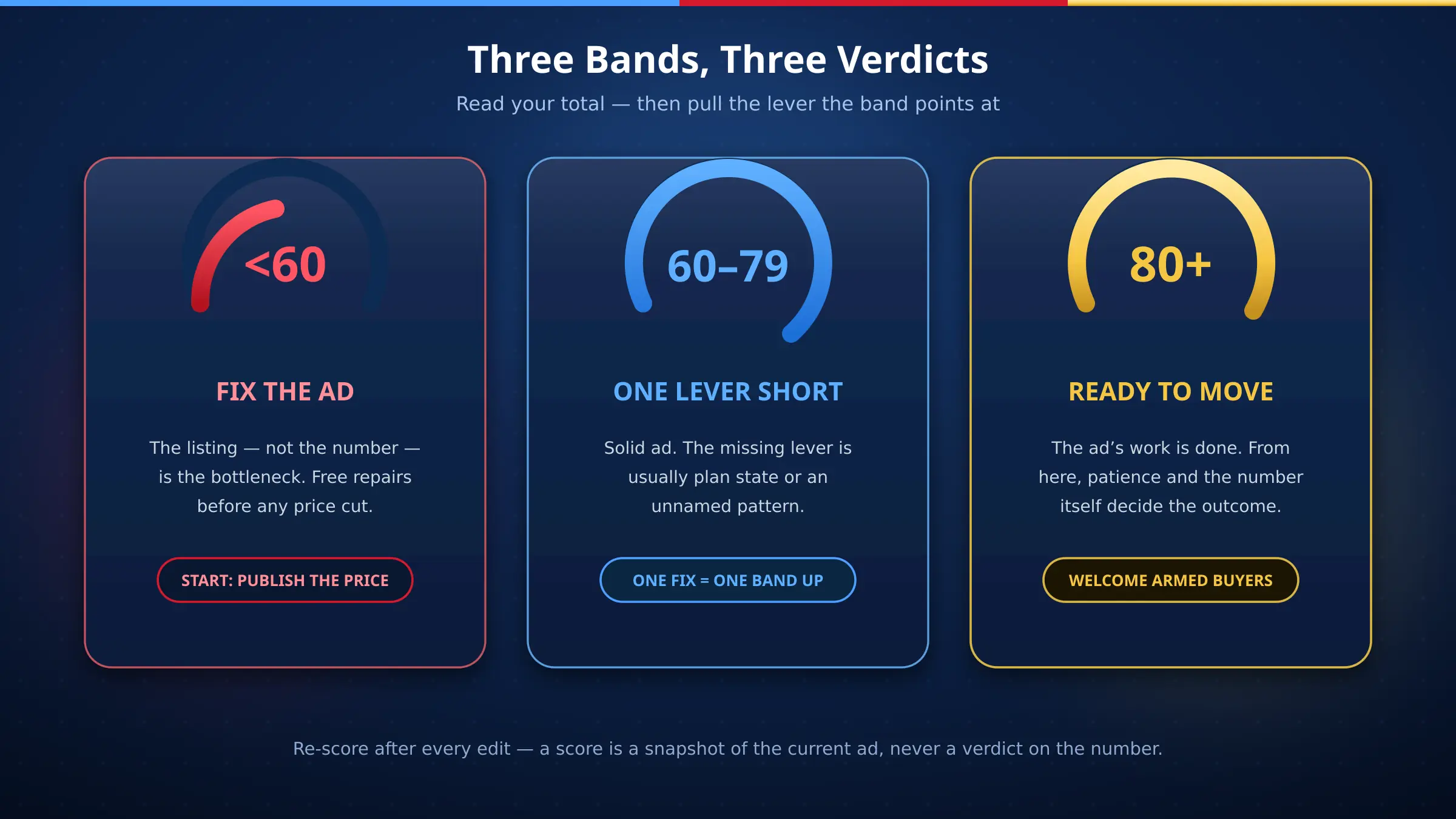
- 80–100 — ready to move. Your ad is doing everything the data rewards; from here, patience and the number itself decide. Expect benchmark-armed buyers — welcome them.
- 60–79 — solid, one lever short. Usually the missing lever is obvious from the table: most often plan state or an unnamed pattern. One fix moves you a band.
- Under 60 — the ad is the bottleneck. Do not cut the price yet, and do not blame the number: a sub-60 listing has structural repairs available that cost nothing. Fix price visibility first — it alone can be 30 points and twelve times the audience.
One habit makes the grades stick: re-score after every edit, the way the market itself re-measures you. Each lever you fix moves your listing onto a shelf with different traffic, different buyers and different comparison sets — so a score is never a verdict, only a snapshot of the current ad.
A Worked Example: 10 → 95
A real-shaped case, composited from the patterns the studies keep finding. A seller lists 055 X26 2662 — a genuine mirror-tail asset — as “055 number for sale, POA, contact me,” on a postpaid line with an open device instalment. Score it against the table: price 0 (POA), plan 0 (open obligations), anchor 0 (no family stated), pattern 5 (a generic “number”), tier 0 (an unpriced listing sits in no tier at all), craft 5 of 10 with replies arriving next-day. Total: 10 out of 100 — and the listing behaves like a 10: nineteen views in a month, for a number whose family averages sixteen thousand dirhams.
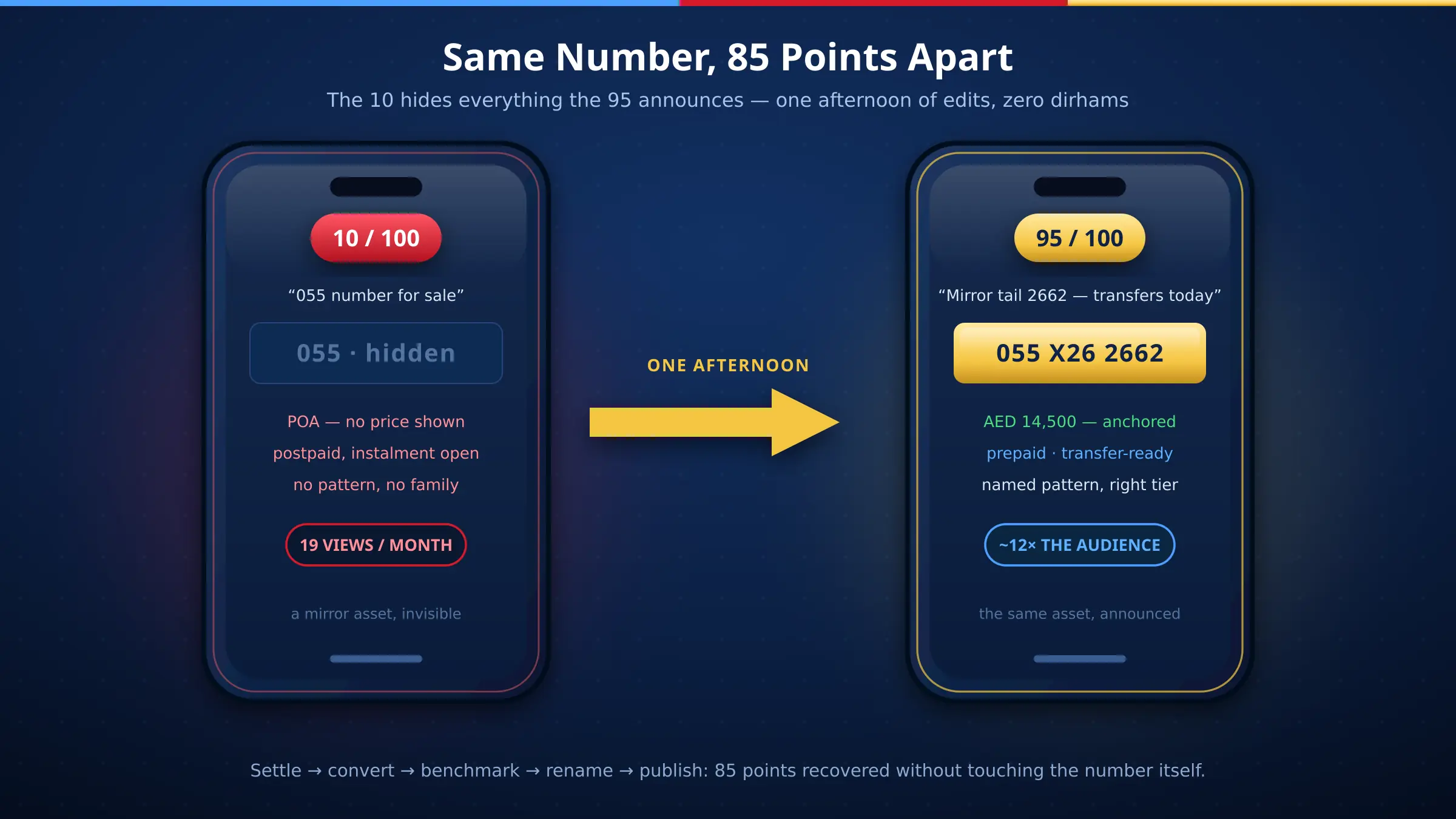
The repair costs one afternoon: settle the instalment, convert to prepaid, look up the mirror family average, retitle as “Mirror tail 2662 — prepaid, transfers today,” publish AED 14,500 against a AED 16,199 family benchmark. New score: 30 + 20 + 15 + 15 + 10, plus the same 5 craft points — 95. Same number, same seller, a different product. The measured effects predict what follows: roughly twelve times the audience of its POA past, on the shelf where mirror buyers actually browse. That delta — eighty-five points, zero dirhams — is the whole argument of this framework. And buyers can run the same arithmetic in reverse: a low-scoring ad wrapped around a strong number is where underpriced inventory hides, exactly as the POA playbook hunts it.
Honest Limits
Three, per house rules. The score predicts audience and process, not sale price — value still comes from the digits, and no ad rescues a mispriced weak number. The weights are calibrated, not carved in stone: they follow measured effect sizes from our POA, attention and prepaid studies, but those measured attention and asking-price effects, not closed sales — the standing caveat of the entire series. And lever 6 is practice, not measurement, which is exactly why it carries the smallest weight. Where the data improves, the weights will move — and this page will say so.
Frequently Asked Questions
What is the Listing Score for UAE mobile numbers?
A 100-point self-assessment that rates a number ad across six levers: published price (30), transfer-ready plan (20), benchmark-anchored ask (15), named pattern (15), right-tier positioning (10) and completeness with responsiveness (10). It judges the ad you control, while the five-pillar framework judges the number itself.
Why is publishing the price worth 30 points?
Because it is the largest measured effect in this site’s data series: hidden-price listings average 18.6 views against 203–248 for priced bands — a roughly 92% audience penalty — and disappear from every price filter. No other single decision moves a listing’s reach as much.
How many points is a prepaid number worth and why?
Twenty — the second-heaviest lever. Prepaid listings average 1.87× postpaid asks and draw 12% more views, because they transfer same-day with no credit check or instalment locks. A fully settled and stated postpaid line scores a partial 10.
What does a good Listing Score look like?
Eighty or above means the ad is doing everything the data rewards — ready to move. Sixty to seventy-nine is solid but one lever short, usually plan state or an unnamed pattern. Below sixty, the ad — not the number — is the bottleneck, and free structural fixes come before any price cut.
How do I know my number’s family average for the anchoring lever?
Use the site’s published benchmarks: the all-ten triple ranking, the rhythm shapes guide, the lucky families hub and the mirror benchmarks all list current family averages. Price within roughly ±25% of your family’s figure — or above it only with a second pattern you can name.
What does “naming the pattern” mean in a listing title?
Stating the structure in words buyers scan for: “mirror tail 2662,” “Double-Double 55 66,” “quad-8 ending” — instead of “VIP number for sale.” Legibility wins the half-second browse: the most-viewed families are the instantly recognisable ones, and the glossary standardises the vocabulary.
Does a high Listing Score guarantee a higher sale price?
No — it predicts audience and transaction smoothness, not value. The score maximises how many qualified buyers see and can act on your ad; what they pay is still decided by the number’s pattern, scarcity and the family benchmarks. A 95-point ad sells a weak number at a weak-number price — faster.
Should I ever accept a lower score on purpose?
One case: a genuine trophy courting serious-enquiries-only may deliberately forgo the 30 price points — the documented POA exception among mirrors and deep repeats. It trades audience for filtration, and it is the informed choice of a few hundred listings market-wide, not a default.
How is the Listing Score different from the five-pillar framework?
The five pillars value the number — pattern strength, prefix, cultural resonance, timing, comparables. The Listing Score rates the advertisement around it — visibility, plan state, anchoring, naming, positioning, craft. Sellers need both: pillars set the fair price, the score makes sure buyers actually meet it.
What is the fastest way to raise a low score?
In order of points per minute: publish a defensible price (up to 30 points, two minutes), name the pattern in your title (15, one minute), state your settled plan status or convert to prepaid (10–20, one store visit), then align the ask with your family average (15, ten minutes with the tables).
Are the weights based on real data?
Four of six levers follow measured effects from this site’s studies — the POA attention penalty, the prepaid premium, the family benchmarks and the attention curve. The completeness lever is labelled practice-based and carries the smallest weight; all effects measure attention and asks, not closed sales, as each study discloses.
Where do I edit my listing to apply these fixes?
On MobileNumber.ae, listing and editing are free: update the price, title and plan details any time, and pair the changes with the selling guide’s process and the safe-transfer checklist. An afternoon of edits is typically worth more reach than a month of waiting.