



Every listing on this marketplace carries a quiet number that nobody talks about: its view counter. Add them up across all 31,000 active listings and you get 5.15 million views — five million moments where someone in the UAE looked at a phone number and imagined owning it. Prices tell you what sellers want. Views tell you what buyers actually stare at — and until today, nobody had analysed them.
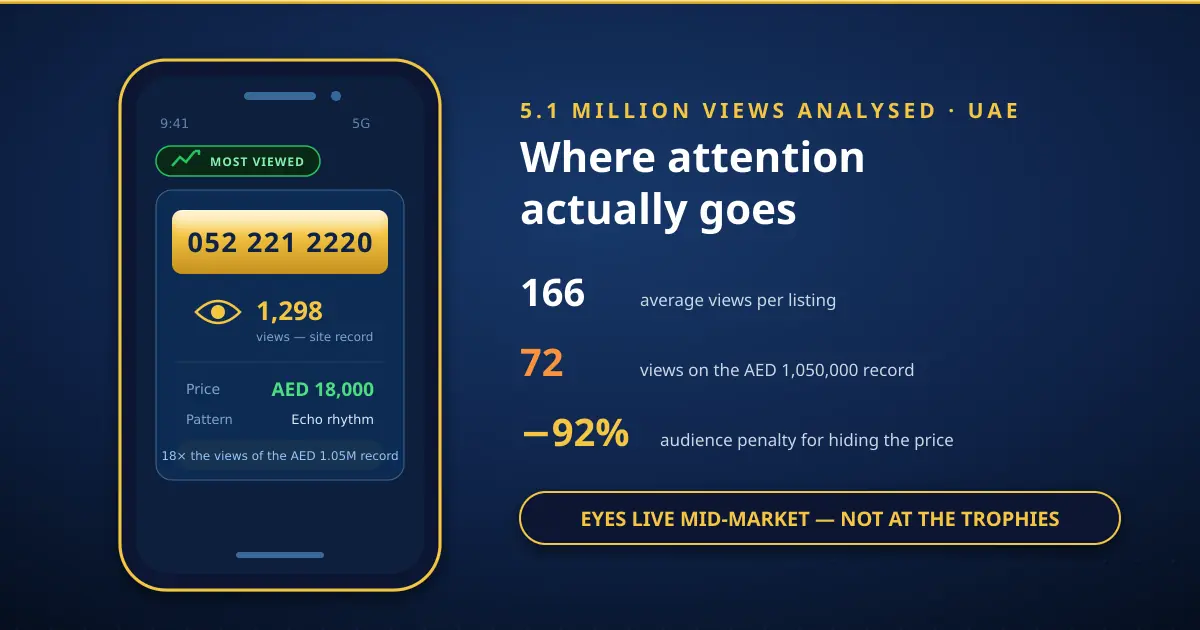
The findings rearrange several assumptions. The most-viewed number on the site costs AED 18,000 — while the AED 1,050,000 record holder has collected just 72 views. Mirrors out-stare every other family. The humble Echo earns more attention than 777. And one behaviour is punished more brutally than anything else we have ever measured: hiding your price costs you roughly 92% of your audience. All figures from a live analysis on 16 July 2026.
What We Measured
Every listing page on MobileNumber.ae counts its views; we aggregated the counters across all 30,999 active listings on 16 July 2026 — 5,154,995 views in total — and analysed how attention distributes across prices, pattern families and listing styles. This is the demand-side companion to our supply-side price studies: the superstition economy measured what sellers ask; this study measures what buyers look at. Where the site’s most-wanted report analysed what people search, view counts capture the next step in the funnel: what they click and linger on.
The Most-Viewed Numbers Right Now
| # | Number | Carrier | Ask | Views |
|---|---|---|---|---|
| 1 | 052 221 2220 | du | AED 18,000 | 1,298 |
| 2 | 058 388 8884 | du | AED 15,000 | 1,199 |
| 3 | 050 332 2180 | e& | AED 1,500 | 847 |
| 4 | 050 299 9320 | e& | AED 1,000 | 786 |
| 5 | 054 401 4443 | e& | AED 5,000 | 689 |
| 6 | 056 281 8080 | e& | AED 3,000 | 645 |
| 7 | 058 521 1151 | Virgin | AED 26,000 | 552 |
| 8 | 050 222 8991 | e& | AED 1,200 | 519 |
| 9 | 050 143 8055 | e& | AED 7,000 | 443 |
| 10 | 058 599 9977 | Virgin | AED 9,800 | 434 |
Read the asks: every entry sits between AED 1,000 and 26,000. Not one trophy, not one POA. The crowd’s eyes live where its wallets do — and the #1 listing is a textbook rhythm number (221 2220’s alternating twos), while #2 stacks a triple-8 against a repeating frame. Patterns you can see in half a second win the click.
The Attention Paradox: 1,298 vs 72
The marketplace’s record listing — 058 X00 0000 at AED 1,050,000 — has collected 72 views. The most-viewed listing has 1,298, at 1.7% of the price. Trophy asks near the top tell the same story: the million-dirham 055 number sits at 375 views, the AED 750,000 pair at 343–423. Attention and price separate completely at the top of the market. The explanation is not that trophies bore people — it is that browsing is aspiration bounded by realism: thousands window-shop what they could conceivably buy this year, while seven-figure listings attract only the tiny audience that belongs there. Sellers of mid-market numbers should read that as good news: your shelf is where the crowd actually walks.
The Attention Curve by Price Band
| Price band | Listings | Avg views per listing |
|---|---|---|
| POA — no public price | 9,456 | 18.6 |
| Under AED 500 | 2,837 | 203.7 |
| AED 500–5,000 | 14,651 | 232.3 |
| AED 5,000–50,000 | 3,903 | 248.2 — the peak |
| AED 50,000+ | 152 | 191.1 |
The curve rises with price, peaks in the golden band — where numbers are special enough to covet and attainable enough to consider — then eases off at the trophy tier. It is the same sweet spot the price-structure guide identifies from the supply side, now confirmed from the demand side.
The POA Penalty, Quantified
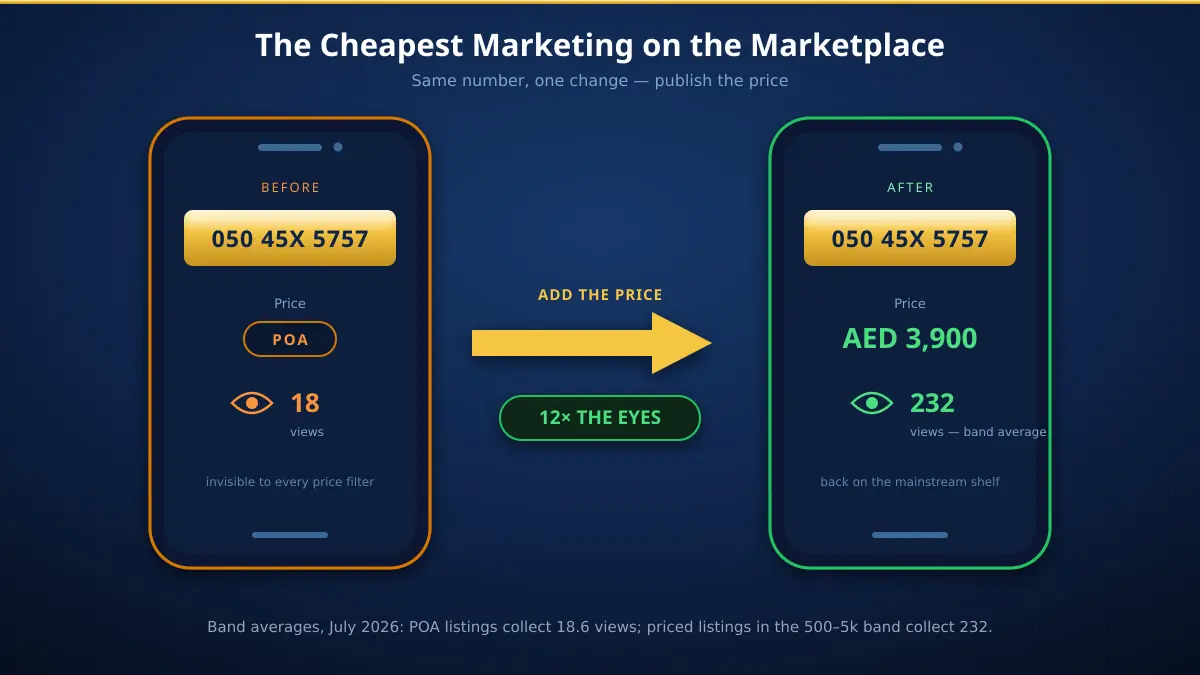
Listings without a public price average 18.6 views. Priced listings in the neighbouring bands average 203 to 248. Hiding the price divides a listing’s audience by roughly twelve — a 92% attention penalty.
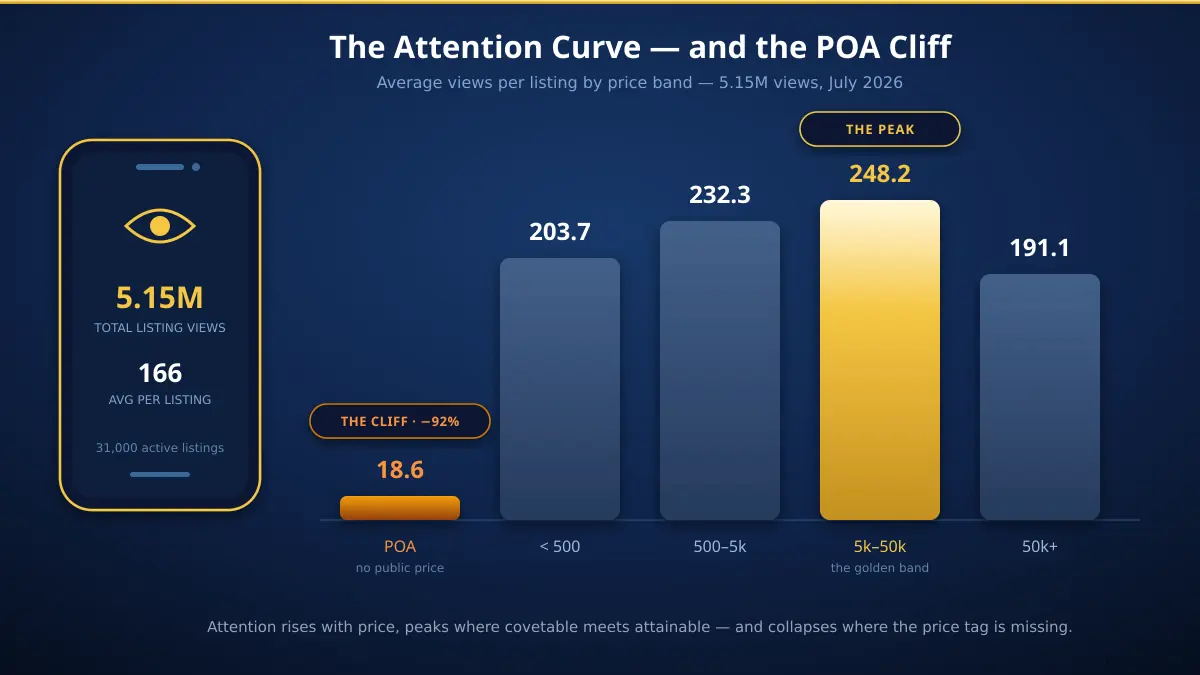
When our POA study argued that hidden prices exile listings into a shadow inventory — invisible to every price filter, reachable only by browsing — that was mechanism. This is measurement: the behavioural cost of the “call me” label, in cold numbers. A seller choosing POA is not filtering for serious buyers; they are removing themselves from twelve of every thirteen pairs of eyes. If one statistic from this study changes real behaviour, let it be this one.
Attention by Family: the Mirror Wins
| Family | Listings | Avg views | vs market (166.3) |
|---|---|---|---|
| Mirror (palindrome) | 561 | 234.7 | 1.41× |
| 786 family | 100 | 222.5 | 1.34× |
| Echo (ABAB) | 2,849 | 198.5 | 1.19× |
| Repeating 4+ | 779 | 192.1 | 1.16× |
| 888 triples | 1,284 | 186.4 | 1.12× |
| 777 triples | 1,515 | 185.5 | 1.12× |
| 000 triples | 972 | 177.6 | 1.07× |
| Whole market | 30,999 | 166.3 | 1.00× |
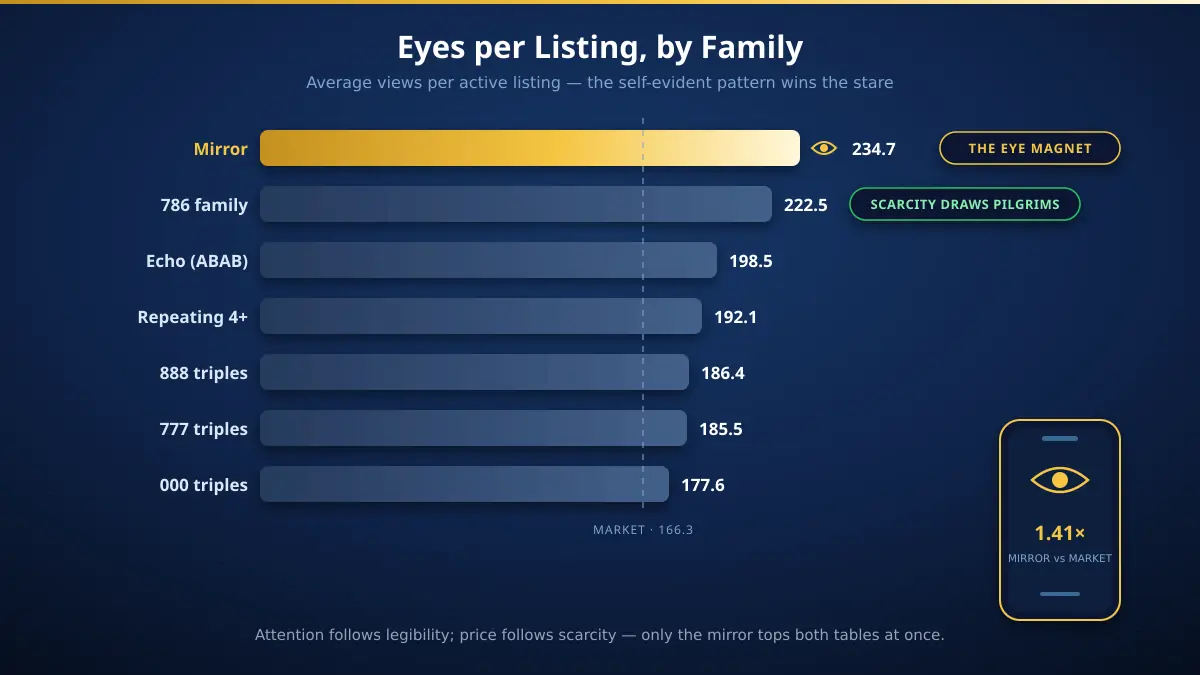
Two surprises hide in the ranking. First, the mirror — not any lucky digit — is the market’s eye magnet, which rhymes perfectly with what we know about the family: mirrors are also the market’s most price-transparent sellers and its highest-average pattern. Self-evidence is a full-stack advantage: a pattern everyone recognises gets stared at, priced confidently and valued highly. Second, the 000 family — the market’s price king at 2.45× — draws only average attention (1.07×): corporate buyers do not window-shop; they arrive, buy and leave. Attention is a consumer metric; zeros are a business product.
Set the two rankings side by side and a quiet rule emerges: attention follows legibility, price follows scarcity, and only the mirror tops both tables at once. The famous sevens and eights sit mid-pack on eyeballs precisely because they are everywhere — 1,500-listing families cannot feel rare in a results grid — while the hundred-listing 786 shelf turns its scarcity into pilgrimage traffic. For buyers building an exit thesis, that split matters: buy legibility if you want a number that markets itself, buy scarcity if you want one that appraises well, and buy a mirror if you refuse to choose.
The Attention-per-Dirham Shelf
The Echo is the marketplace’s attention bargain: 1.19× the market’s eyeballs at 26% below the market’s average price. No other family combines above-average attention with a below-average ask — the same shelf our rhythm study called “structure below market price,” now validated by demand. For a business that wants a number people notice without golden-tier money, the ABAB shelf is, measurably, the efficient frontier.
Why Attention Behaves This Way
- Realistic aspiration rules browsing. People linger on what they might plausibly buy — which concentrates views between AED 1,000 and 50,000 and starves the trophy tier of casual traffic.
- Half-second patterns win the click. In a results grid, a mirror or an alternating tail is visible before thought; a subtle stacked trophy is not. The click goes to the instantly legible — the same cognitive chunking that drives the rhythm premium.
- A visible price is an invitation; a missing one is a wall. Filters skip POA listings entirely and browsers skip what they cannot evaluate — the 18.6-view cliff is both effects compounding.
- Cultural pull is real but secondary: 786’s 1.34× attention on just 100 listings shows scarce meaning still draws pilgrims — consistent with its +52% faith premium — yet even it trails the purely structural mirror.
What Sellers Should Do With This
- Publish your price. The single highest-leverage act on this marketplace: it moves you from the 18.6-view shadow to the 200+ view mainstream. Anchor it with the calculator and the family tables.
- If your number has a visible pattern, lead with it. Titles that name the shape — mirror, double-double, triple-8 tail — match how browsers scan; the seller’s guide covers listing copy.
- Price into the attention peak when plausible. A defensible ask inside the 5k–50k golden band puts you on the busiest shelf in the market — where views average 248 and buyers arrive pre-qualified.
- Treat low views as a diagnosis, not a verdict. A strong number with 20 views usually has a listing problem — hidden price, unnamed pattern — not a number problem. Fix the listing before you cut the ask; editing is free.
How Buyers Should Read View Counts
Views are a competition signal, not a quality score. A 1,200-view listing is being watched by other buyers — expect less negotiating room and faster disappearance; the negotiation guide’s patience tactics work poorly there. Conversely, the 18.6-view POA shadow and the low-traffic trophy tier are where overlooked value hides: a superb number with few views is not unloved, it is unfound — and the POA playbook shows how to hunt there with a benchmark in hand. Popular is not better; popular is merely crowded.
Honest Limits of the Data
Three caveats, in the tradition of our methodology notes. Views are cumulative, not time-normalised: older listings have had longer to collect them, so family and band comparisons assume broadly similar age mixes — safe at the scale of thousands, weaker for any single listing. Views measure interest, not transactions: nothing here says the most-viewed numbers sell fastest, only that they are seen most. And a view is a page-load, not a person: repeat visits and idle curiosity inflate absolute counts — which is why every claim above rests on relative comparisons between segments measured the same way, not on the raw totals.
The Study in Numbers
| Metric | Value (16 July 2026) |
|---|---|
| Total listing views, all active listings | 5,154,995 |
| Average per listing / most-viewed listing | 166.3 / 1,298 (052 221 2220, AED 18,000) |
| Views on the AED 1.05M site record | 72 |
| Attention peak | AED 5k–50k band — 248.2 views/listing |
| The POA penalty | 18.6 views/listing — ≈92% below priced bands |
| Most-watched family | Mirrors — 234.7 views/listing (1.41× market) |
Researchers and journalists are welcome to cite this study with attribution and a link, as with our superstition-economy study. Citable line: “On the UAE’s largest number marketplace, hiding a listing’s price cuts its audience by roughly 92% — while the million-dirham record attracts fewer views than an ordinary AED 1,000 starter.”
Frequently Asked Questions
What is the most viewed mobile number in the UAE?
Currently 052 221 2220, a du rhythm number asking AED 18,000, with 1,298 views — the highest counter on the marketplace. The runner-up is 058 388 8884 at 1,199 views, and every listing in the top ten asks between AED 1,000 and 26,000.
Do expensive VIP numbers get the most views?
No — attention and price separate at the top. The AED 1,050,000 site record has 72 views while the most-viewed listing, at 1.7% of that price, has 1,298. Views peak in the AED 5,000–50,000 golden band at 248 per listing and ease to 191 above AED 50,000.
How many views does a typical number listing get?
The market average is 166 views per active listing, from 5.15 million total views across 30,999 listings. Priced listings in the main bands average 203–248; hidden-price (POA) listings average just 18.6.
How much attention do POA listings lose?
Roughly 92%: POA listings average 18.6 views against 203–248 for priced bands — about one-twelfth the audience. The mechanism is double: price filters skip unpriced listings entirely, and browsers skip what they cannot evaluate at a glance.
Which number pattern gets viewed the most?
Mirrors: palindromic numbers average 234.7 views per listing, 1.41× the market — ahead of 786 numbers (222.5), Echo ABAB tails (198.5) and deep repeating runs (192.1). Instantly recognisable structure wins the click before any lucky meaning does.
Why do mirror numbers attract so much attention?
Because they are self-evident: a palindrome reads as special in half a second inside a results grid, with no cultural knowledge required. The same property makes mirror sellers the market’s most price-confident and the family’s average ask its highest — visibility, confidence and value reinforce each other.
Does a high view count mean a number will sell for more?
Not directly — views measure interest, not transactions, and this study makes no sales claims. For buyers a high counter mainly signals competition: less negotiating room and shorter shelf life. Value still comes from pattern, scarcity and the family benchmarks, not from popularity.
Are view counts a reliable metric?
With honest limits: counters are cumulative (older listings have had longer to accumulate), a view is a page-load rather than a unique person, and interest is not purchase intent. All conclusions in this study therefore rest on relative comparisons between large segments measured identically, not on raw totals.
What is the best price range to list a number for maximum views?
The AED 5,000–50,000 golden band is the attention peak at 248 views per listing, followed closely by AED 500–5,000 at 232. The strongest single action, though, is simply publishing a price at all — it moves a listing from the 18.6-view shadow into the mainstream regardless of band.
Why does the 000 family get only average views despite its record prices?
Because its buyers are businesses, not browsers: corporate purchasers arrive with intent, transact and leave, generating few window-shopping views. The zero family tops the price rankings at 2.45× the market average while drawing just 1.07× its attention — attention is a consumer metric.
Where can overlooked bargains hide by this data?
In the low-attention zones: the POA shadow inventory (18.6 views average) and the quiet trophy tier. A strong number with few views is unfound rather than unloved — approach it with a family benchmark and the POA playbook, where the least-seen listings meet the most-prepared buyers.
How do I get more views on my own listing?
Publish a defensible price (the 92% penalty is the whole game), name the visible pattern in your title, and if your valuation supports it, position inside the 5k–50k attention peak. Listing and editing are free on MobileNumber.ae, and the seller’s guide covers copy that matches how browsers scan.