



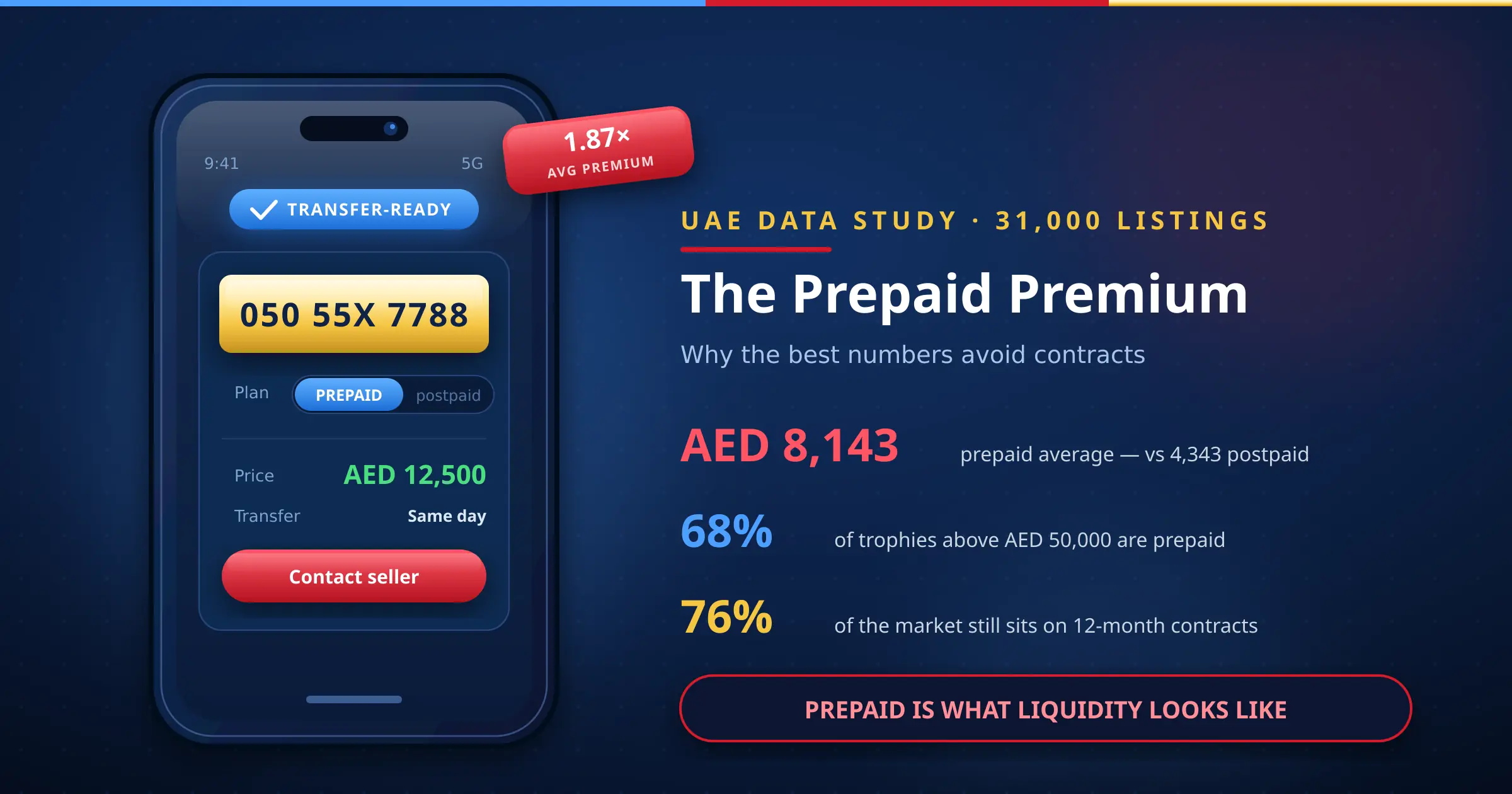
Ask the UAE number market a simple question — which plan do valuable numbers live on? — and the inventory answers with a pattern too sharp to be coincidence. 85% of all listings sit on postpaid lines. But cross the AED 50,000 trophy line and the world flips: 68% of the market’s most expensive numbers live on prepaid. The average prepaid listing asks AED 8,143; the average postpaid listing asks AED 4,343 — a 1.87× gap we call the prepaid premium.
This study measures that gap across all 31,000 active listings, explains the machinery behind it — and is careful about what the premium is not: prepaid does not make a number valuable. Owners of valuable numbers choose prepaid, because prepaid is what liquidity looks like in this market. Understanding that one sentence will change how you list, how you shop, and how you read a listing’s plan badge. All figures from 17 July 2026.
What We Measured
Every active listing on MobileNumber.ae declares its plan type — prepaid or postpaid — and its contract commitment; we analysed all 30,999 active listings on 17 July 2026 across both dimensions, against asking prices and view counts. This is the plan-type companion to our prepaid vs postpaid decision guide: that article advises which plan suits you; this one reveals what the market itself has already decided — and the split is anything but random.
The Headline Gap: 1.87×
| Plan type | Active listings | Share | Average ask | Avg views |
|---|---|---|---|---|
| Prepaid | 4,475 | 14.4% | AED 8,143 | 184.2 |
| Postpaid | 26,522 | 85.6% | AED 4,343 | 164.3 |
One listing in seven is prepaid — yet that minority out-prices the majority by 87% on average. A gap this size across 21,500 priced listings is not noise; it is structure. The next two sections show where it comes from.
The Tier Flip: 84% → 32%
| Price tier | Priced listings | Postpaid share | Prepaid share |
|---|---|---|---|
| Under AED 5,000 | 17,488 | 83.7% | 16.3% |
| AED 5,000–50,000 (golden) | 3,903 | 73.1% | 26.9% |
| AED 50,000+ (trophy) | 152 | 31.6% | 68.4% |
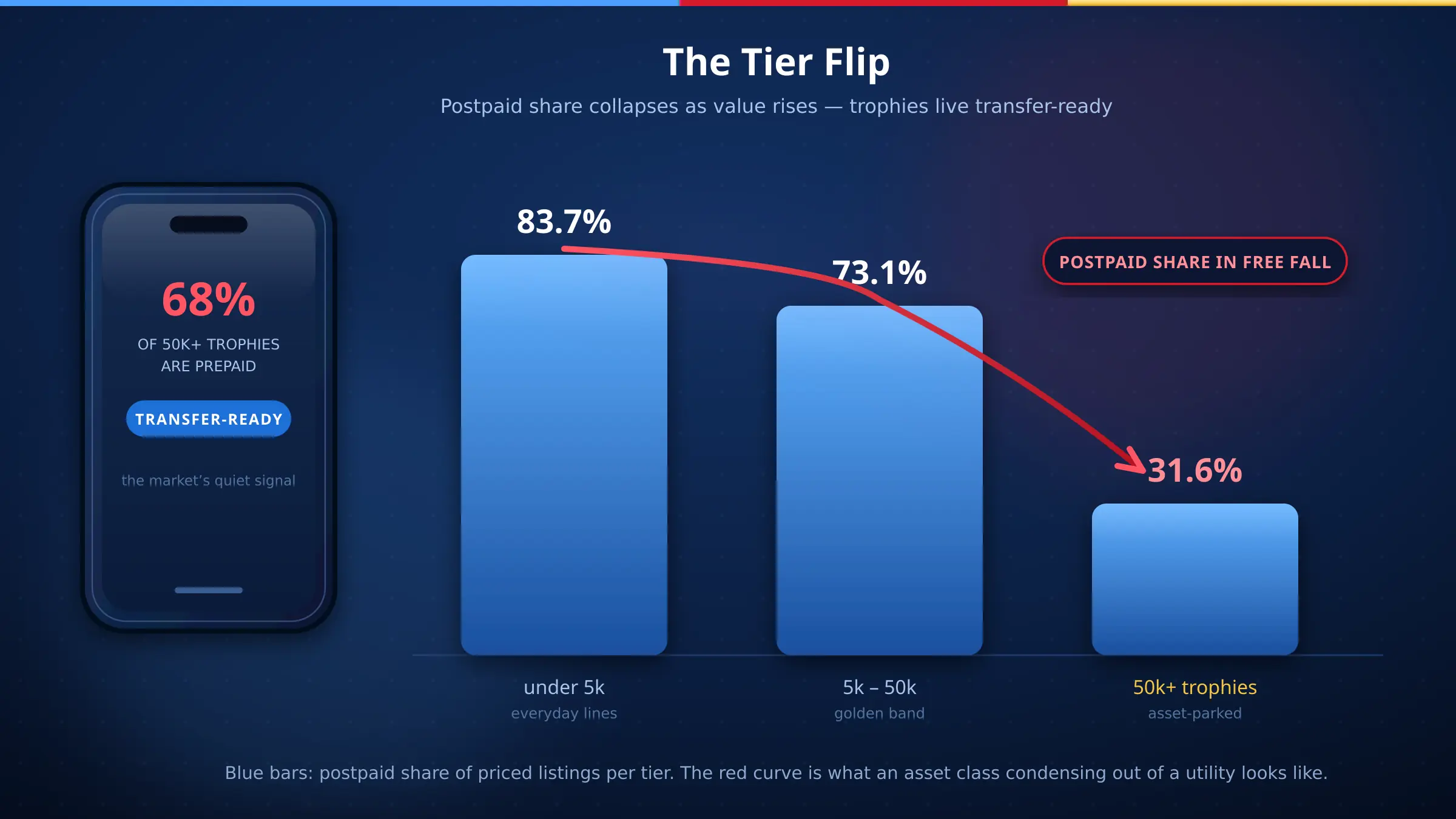
Follow the postpaid share down the tiers: 84%, 73%, 32%. Somewhere between a nice number and a premium-tier asset, owners stop treating the line as a phone plan and start treating it as an exit-ready holding. The record tier makes the endpoint vivid: two of every three numbers above AED 50,000 sit on prepaid — the exact opposite of the market’s base rate.
The curve is best read as a portrait of holding behaviour. In the everyday tier, the number and the phone plan are the same object — you sell the line you happen to live on, contract and all. In the golden band, a quarter of owners have already made the mental switch from user to holder. By the trophy tier the switch is nearly universal: the number has been separated from daily life, parked on a minimal prepaid line, recharged just enough to stay valid — a safe-deposit box that happens to ring. The tier flip is what an asset class looks like when it condenses out of a utility.
Why Trophies Migrate to Prepaid
The mechanics were established across our transfer guides; the inventory now shows their fingerprints at scale:
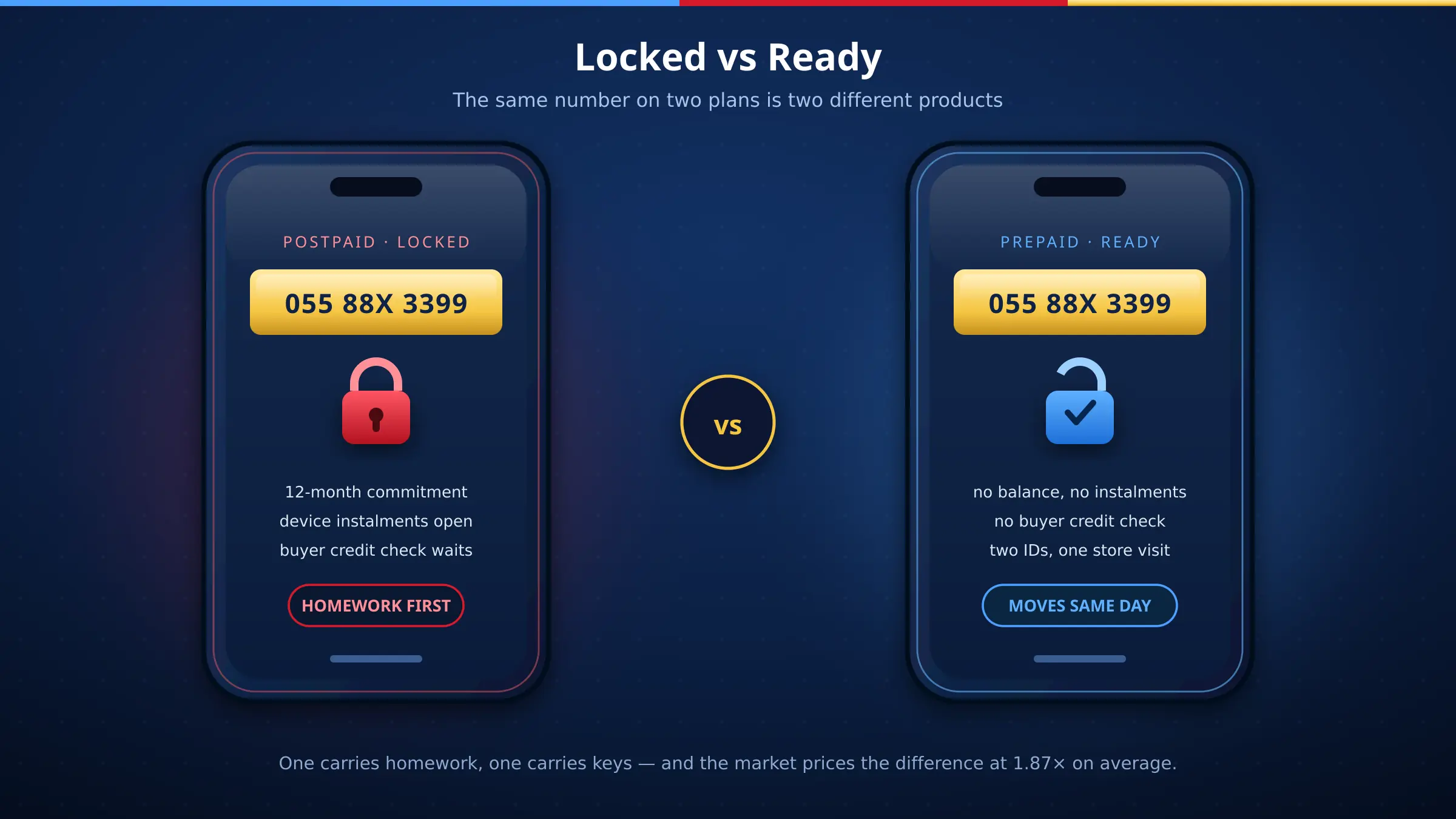
- Prepaid transfers same-day, unconditionally. Two Emirates IDs, one store visit plus a small carrier fee — no credit check on the buyer, no re-underwriting, no surprises. The transfer guide calls prepaid the fast lane for a reason.
- Postpaid stacks conditions. Final bill cleared to zero, device instalments settled or reassigned, and the buyer must pass the carrier’s postpaid eligibility check — any one of which can stall or kill a deal at the counter.
- Serious sellers know this. A trophy owner expecting a six-figure buyer removes every friction in advance — the same logic that makes confident sellers publish prices. Prepaid is the plan-type version of a printed price: a signal that this listing is ready to move.
- Buyers reward the signal. A transfer that can complete this afternoon is worth paying for when the alternative is a week of bill-settling — part of the premium is simply the market pricing convenience.
On this market, prepaid is not a phone plan — it is a state of readiness. The plan badge quietly answers the buyer’s most important logistical question: “can this number actually move today?”
The 12-Month Default
The contract column explains where the postpaid mass comes from: 23,489 listings — 76% of the entire market — carry a standard 12-month commitment, against 7,370 no-commitment lines and a rounding-error of 24-month and short-term contracts. These are, overwhelmingly, ordinary daily-driver lines whose owners happen to be selling: the number was acquired for use, the contract came with the plan, and the listing inherited it. Nothing is wrong with that — but it means the typical listing carries transfer homework, and the minority that does not has a structural head start. Before buying into a commitment, check what remains of it and who settles it; the family-transfer guide’s postpaid checklist applies to purchases unchanged.
Attention Agrees
Our attention study gives the premium a second, independent confirmation: prepaid listings average 184.2 views against 164.3 for postpaid — a 12% attention edge that mirrors the price edge. Browsers cannot always articulate why a listing feels more buyable, but the counters suggest they sense it: the transfer-ready shelf simply gets more eyes per listing, on top of higher asks. Signals compound — a prepaid, price-published, pattern-named listing stacks three visibility advantages this site has now measured separately.
What Buyers Should Do
- Read the plan badge before the price. Prepaid means the number can be yours today; postpaid means the timeline belongs to the seller’s unpaid bill and your credit check. Budget time accordingly.
- On a postpaid listing, ask three questions up front: current balance, device instalments outstanding, remaining commitment. Get the answers in writing before agreeing anything — per the safe-buying checklist.
- Price the friction into your offer. A postpaid trophy with obligations attached should not cost the same as its prepaid twin — the market’s own 1.87× gap is your negotiation precedent.
- Convert after purchase if you prefer contracts: buy prepaid for the clean transfer, then move to postpaid at your leisure — the plan guide covers the switch in both directions.
What Sellers Should Do
The playbook writes itself from the data: if your number is worth more than an everyday line, list it transfer-ready. Clear the balance, settle or migrate device plans, convert to prepaid, and only then publish — with a price, per the POA study, and a named pattern, per the attention study. You will be listing into the segment that averages 1.87× the asks and 12% more views, and every serious buyer’s first logistical objection disappears before it is raised. The seller’s guide covers the rest of the launch checklist; listing is free.
Converting Before You List
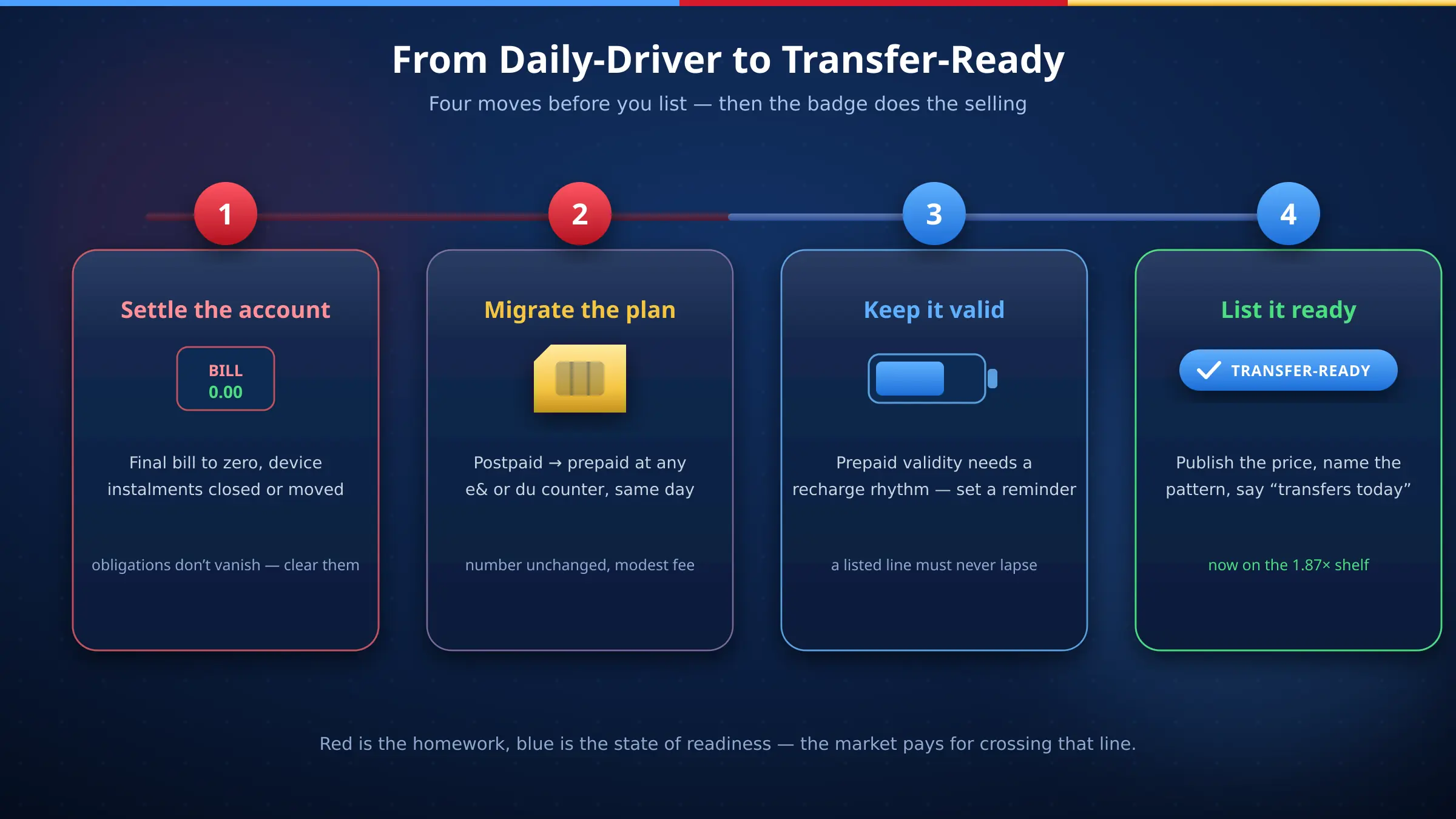
- Settle the account: final bill to zero, instalments closed or transferred to another line — postpaid obligations do not vanish with the plan change.
- Request the migration: postpaid-to-prepaid is a standard counter service at e& and du; same-day, modest fee, number unchanged.
- Keep the line alive: prepaid lines have recharge-validity rules — set a reminder so a listed number never lapses while it waits for its buyer.
- Then list it transfer-ready — and say so in the title. “Prepaid — transfers today” is five words of copy backed by everything this study measured.
Honest Limits: Selection, Not Magic
In the tradition of our methodology notes: the prepaid premium is a selection effect, not a causal one. Prepaid does not add AED 3,800 to a number; owners of already-valuable numbers disproportionately park them on prepaid, so the plan type selects for quality rather than creating it. Converting a weak number to prepaid buys convenience, a faster transfer and the attention edge — it does not buy a better number. Likewise, plenty of excellent numbers sit on postpaid simply because their owners still use them daily; a contract is a to-do list, not a defect. Read the badge as a liquidity signal and a probability, never as a verdict on the digits themselves — the digits are judged by the five pillars, same as always.
Does Carrier Change the Picture?
Directionally, no: the migration logic is carrier-neutral, because the friction it removes — credit checks, instalment locks, final bills — exists identically at e& and du, and both convert plans over the counter the same day. What differs is starting inventory: e&’s older, larger base skews harder toward everyday 12-month lines, while du’s smaller premium-heavy ranges — home to most of the market’s top asks — reach the prepaid state more often simply because more of their numbers are held as assets. The rule for readers is unchanged either way: on any carrier, the plan badge tells you how fast the number can move.
The Study in Numbers
| Metric | Value (17 July 2026) |
|---|---|
| Active listings analysed | 30,999 |
| Prepaid share of inventory / of trophy tier (50k+) | 14.4% / 68.4% |
| Average ask — prepaid vs postpaid | AED 8,143 vs AED 4,343 (1.87×) |
| Postpaid share by tier | 83.7% → 73.1% → 31.6% |
| Listings on 12-month commitments | 23,489 (76% of market) |
| Attention edge, prepaid | 184.2 vs 164.3 views/listing (+12%) |
Cite with attribution and a link, as with the superstition and attention studies. Citable line: “Above AED 50,000, two-thirds of the UAE’s listed VIP numbers sit on prepaid — the market’s quiet signal that a serious number is kept transfer-ready.”
Frequently Asked Questions
What is the prepaid premium in UAE mobile numbers?
It is the measured price gap between plan types on the resale market: prepaid listings average AED 8,143 against AED 4,343 for postpaid — 1.87× — despite prepaid being only 14% of inventory. The gap reflects selection: owners of valuable numbers keep them on prepaid because it transfers fastest.
Why are most expensive VIP numbers on prepaid?
Because prepaid is transfer-ready: same-day ownership change with no buyer credit check, no instalment locks and no final-bill risk. Above AED 50,000, 68% of listings are prepaid — serious sellers remove every friction before a six-figure buyer appears.
Is it better to buy a prepaid or postpaid VIP number?
For the transaction itself, prepaid: the transfer completes the same day unconditionally. A postpaid purchase adds the seller’s final bill, any device instalments and your own eligibility check. You can always convert to postpaid after the number is safely yours.
Does converting my number to prepaid increase its value?
No — the premium is a selection effect, not magic. Conversion buys convenience, a faster transfer and a measured 12% attention edge, which help a good number sell; they do not make a weak number strong. The digits are still valued by pattern, scarcity and the five-pillar framework.
How do I convert a postpaid number to prepaid before selling?
Settle the account first — final bill to zero, device instalments closed or moved — then request the standard postpaid-to-prepaid migration at any e& or du store; it completes same-day with the number unchanged. Afterwards, mind prepaid recharge-validity rules so the line stays active while listed.
What share of UAE number listings are postpaid?
85.6% — 26,522 of 30,999 active listings — and 76% of the whole market carries a standard 12-month commitment. Most listings are ordinary daily-use lines whose owners are selling, which is exactly why the transfer-ready prepaid minority stands out.
Do prepaid listings really get more views?
Yes: 184.2 views per listing against 164.3 for postpaid, a 12% edge measured across the site’s 5.15 million listing views. It mirrors the price gap and stacks with the other measured visibility levers — publishing a price and naming the pattern.
Can I buy a postpaid VIP number if I fail the credit check?
Ask the seller to convert the line to prepaid before transfer — a standard same-day counter service once the account is settled. The ownership change then proceeds without any eligibility check, and you can keep the number on prepaid indefinitely.
What should I check before buying a postpaid listing?
Three things in writing: the current account balance, outstanding device instalments, and the remaining contract commitment. Each one must be resolved before the number can legally move, and each is a fair input to your offer price.
Does the 12-month commitment transfer to the buyer?
Postpaid obligations are settled or re-contracted at transfer, not silently inherited: the seller clears the balance and instalments, and the buyer signs their own plan going forward — or takes the line over as prepaid. Never complete a purchase while the old commitment’s status is unclear.
Is the prepaid premium the same on e& and du?
The mechanism is identical on both carriers — same frictions, same same-day conversion — so the badge means the same thing everywhere. Composition differs slightly: du’s premium-heavy ranges hold more asset-parked prepaid trophies, while e&’s larger base skews toward everyday 12-month lines.
Where can I browse transfer-ready numbers?
Plan type is shown on every listing on MobileNumber.ae — look for prepaid in the details when browsing the VIP, golden or premium tiers. For the fastest possible purchase, shortlist prepaid listings with a published price and a named pattern: the three signals this site has measured all point the same way.