



Ask most buyers what a VIP mobile number costs and you get a shrug or a horror story about a million-dirham 700-7777. Both miss the point. The UAE number market is a ladder, not a lottery — and the single most useful thing a buyer can know is what their specific budget actually buys today. This guide answers that with live data: every price band, the real inventory inside it, and the surprising line where money stops buying prestige and starts buying genuine scarcity.
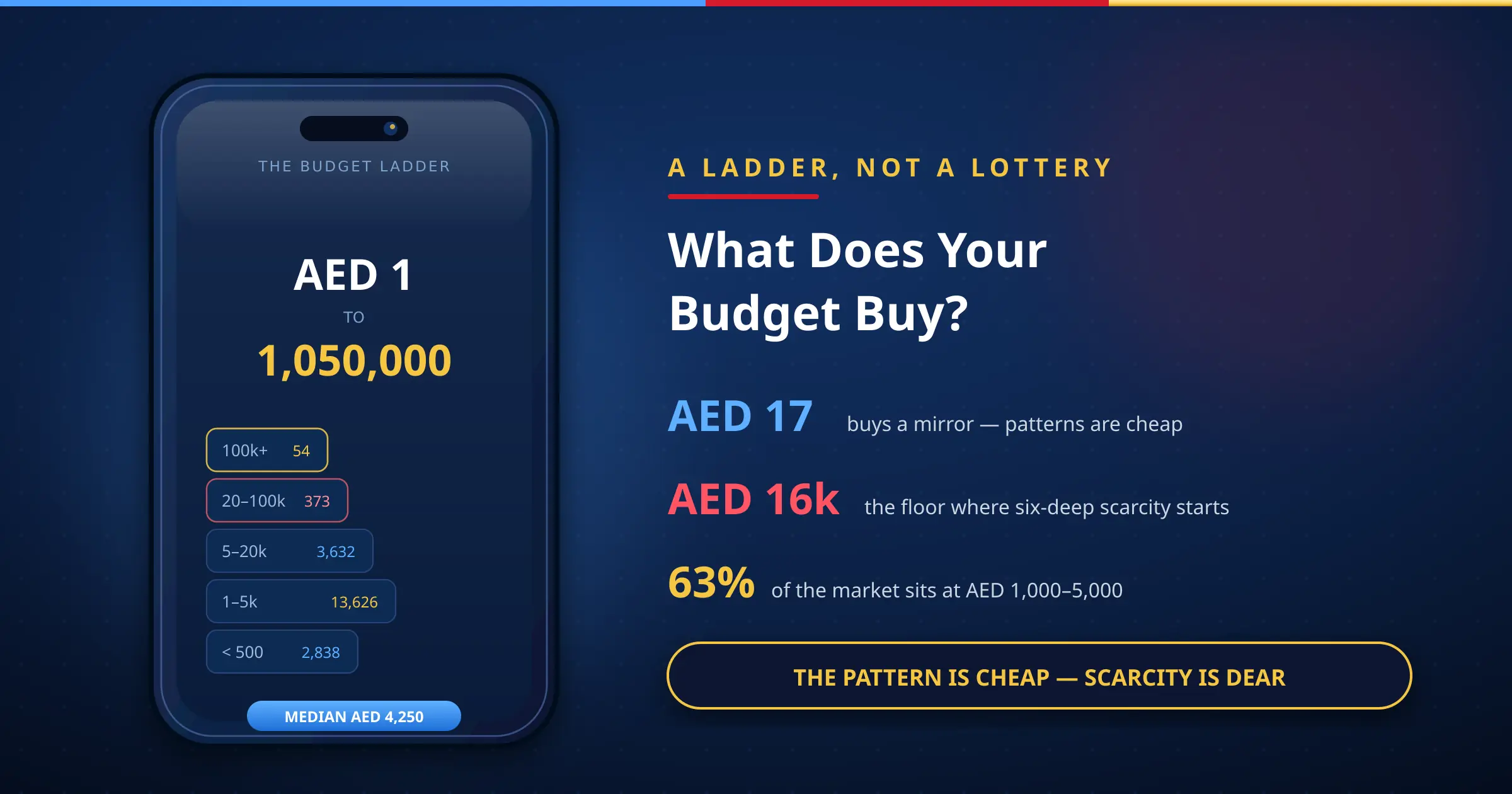
Two findings reset expectations before we start. First, a pattern is not a luxury — the cheapest mirror number on the marketplace asks AED 17, and 46% of all sub-AED 500 listings already contain a triple. Second, the real budget wall sits higher than you think: no six-identical-digit number on the entire marketplace is priced below AED 16,000. Everything between those two facts is the story of what your money buys.
The Budget Ladder at a Glance
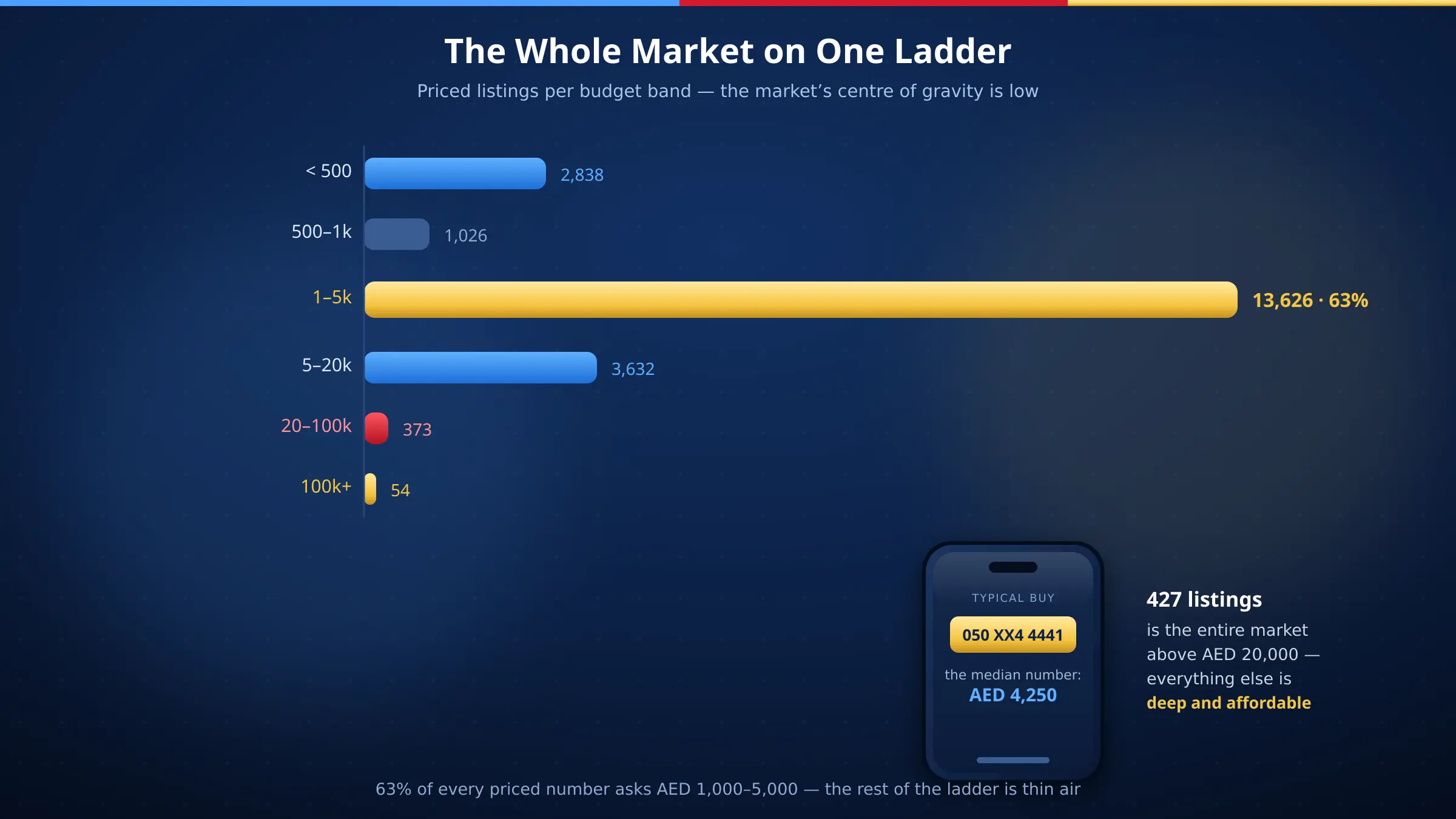
Counted across all publicly priced listings on the day of writing, this is the whole market on one ladder:
| Budget band | Live listings | Average ask | Contain a triple | Six-deep numbers |
|---|---|---|---|---|
| Under AED 500 | 2,838 | AED 238 | 1,294 (46%) | 0 |
| AED 500–1,000 | 1,026 | AED 638 | 478 (47%) | 0 |
| AED 1,000–5,000 | 13,626 | AED 3,552 | 4,647 (34%) | 0 |
| AED 5,000–20,000 | 3,632 | AED 7,783 | 3,006 (83%) | 3 |
| AED 20,000–100,000 | 373 | AED 40,330 | 277 (74%) | 4 |
| AED 100,000+ | 54 | AED 294,963 | 44 (81%) | 5 |
Two shapes jump out. The 1,000–5,000 band is enormous — 13,626 listings, 63% of the entire priced market — while everything above AED 20,000 is a rounding error of 427 numbers combined. And triples are everywhere at every price, but the share of listings built around a pattern jumps sharply once you cross AED 5,000, from a third to over four-fifths. That jump is where you stop buying a number that happens to have a repeat and start buying a number that is the repeat.
How These Prices Were Counted
Method in three sentences: every active listing with a public asking price was bucketed by price band on the day of publication, then scanned for pattern content (triples, mirror tails, six-identical-digit runs) using the same character-level method as the digit census. Prices are asking prices, not closed sales, among the 21,549 publicly priced listings — the other 30.5% list as POA and are excluded because they carry no comparable number. Market-wide figures (median AED 4,250, average AED 5,057) match the continuously recomputed statistics reference page.
Under AED 500: The Pattern Is Cheap, the Prestige Is Not
Direct answer: under AED 500 you can absolutely buy a patterned number — a triple ending, a mirror tail, even a repeating pair — you just cannot buy a famous one. There are 2,838 listings in this band averaging AED 238, and 1,294 of them contain a triple. The cheapest mirror number on the whole marketplace asks AED 17.
What separates these from the expensive shelves is context, not pattern. A triple sitting mid-number on a 056 line (056 344 4643, AED 400) reads very differently from the same three digits ending a 050 line. This band is where the pattern exists but the prefix is ordinary, the position is awkward, or the surrounding digits are noisy. For a first VIP-ish number, a business burner, or a gift on a budget, it is genuinely good value — the full budget buyer’s guide lives entirely in this zone.
46% of sub-AED 500 listings contain a triple — a higher share than the giant 1,000–5,000 band (34%). Cheap does not mean plain. It means the pattern is there but the legibility, prefix or position that commands a premium is not.
AED 500–1,000: The Overlooked Middle
The smallest band on the ladder — just 1,026 listings averaging AED 638 — and the most overlooked. It sits above impulse-buy territory but below where most sellers bother to price a genuinely special number, so it fills with in-between stock: a decent pattern on a common prefix, or a clean number whose owner wants slightly more than scrap value. Buyers who widen a “under 500” search to “under 1,000” roughly double their candidate pool for very little extra spend. It is the single most efficient budget stretch on the ladder, which is why the value calculator is worth running before you cap a search here.
AED 1,000–5,000: Where 63% of the Market Lives
If there is a “normal” price for a nice UAE number, it is here. This band holds 13,626 listings — 63% of every priced number on the marketplace — averaging AED 3,552. The median asking price of the entire market, AED 4,250, sits inside it. This is the default answer to “what should a good number cost?”
Inventory here is broad and genuinely good: 4,647 listings contain a triple, 1,346 carry a mirror tail, and every prefix from 050 to 058 is well represented. You will find clean triple endings, tidy mirrors, and the occasional birthday or rhythm pattern at the top of the band. What you will not usually find is a trophy prefix combined with a trophy pattern — that combination is exactly what pushes a number into the next band up. For most personal and small-business buyers, the search should start and often end here.
AED 5,000–20,000: The Serious Buyer’s Band
Above AED 5,000 the market changes character. There are 3,632 listings averaging AED 7,783, and the share built around a pattern leaps to 83%. This is where round 000 tails concentrate — 162 of the marketplace’s zero-ending numbers sit in this band — and where premium prefixes start commanding their premium rather than blending in. It is also the first band where six-identical-digit numbers appear at all: three of them, the cheapest anywhere on the marketplace.
Buyers here are usually deliberate: a growing business wanting a memorable line, an investor building a small portfolio, or someone who has decided the 000 family or a strong mirror is worth real money. The five-pillar valuation framework earns its keep in this band — the gap between a fair AED 7,000 and an optimistic AED 15,000 for similar-looking numbers is wide, and it pays to know which pillar justifies the difference.
AED 20,000–100,000: The Trophy Threshold
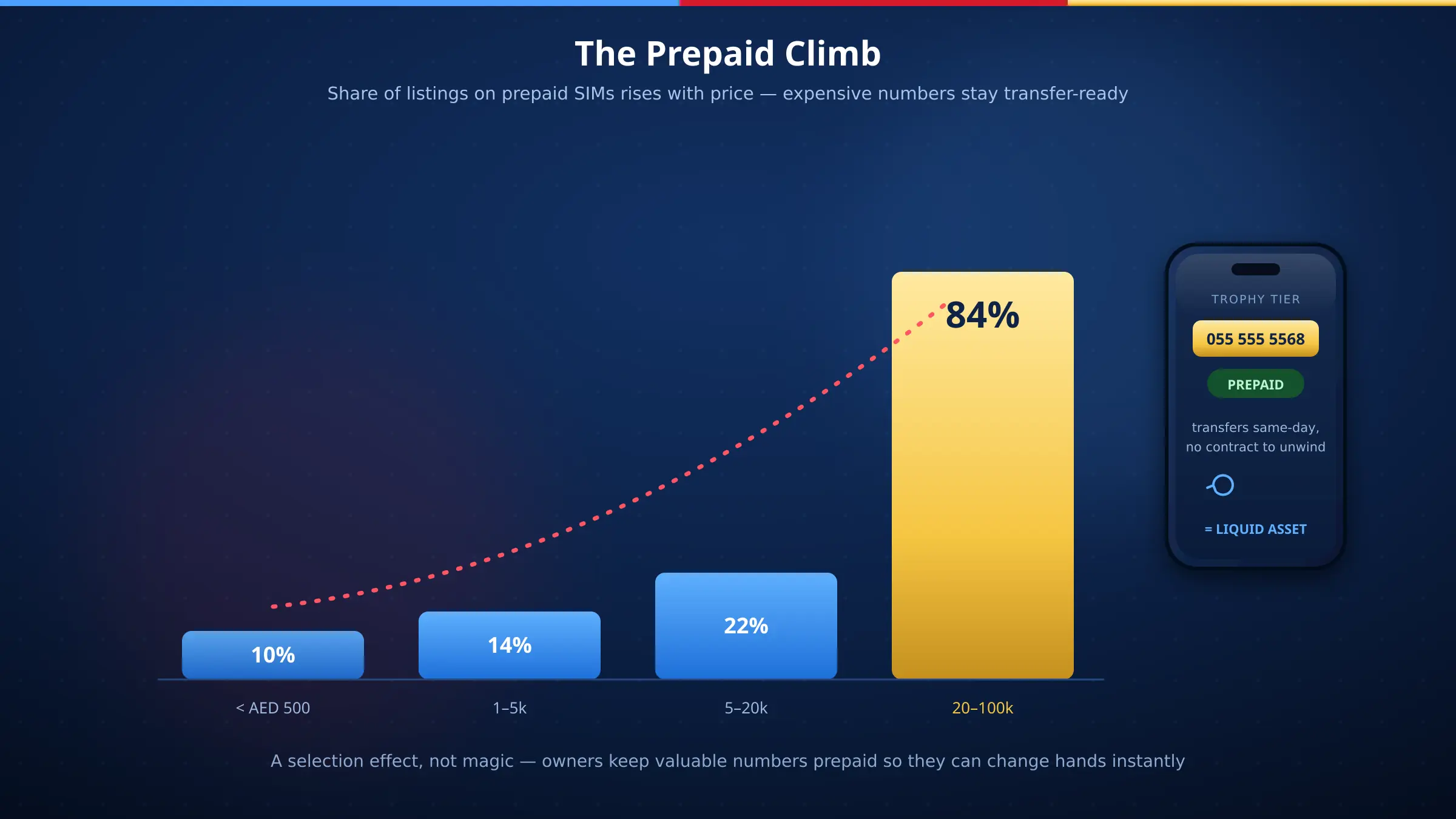
Only 373 listings cross AED 20,000, averaging AED 40,330 — and the composition of this band tells its own story. 84% of them are prepaid, versus roughly 14% down in the core band. That is not a coincidence; it is the clearest possible confirmation of the prepaid premium selection effect: owners of genuinely valuable numbers keep them on prepaid SIMs precisely because prepaid transfers same-day, with no contract to unwind. At this level the number is an asset, and the plan type is chosen to make it liquid.
What AED 20,000–100,000 buys is a number that is special on two axes at once — a strong pattern and a strong prefix, or a rare structure like a near-complete five-of-a-kind (055 5555 689, AED 12,000 sits just below; the full quints climb into this band and above). Buyers here should read the negotiation guide before making contact; at these sums, the asking price is an opening position, not a fixed one.
AED 100,000+: The Record Tier
At the very top sit just 54 listings, averaging AED 294,963 and running all the way to the site record of AED 1,050,000. This is the tier the headlines come from — six-figure sevens, near-perfect zero runs, the most expensive numbers ever listed. Five of the marketplace’s rare six-deep numbers live up here, and even in this thin air 81% of listings are built around a pattern.
Practically, this tier is a different market: buyers are collectors, corporations, or high-net-worth individuals for whom the number is a statement, and deals almost always route through the site’s Safe Deal verified transfer rather than a quick WhatsApp handshake. If your budget lives here, price is rarely the constraint — finding the specific number is, which is exactly what the Wanted Board exists to solve.
The Pattern Floor: What Money Actually Gates
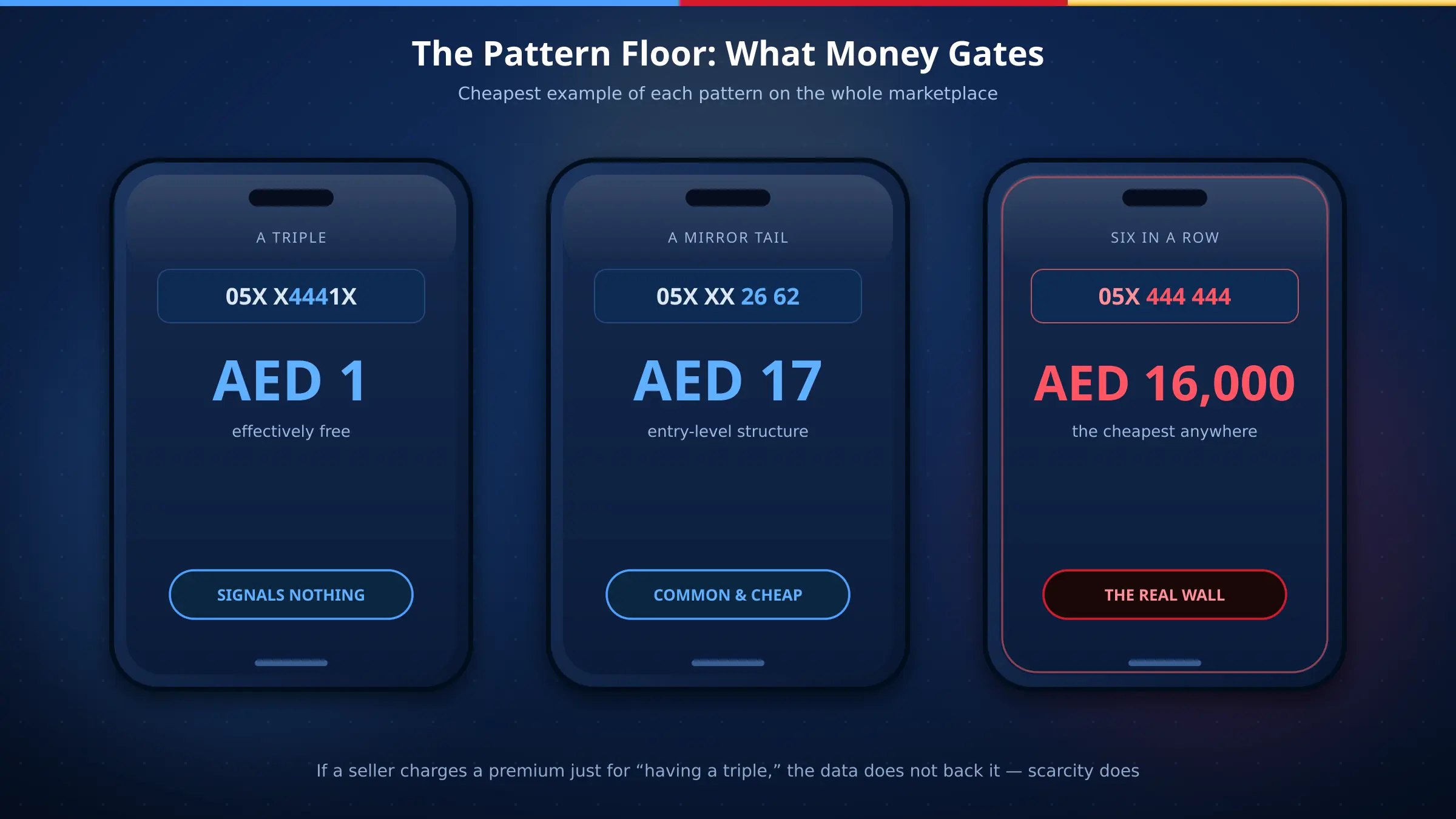
Here is the most useful single insight in this guide. Most patterns are not gated by budget at all:
| Pattern | Cheapest on the marketplace | What that tells you |
|---|---|---|
| A triple (three-in-a-row) | AED 1 | Effectively free — a triple alone signals almost nothing about price |
| A mirror tail | AED 17 | Structure is common; a plain mirror is entry-level |
| A six-identical-digit run | AED 16,000 | The real wall — genuine scarcity begins here |
The takeaway for buyers: if a seller is charging a premium simply because a number “has a triple” or “has a mirror,” the data does not support it — those structures exist for pocket change. Real budget walls appear only at genuine scarcity: six-deep runs, trophy prefixes, and the specific culturally-loaded families like 786 or high 777 tails. This is the same lesson the digit census reached from the other direction: presence is cheap, concentration is dear.
The Prepaid Climb: Why Expensive Numbers Transfer Same-Day
One statistic threads the whole ladder together. The share of prepaid listings climbs steadily with price:
- Under AED 500: ~10% prepaid
- AED 1,000–5,000: ~14% prepaid
- AED 5,000–20,000: ~22% prepaid
- AED 20,000–100,000: ~84% prepaid
The jump at the trophy threshold is dramatic and deliberate. A cheap number is whatever plan its owner happens to have; an expensive number is a managed asset, and its owner keeps it prepaid so it can change hands the same day without a contract to settle. For a buyer, this is a quiet quality signal: at the top of the market, prepaid is the norm, and a high-value postpaid number that requires settlement is the exception worth asking questions about. The mechanism is explained in full in the prepaid premium study.
How to Stretch Your Budget
- Widen the band, not the pattern. Moving a cap from AED 500 to AED 1,000 roughly doubles your candidate pool; insisting on a specific rare pattern narrows it far faster than money ever will.
- Buy the pattern, skip the prefix. The same triple ending costs a fraction on an ordinary prefix. If the digits matter more than the code, the sub-AED 500 band is full of value — browse the full marketplace with a price filter.
- Don’t pay a premium for a bare pattern. A triple or mirror alone is entry-level; if that is all a number offers, benchmark it against the AED 238 average of the bottom band before agreeing.
- Post what you want. If your exact wish is not listed at your price, the Wanted Board lets you name the budget and let sellers come to you — often cheaper than chasing a premium listing.
- Verify before you value. Run any candidate through the value calculator and confirm it is transfer-ready; a fair price on a number you cannot cleanly transfer is no bargain.
Honest Limits of This Guide
These are asking prices among the 21,549 publicly priced listings, not closed-sale records — every band average reflects what sellers currently ask, and real transactions often close lower after negotiation. The 30.5% of the market listed as POA is excluded entirely, and because hidden prices cluster at the higher end, the true top of the market is slightly thicker than the priced counts alone suggest. Pattern shares count structural presence, not quality or position — a triple in the middle of a number is counted the same as a triple on the tail, though the market prices them very differently. All figures were recomputed against the live database on the date of publication and will drift as inventory turns over; for continuously refreshed headline numbers, the statistics page is the live reference.
Frequently Asked Questions
How much does a VIP mobile number cost in the UAE?
The priced market runs from AED 1 to AED 1,050,000, with a median asking price of AED 4,250 and an average of AED 5,057. About 63% of all priced numbers ask between AED 1,000 and 5,000, so that band is the realistic answer for most buyers.
What is the cheapest VIP number I can buy?
Patterned numbers start under AED 500 — there are 2,838 such listings averaging AED 238, and 46% of them contain a triple. The cheapest mirror-tail number on the marketplace asks just AED 17. You buy the pattern; you do not buy a prestige prefix or position.
What can I buy for AED 1,000 to 5,000?
The market’s core inventory: clean triple endings, tidy mirror tails, and rhythm patterns across every prefix from 050 to 058. This band holds 13,626 listings — 63% of the priced market — averaging AED 3,552. It is where most personal and small-business buyers should focus.
Do you need a big budget to get a patterned number?
No. Triples and mirrors are available for pocket change — the cheapest triple asks AED 1 and the cheapest mirror AED 17. Budget only becomes a real wall at genuine scarcity: no six-identical-digit number on the marketplace is priced below AED 16,000.
Why are the most expensive numbers almost all prepaid?
Because prepaid numbers transfer same-day with no contract to settle. Owners of valuable numbers keep them prepaid to stay liquid, so at the AED 20,000–100,000 level about 84% of listings are prepaid, versus roughly 14% in the core band. It is a selection effect, not magic — prepaid signals a managed asset.
What is the average price of a UAE mobile number?
Among publicly priced listings, the average asking price is AED 5,057 and the median is AED 4,250. The average sits above the median because a small number of six-figure trophy listings pull it upward; the median better reflects what a typical buyer pays.
Is AED 5,000 enough for a good UAE number?
Comfortably. AED 5,000 places you at the top of the market’s largest band and the entry of the serious band, where round 000 tails and premium prefixes begin to concentrate. It buys a genuinely memorable number without crossing into trophy territory.
What does AED 100,000 or more buy?
The record tier — just 54 listings averaging AED 294,963 and running to the AED 1,050,000 site record. These are six-figure sevens, near-perfect zero runs, and rare six-deep numbers, typically bought by collectors or corporations through escrow rather than a quick handshake.
Should I pay more just because a number has a triple?
Not on the triple alone. Triples exist at every price down to AED 1, so a bare triple signals little about value. Pay a premium only when the pattern combines with a strong prefix, a clean tail position, or genuine scarcity like a six-deep run or a culturally significant family.
Where does the price jump the most as budgets rise?
Between the core band and the trophy band. Below AED 20,000 the market is deep and prices rise gradually; above it, inventory thins to 427 listings total and averages leap from about AED 7,800 to AED 40,000 and beyond. The scarcity, not the pattern, drives that jump.
Can I negotiate the asking price?
Yes — asking prices are opening positions, especially above AED 5,000 where each number is unique and comparables are scarce. Closed sales frequently land below the listed figure. The negotiation guide covers how to anchor an offer with family-average comparables.
What if the number I want is not listed at my budget?
Post a buyer request on the Wanted Board naming your prefix, pattern and budget. Sellers who own a matching number contact you directly — often a cheaper route than paying the premium on a scarce active listing, and the only way to reach numbers held privately and never listed.