




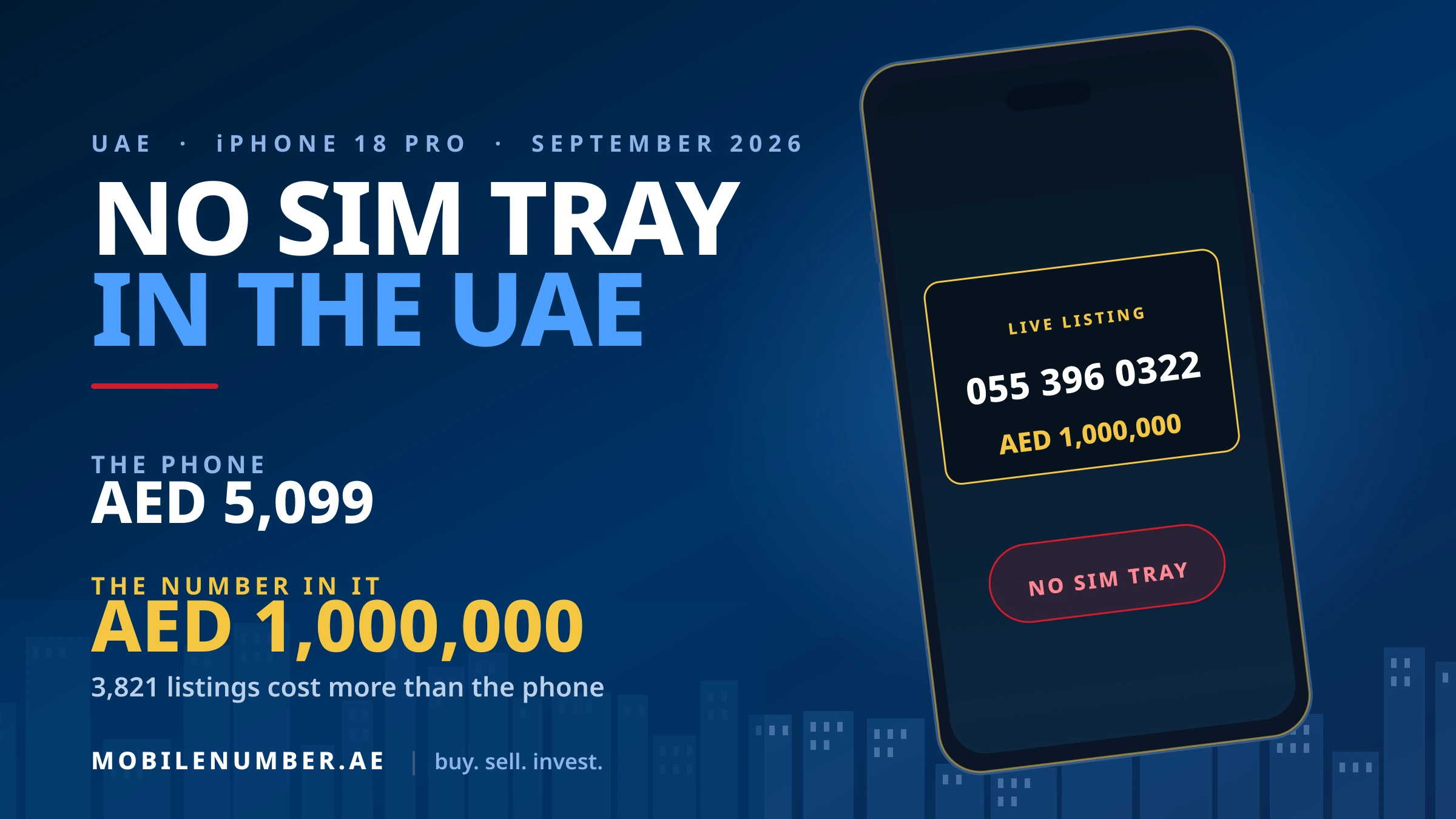
Apple introduced the iPhone 18 Pro and iPhone 18 Pro Max on 9 September 2026. Pre-orders opened on 12 September, and the phones reach shops on 18 September. In the UAE they start at AED 5,099 and AED 5,499.
Almost every write-up so far has covered the A20 Pro chip, the variable-aperture camera and the redesigned Dynamic Island. One change matters far more if you own a premium number, and it is not a feature at all: the UAE is one of twelve markets where these phones arrive with no SIM tray. Not eSIM-preferred. eSIM-only, physically.
That single omission changes how a number is handed over, introduces a way to be defrauded that did not exist last week, and invites a comparison nobody on this marketplace has made out loud: the phone costs AED 5,099, and 3,821 of the numbers listed here cost more than that. Every marketplace figure below was counted on the day of publication.
TL;DR — the short version
- No SIM tray in the UAE. Apple lists twelve eSIM-only markets for the iPhone 18 Pro and Pro Max — and that list includes all six GCC states. Europe and the UK keep the tray.
- The UAE gets the longer-lasting phone because of it. Apple quotes up to 36 hours of video playback on the 18 Pro and 45 hours on the Pro Max here; the tray models quoted elsewhere are 34 and 43.
- Two lines can be active at once. Apple's UAE specifications say "Dual eSIM (two active eSIMs; stores eight or more eSIMs)". Your premium number and your work number fit in one phone.
- ⚠ "I'll transfer the eSIM to you" is not a sale. Apple's eSIM Quick Transfer moves a line between two phones without involving the operator. The registered owner does not change. Anyone who accepts that instead of a carrier-store transfer has paid for a number that is still in someone else's name.
- 3,821 listings — 10.7% of the 35,832 that publish a price — ask more than an iPhone 18 Pro. The most expensive asks AED 1,050,000, which is 206 phones.
- Split by seller, the picture inverts: our own inventory has a median asking price of AED 4,250, just under the phone. Independent sellers sit at AED 325 — about a sixteenth of it.
What Apple actually changed for the UAE
Apple has shipped eSIM-only iPhones in the United States since the iPhone 14. What is new is how far that list now reaches. For the iPhone 18 Pro and Pro Max, Apple names twelve countries and regions where the phone has no SIM tray at all:
| eSIM-only for iPhone 18 Pro / Pro Max |
|---|
| Bahrain, Canada, Guam, Japan, Kuwait, Mexico, Oman, Qatar, Saudi Arabia, United Arab Emirates, United States, U.S. Virgin Islands |
Read that list again and the pattern is regional: every GCC state is on it. Bahrain, Kuwait, Oman, Qatar, Saudi Arabia and the UAE all lose the tray in the same generation. Everywhere else — including the UK and the rest of Europe — the iPhone 18 Pro still has one, exactly as the 17 Pro did.
For a UAE buyer this is not a setting you can opt out of. There is no tray model sold here. If you walk out of a shop on 18 September with an iPhone 18 Pro, your number has to arrive on it as an eSIM or it does not arrive at all.
The UAE gets the bigger battery — because the tray is gone
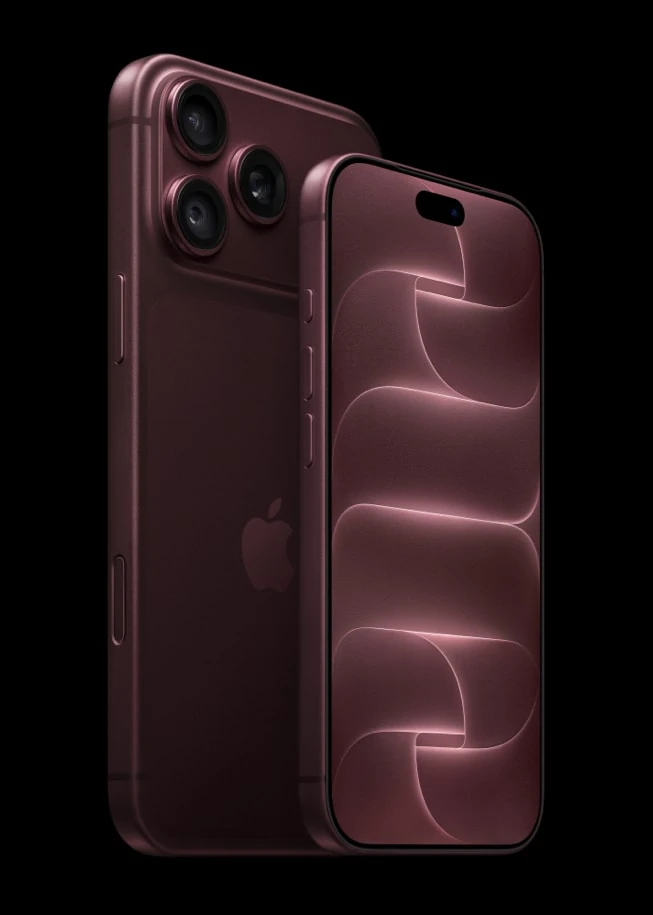
Removing the tray frees internal volume, and Apple spends it on the cell. That produces the small oddity that the UAE specification sheet quotes better battery figures than the European one for the same model name:
| Video playback, Apple's own figures | iPhone 18 Pro | iPhone 18 Pro Max |
|---|---|---|
| eSIM-only (UAE, GCC, US, Canada, Japan …) | up to 36 h | up to 45 h |
| With SIM tray (UK, Europe …) | up to 34 h | up to 43 h |
| Streamed video, eSIM-only | up to 33 h | up to 40 h |
Two hours is not a reason to buy a phone. It is worth stating plainly because the two sets of numbers are circulating side by side and being compared as if they described the same device. They do not. If you are reading a European review of the iPhone 18 Pro, its battery section is describing a phone that is not sold here.
Two active eSIMs: your premium number and your work number
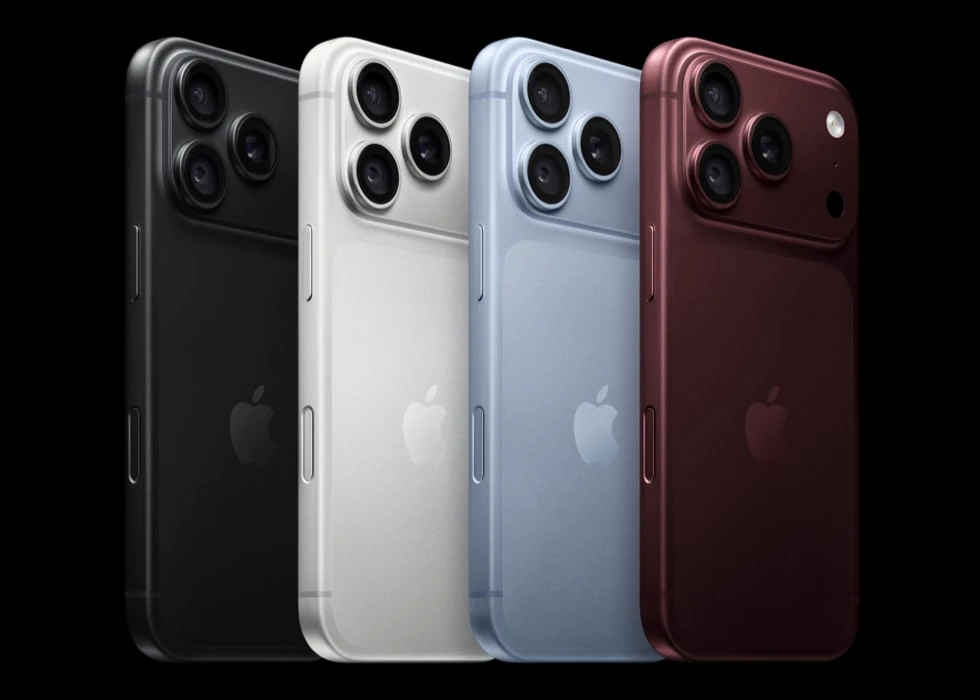
Apple's UAE specification page states it directly: "Dual eSIM (two active eSIMs; stores eight or more eSIMs)". Both lines ring. Both can send and receive messages. You choose which one carries mobile data, and that choice is one line at a time — a limitation of how phones handle data, not of eSIM.
This matters for a specific and common situation on this marketplace. People buy a premium number as the number they hand out — the one on the car, the sign, the business card — while keeping an older line for banking apps, government accounts and the dozens of services that were registered to it years ago. Until now that meant two phones or a tray plus an eSIM. On an iPhone 18 Pro it is two profiles in one device.
Whether a given operator will provision a second eSIM on your account is a question for that operator, and the answer has changed more than once. Apple states that eSIM is supported by more than 500 carriers worldwide, naming e& and du among them. Virgin Mobile documents eSIM support for iPhone XS and later on its own help pages. Before you plan around two lines, confirm the second profile with your operator rather than with a specification sheet.
The mechanics of getting a premium number onto an eSIM in the first place — per operator, step by step — are covered in our eSIM and VIP numbers guide. Nothing about that process changed this week. What changed is that it is no longer optional.
What this changes when a number changes hands
Until this month a private handover in the UAE had a physical object in it. The seller put a SIM card on the table. Whatever else was unclear, both sides could see the thing that was being sold. That object is gone, and it was doing more work than anyone noticed.
Three practical consequences follow.
There is nothing to hand over. A number now moves as a QR code or an in-app activation issued by the operator to a named account holder. It cannot be passed across a table, and it cannot be posted. Any seller offering to courier you a SIM for an iPhone 18 Pro is describing a transaction that cannot complete on that phone.
The operator is now unavoidable. That is an improvement. The ownership transfer was always the step that actually moved the asset; the SIM card merely made it feel optional. With no card to swap, the only path from seller to buyer runs through a carrier store with both parties and both Emirates IDs present — which is exactly the path the TDRA framework expects.
The timing changes. A card could be handed over and activated later. An eSIM is issued to a device. If you are buying a number and collecting a new iPhone in the same week, do the transfer first and the activation second, or you will be issued a profile for a phone you no longer intend to use.
"I will transfer the eSIM to you" is not a sale
This is the part of the change that will cost somebody money, and it deserves its own section.
iPhones have a feature called eSIM Quick Transfer. On a new phone you open the cellular settings, choose to transfer a line from a nearby iPhone, confirm on both devices, and the line moves. The operator is not involved and the account holder does not change. It is designed for one person replacing their own handset.
Put that feature in a private sale and you have a new failure mode. A seller can move a working line onto a buyer's brand-new iPhone 18 Pro in under a minute. The buyer sees their number arrive, makes calls, receives messages — and owns nothing. The line is still registered to the seller. The seller can suspend it, report it lost, or transfer it away again, and the operator will act on their instruction because the operator has no record of any sale.
| eSIM Quick Transfer | Carrier ownership transfer | |
|---|---|---|
| Who performs it | The two phone owners | The operator, in store |
| Operator involved | No | Yes |
| Registered owner afterwards | Unchanged — still the seller | The buyer |
| Time it takes | Under a minute | Typically 30–90 minutes |
| Can the other side reverse it | Yes | No |
| Suitable for a purchase | No | Yes |
The defence is the same one that has always applied, and it now has to be stated out loud because the shortcut looks so convincing: money moves when the operator confirms the registration is in the buyer's name. Not when the number rings. Our scam-protection guide covers the other patterns; this one is new as of this week. MobileNumber.ae never holds either side's money — the Verified Transfer checklist exists to sequence the store visit, not to sit in the middle of the payment.
The phone costs AED 5,099. Here is what the numbers in it cost.
An iPhone 18 Pro starts at AED 5,099 in the UAE and the Pro Max at AED 5,499. Those are useful reference points because most people have just decided whether that is a lot of money. Against that yardstick, here is the live inventory of this marketplace — 45,292 active listings, of which 35,832 publish a price.
| Live listings measured against the phone | Count |
|---|---|
| Ask more than an iPhone 18 Pro (AED 5,099) | 3,821 (10.7% of priced listings) |
| Ask more than an iPhone 18 Pro Max (AED 5,499) | 3,818 |
| Ask between the two phone prices | 3 |
| Ask less than an iPhone 18 Pro | 32,011 |
| Ask AED 100,000 or more | 67 |
| Ask AED 500,000 or more | 10 |
| Highest asking price on the marketplace | AED 1,050,000 — 206 phones |
Only 3 listings in the entire inventory fall between AED 5,099 and AED 5,499. Asking prices cluster on round figures, so the two phone prices sit inside the same gap in the distribution — which is a reminder that these brackets are a narrative device, not a market structure.
⛔ A single median across that inventory would be a fabrication, because two very different groups of sellers are in it. Split properly:
| Who is selling | Priced listings | Median asking price | Above AED 5,099 |
|---|---|---|---|
| MobileNumber.ae's own inventory | 21,354 | AED 4,250 | 3,610 (16.9%) |
| Independent sellers (197 of them) | 14,478 | AED 325 | 211 (1.5%) |
The two lines tell opposite stories and both are true. Our own median of AED 4,250 sits AED 849 below the price of the phone — close enough that for a large share of buyers the number and the handset are the same order of purchase. The independent median of AED 325 is about a sixteenth of the phone: for most private sellers the number is a rounding error next to the device it goes into.
What survives from both columns is the shape of the market rather than a single headline. Premium numbers are not uniformly expensive. A small, well-defined minority costs more than a flagship phone, and the ordinary majority does not come close.
Where the comparison breaks down
Three caveats, because the tables above are more quotable than they are precise.
These are asking prices, not sale prices. They are what sellers are requesting today. A number listed at AED 1,050,000 has not sold for AED 1,050,000; it has been offered at it. We publish what is asked because that is what we can see, and we do not publish claimed sale figures at all.
A phone depreciates and a number does not, so the comparison is unfair in both directions. The iPhone 18 Pro will be worth a fraction of AED 5,099 in three years. Whether a premium number holds its asking price over the same period is a separate question with far less evidence behind it than the investment articles suggest — we went through what the data does and does not support in our look at premium numbers as an investment.
9,460 of the 45,292 active listings publish no price at all. Everything above is measured on the 35,832 that do, and sellers who withhold a figure are not a random sample of the market.
Before you upgrade: four things worth doing first
- Convert the number you intend to keep, before collection day. Moving a line to eSIM is free and takes minutes at any operator, and doing it on your current phone means the new one is a restore rather than a rescue. The per-operator steps are in the eSIM guide.
- Write down which line carries your bank. With two active eSIMs it is easy to end up with your one-time codes arriving on the line you hand out publicly. UAE banks have been retiring SMS codes, and what replaced them is tied to a specific number and device.
- Check what is still registered to an old line before you let it lapse. The list is longer than people expect — we counted twelve account types that commonly survive a handset change unnoticed.
- If the number is going to a family member, use the family route. It is a different counter and different paperwork from a sale — the process is here.
If you are buying or selling a number this week
The launch window creates a short, predictable pattern. People collect a phone, discover there is no tray, and go looking for an answer on the same day. If you are on either side of a number sale between now and the end of September, three things are worth knowing.
Sellers: expect buyers to ask whether the number works on an eSIM-only phone. The answer is yes, for every number on every UAE operator — the number is not the SIM. Saying so plainly will save you a conversation. What you must not offer, however convenient it sounds, is to Quick Transfer the line instead of attending the store.
Buyers: the phone is the easy purchase. Decide the number first, because the number outlasts it. If you are still choosing, the value calculator gives you a reference figure before you negotiate, and the pattern families are laid out in our patterns guide.
Either way: the operator counter is now the only place a sale completes. Bring both Emirates IDs, settle the payment against the operator's confirmation and not against a ringing phone.
Browsing by operator is the fastest way to see what a given eSIM account can hold: Etisalat numbers (44,121 listings), du numbers (1,162), Virgin Mobile numbers (9). By prefix, the shared 058 range carries 338 listings across du and Virgin. Or start from VIP numbers and premium numbers if the budget is already set.
Frequently asked questions
Does the iPhone 18 Pro have a SIM tray in the UAE?
No. The UAE is one of twelve markets where Apple ships the iPhone 18 Pro and iPhone 18 Pro Max with no SIM tray at all. The phone takes eSIM only and is not compatible with physical SIM cards. Models sold in the UK and Europe do still have a tray, which is why some reviews describe a phone that is not on sale here.
Will my existing UAE mobile number work on an iPhone 18 Pro?
Yes. The number is not the SIM card. Any number on Etisalat, du or Virgin Mobile can be issued as an eSIM profile, and moving it is free. Do it before you set up the new phone rather than after.
Can I put my VIP number and my work number on the same iPhone 18 Pro?
The phone supports it. Apple's UAE specifications state dual eSIM with two active profiles and storage for eight or more. Both lines ring and both handle messages; one line at a time carries mobile data. Whether your operator will provision a second profile on your account is worth confirming with them directly.
Is it safe to buy a number if the seller just transfers the eSIM to my phone?
No. eSIM Quick Transfer moves a line between two phones without involving the operator, and it does not change the registered owner. The number would still be in the seller's name, and they could suspend or move it afterwards. A purchase is only complete when the operator has re-registered the number to you.
How do I transfer ownership of a number now that there is no SIM card?
The same way as before, minus the card. Buyer and seller attend an operator store together with original Emirates IDs, the operator re-registers the number, and the buyer is then issued an eSIM profile for their own device. A properly documented transfer is typically processed in 30 to 90 minutes.
How much does the iPhone 18 Pro cost in the UAE?
It starts at AED 5,099 for the iPhone 18 Pro and AED 5,499 for the iPhone 18 Pro Max, with storage from 256GB up to 2TB. Pre-orders opened on 12 September 2026 and the phones went on sale on 18 September.
How many mobile numbers cost more than an iPhone 18 Pro?
On this marketplace, 3,821 of the 35,832 listings that publish a price ask more than AED 5,099 — about 10.7%. The highest asking price is AED 1,050,000, which is 206 times the price of the phone.
Why does the UAE model have better battery life than the European one?
Because there is no SIM tray to accommodate, which leaves room for a larger cell. Apple quotes up to 36 hours of video playback for the eSIM-only iPhone 18 Pro and 45 hours for the Pro Max, against 34 and 43 hours for the versions that keep the tray.
Do Etisalat, du and Virgin Mobile all support eSIM?
Apple states that eSIM is supported by more than 500 carriers worldwide and names e& and du among them. Virgin Mobile documents eSIM support for iPhone XS and later on its own help pages. Since the UAE phone has no alternative, confirm activation with your own operator before collection day.
Is a premium number a better buy than the phone it goes into?
They are not the same kind of purchase. The phone loses value over three years; the number does not depreciate in the same way, but neither does it have a documented resale record on this marketplace. Our figures are asking prices, and we do not publish claimed sale prices.
What is the median price of a UAE premium number?
There is no single honest answer, because two different groups sell here. Across MobileNumber.ae's own 21,354 priced listings the median asking price is AED 4,250. Across the 14,478 listings from 197 independent sellers it is AED 325. Quoting one number for the whole market would mix the two.
Does MobileNumber.ae hold the money until the transfer completes?
No. We do not hold funds at any point — holding customer money in the UAE requires a licence we do not claim to have. Payment is settled directly between buyer and seller, and the Verified Transfer checklist exists to sequence the operator visit so that the money moves against the operator's confirmation.
Can I still buy an iPhone 18 Pro with a SIM tray and import it?
Tray models exist in other markets, but a phone bought abroad carries that market's warranty and support terms, and eSIM remains the only path an unlocked handset needs in the UAE anyway. There is no UAE number that requires a physical card.
Which prefix should I choose if I am buying a number for a new phone?
The prefix does not affect eSIM at all — it is a price and perception decision. The 050 range is the oldest and deepest, 055 the scarcest on du, and 058 is the only prefix shared between two operators. Our patterns guide covers what actually moves the price.
Method, and what these figures do not show
Apple's specifications, the eSIM-only market list and the UAE prices come from Apple's own UAE pages and from Apple's launch announcement of 9 September 2026. Where press figures and Apple's UAE page disagreed — as they did on battery life — we used Apple's UAE page, because that is the phone sold here.
The marketplace figures were counted on the day of publication across 45,292 active listings. Price statistics use only the 35,832 listings that publish a figure and are always split between MobileNumber.ae's own inventory and independent sellers, because our own listings are the larger group and an unsegmented median would describe neither. Counts of listings above a price threshold include both groups.
What these figures cannot tell you: what any number sold for, how long a listing takes to sell, or whether today's asking prices will hold. We have no completed-sale dataset worth publishing, and we would rather say so than model one.
Apple product images in this article are Apple's own and are reproduced unmodified.