





What Is a VIP Restaurant Number?
A VIP restaurant number is a premium, easy-to-remember UAE mobile number used to take direct orders, reservations and WhatsApp messages. It is a marketing asset, not just a line: a number like a clean repeater or a round ending sticks in a customer's memory, so they call you instead of opening a delivery app. The same SIM works for everyone — the value is recall and trust.
This matters in one of the world's busiest food markets. The UAE food-delivery sector reached roughly USD 10.86 billion in 2026, smartphone penetration sits near 97.6%, and diners order around 3.2 times a week. In that environment, the restaurants that win are the ones customers can reach without a middleman.
Why Your Phone Number Is a Margin Tool
For a restaurant, the phone number is a margin tool disguised as contact info. Every order placed through a delivery aggregator carries a commission; every order placed directly does not. Because UAE diners order so frequently, the channel a customer uses on their first order tends to become a habit — and habits decide your long-term margin.
The strategic problem with aggregators is ownership. When a customer orders through an app, the app owns the relationship: the phone number, the order history and the marketing permission all sit with the platform, not the kitchen. A memorable direct-order number flips that. It turns a delivery-app discovery into a relationship you control. For the wider case on why a number is a business asset, see our guide to business mobile numbers in the UAE.
Consider the asymmetry. A delivery app can raise your commission, place a competitor's promotion beside your listing, or bury you in search the moment you stop paying for visibility. None of that touches a customer who has your number saved. The aggregator is a strong acquisition channel — useful for discovery — but a costly place to keep customers you have already won. The smart play is to use the apps to get found, then move repeat diners onto a number you own.
The cheapest customer you will ever serve is the one who already has your number saved. The most expensive is the one who only finds you through an app that charges you to reach them.
The Commission Math: Apps vs Direct
Aggregator commission is the single biggest controllable cost in delivery. In the UAE, platforms typically charge 15–30% per order, with most standard partners paying 25–30% once delivery, platform and payment fees are combined. On thin food margins, that is often the difference between profit and loss on a delivery order.
| Factor | Order via aggregator | Direct order (your number) |
|---|---|---|
| Commission per order | ~25–30% | 0% |
| Who owns the customer data | The platform | You |
| Repeat-order marketing | Platform decides | You message directly |
| Brand on the order | App brand first | Your brand only |
| Discounting pressure | High (app promos) | You set the offer |
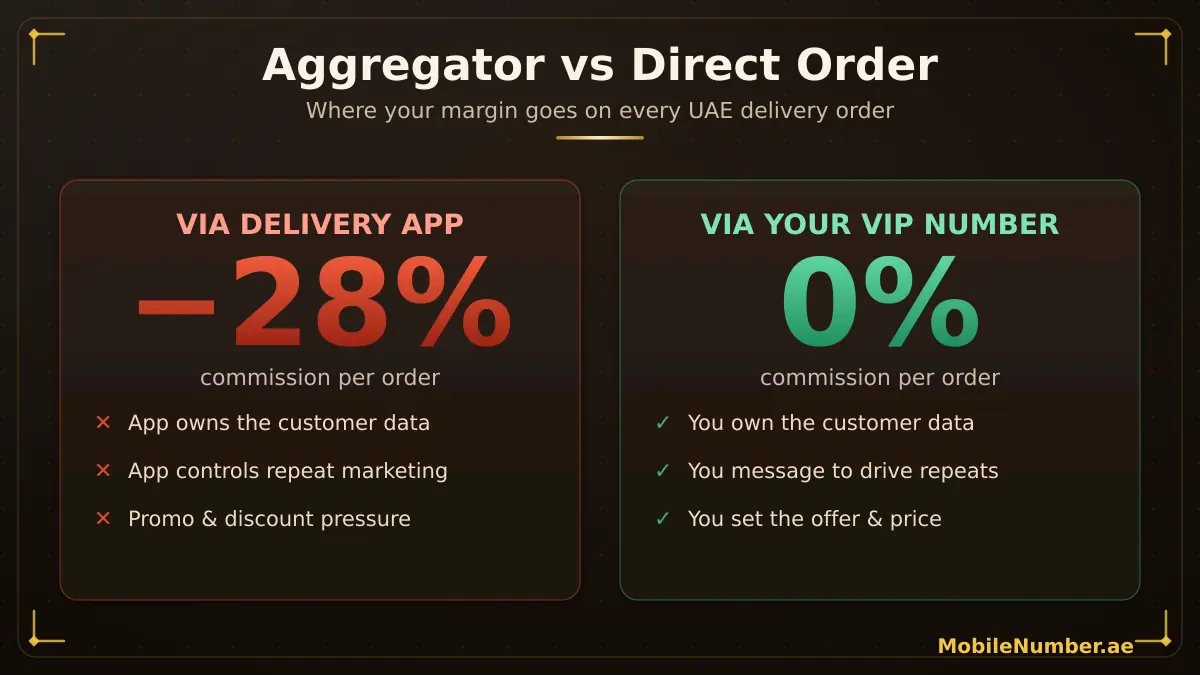
Take a kitchen doing 40 delivery orders a day at an average AED 60 ticket and a 28% commission. That is roughly AED 672 a day, or about AED 20,000 a month, paid to the platform. Shifting even one in five of those orders to a direct number saves around AED 4,000 a month — many times the cost of a premium number, every month.
Direct Orders and WhatsApp: Owning the Customer
WhatsApp is the engine that makes a direct number pay. UAE customers already live in WhatsApp, so a memorable number doubles as your ordering channel: menu, order, payment link and reorder, all in one chat. Once a customer saves the number, reordering is a two-tap habit that costs you nothing.
The data backs the model. Around 81% of consumers say they would join a restaurant loyalty programme, and loyalty members visit roughly 20% more often. A direct number is the foundation of that loyalty layer — you cannot run your own retention programme on customers an app refuses to let you contact. For the channel mechanics, see our WhatsApp Business number guide.
A direct number also unlocks marketing the apps will never give you. With permission, you can send a quiet "your usual?" on a slow Tuesday, a Friday-brunch offer, or a birthday voucher — messages that land in the channel UAE diners check most. Each one costs almost nothing and reaches a customer who already chose you. Over a year, that owned audience becomes a more reliable revenue line than any promotion you rent on a platform.
Turning a first app order into a direct regular
The highest-return move is converting app customers you have already paid for. Drop a small printed card in every delivery bag: "Order direct on WhatsApp — same price, faster, and you help us skip the apps." Add a modest first-direct-order incentive, like a free drink. You pay the commission once on the discovery order, then keep every order after it. With UAE diners ordering about 3.2 times a week, a single conversion can save dozens of commissions a year.
What Makes a Great Restaurant Number
A great restaurant number is short to say, easy to picture, and hard to forget. Recall beats prestige here: the goal is a number a customer can dial from memory after seeing it once on a bag or a receipt. The strongest patterns are the ones the brain stores as a single chunk, not ten separate digits.
- Repeaters — endings like 8000, 7777 or 1000 read as one block.
- Round endings — numbers ending in 000 or 500 feel "clean" and stick.
- Mirror and sequence — patterns like 4321 or 1221 are visually memorable.
- Brand-fit digits — a lucky digit that matches your audience adds appeal.
There is a simple psychology behind this. The brain remembers numbers in chunks, not as ten separate digits, so a number that compresses into two or three blocks — a prefix, then a clean repeater — is far easier to store than a random string. A number you can say as "double-seven, triple-zero" will out-perform a cheaper number that has to be read digit by digit. Recall, not rarity, is the return on investment for a restaurant.
For the full breakdown of which patterns hold value, read our guide to the best mobile number patterns. Recall is the metric that matters; choose the pattern your customers will remember, then test it on real people before you buy.
Where the Number Works for Your Brand
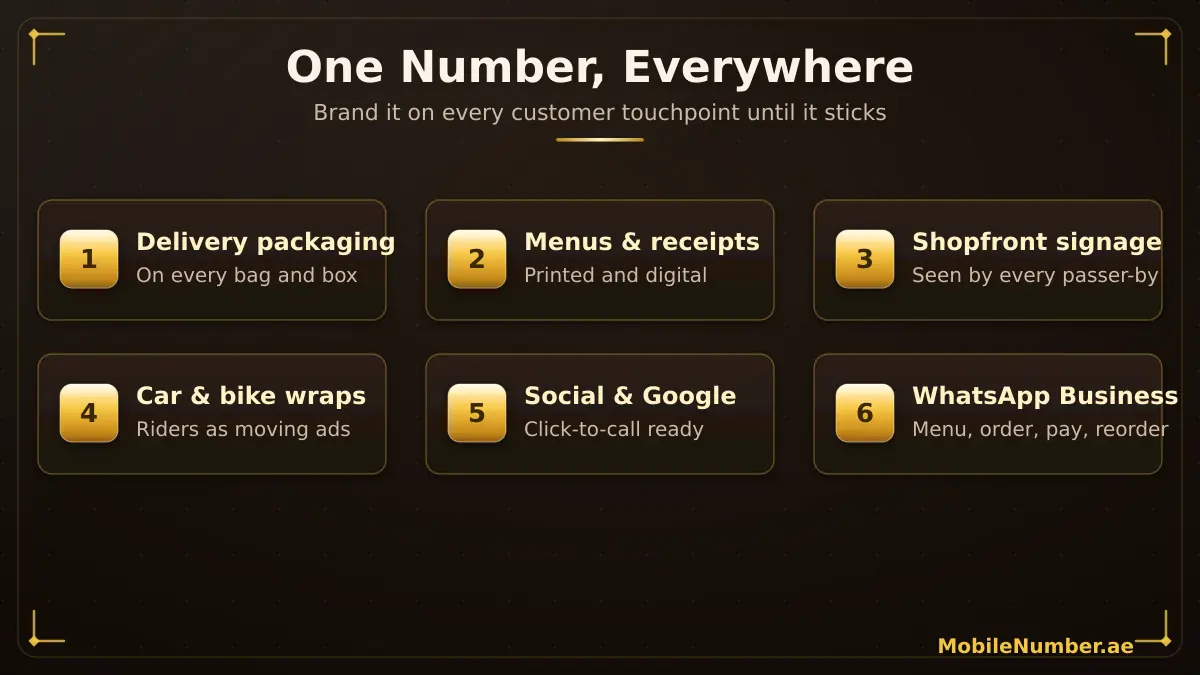
A VIP number only pays back when it is visible everywhere a customer meets your brand. Treat it as a logo: one number, printed consistently across every touchpoint, until it becomes part of how people think of you.
- Delivery packaging — bags, boxes and stickers seen at the moment of eating.
- Menus and receipts — printed and digital, with a "order direct" line.
- Shopfront and signage — visible to every passer-by.
- Car and bike wraps — your own delivery riders as moving billboards.
- Social bios and Google profile — the click-to-call number.
What a VIP Restaurant Number Costs
Price depends on how clean and memorable the pattern is. For a restaurant, the right lens is payback, not prestige — a mid-tier memorable number usually pays for itself within weeks of commission saved. The ranges below reflect typical UAE marketplace listings in 2026 and are guidance, not quotes.
| Number type | Example pattern | Indicative price (AED) |
|---|---|---|
| Lightly memorable | one repeated pair | 1,000 – 3,000 |
| Strong recall | round 000 / 500 ending | 3,000 – 10,000 |
| Premium repeater | clean 7000 / 8000 ending | 10,000 – 40,000 |
| Trophy / flagship | quad-repeat ending | 50,000+ |
Think of it as a one-time media buy that never expires. A printed billboard or an app promotion stops working the day you stop paying; a memorable number you own keeps earning every time a customer dials it, for as long as you trade. Judged that way, even a premium repeater is cheap per year of use. To benchmark against real figures, check our UAE number valuation guide and the latest market prices.
How to Choose and Buy a Restaurant Number
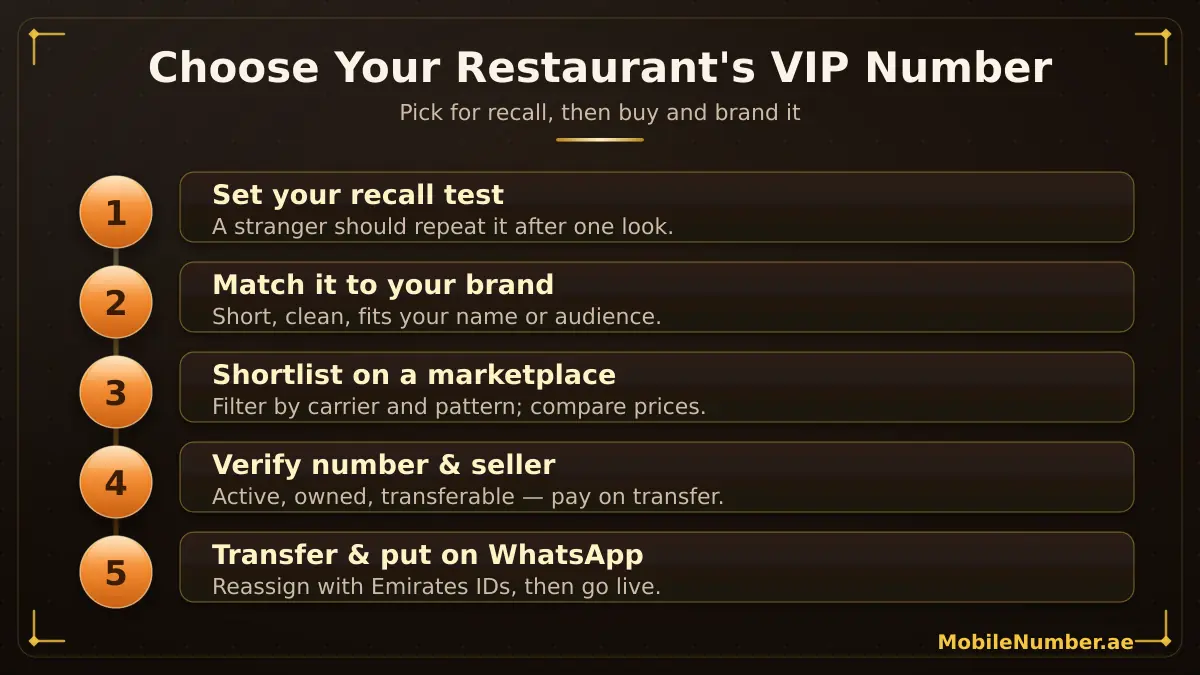
Buying a restaurant number follows the standard UAE transfer process. The skill is in the choosing; the paperwork is routine.
- Set your recall test. Pick a number a stranger can repeat after seeing it once — say it aloud and test it on staff.
- Match it to your brand. Favour a pattern that fits your name or audience; keep it short and clean.
- Shortlist on a trusted marketplace. Filter by carrier and pattern, and compare prices against realistic ranges.
- Verify the number and seller. Confirm it is active and genuinely owned; never pay in full before transfer is arranged.
For the complete buyer process and scam-avoidance, see our how to buy a VIP mobile number guide.
Single Number vs Multi-Branch Strategy
One brand should have one hero number. For multi-branch operators, the cleanest model is a single memorable number for orders, routed or triaged behind the scenes, so customers only ever learn one number. A single, well-branded line concentrates recall instead of splitting it across locations.
If branches must have their own lines for operations, keep them in a tidy family — consecutive or matching endings — so the brand still reads as one. Restaurants that work with a sales or delivery field team can borrow the same logic used by property agents in our real estate VIP numbers guide and our guide for car dealers.
Common Mistakes Restaurants Make
Most restaurants underuse their number rather than overspend on it. The classic errors are avoidable.
Changing the number after customers learn it; printing it inconsistently across channels; choosing a hard-to-say "deal" number over a memorable one; and relying only on apps so the platform — not you — owns every customer you paid commission to win.
The fix is discipline: pick one strong number, brand it everywhere, push direct ordering on every order, and never change it. Recall is an asset you build once and keep.
Frequently Asked Questions
Why does a restaurant need a VIP mobile number?
A VIP number is easy to remember, so customers order directly instead of through a delivery app. That saves the 25–30% aggregator commission, builds repeat business, and gives the restaurant ownership of the customer relationship and data. It is a marketing asset, not just a contact line.
How much commission do UAE delivery apps charge?
UAE food-delivery platforms typically charge 15–30% per order, with most standard restaurant partners paying 25–30% once delivery, platform and payment fees are combined. On thin food margins, this is often the largest single controllable cost on a delivery order.
How much does a VIP restaurant number cost in the UAE?
It depends on the pattern. A lightly memorable number can start around AED 1,000–3,000, a strong round-ending number runs AED 3,000–10,000, and premium repeaters reach AED 10,000–40,000 or more. For a busy kitchen, a mid-tier number often pays for itself within weeks of saved commission.
What makes a phone number memorable for a restaurant?
Short, chunked patterns are easiest to recall — repeaters like 7000 or 8000, round endings in 000 or 500, and simple sequences or mirrors. The test is whether a customer can repeat the number after seeing it once on a bag or receipt.
Can I use a VIP number with WhatsApp Business?
Yes. A VIP number works with WhatsApp Business, which is the ideal direct-order channel in the UAE. Customers can browse the menu, order, pay by link and reorder in one chat, and the saved number makes reordering a two-tap habit.
Is buying a premium number worth it for a small cafe?
Often yes, because the payback scales with order volume, not restaurant size. Even a small cafe doing steady delivery saves meaningful commission by shifting repeat customers to direct orders. Start with an affordable, highly memorable number rather than an expensive trophy one.
Should each branch have its own number?
Usually no. One brand should have one hero number so recall is concentrated, with calls routed behind the scenes. If branches need their own lines for operations, keep them as a matching family of endings so the brand still reads as one number.
How do I transfer a VIP number to my restaurant's name?
Both buyer and seller visit the carrier — Etisalat, du, Virgin Mobile — with valid Emirates IDs to reassign ownership under TDRA rules. Agree the price and terms in writing first, and only release full payment once the carrier transfer is arranged.
Do delivery apps still matter if I have a direct number?
Yes. Aggregators remain the best discovery channel for reaching new customers, so most restaurants keep them. The goal is not to abandon the apps but to convert the customers they bring into direct, repeat orders — using the apps to be found and your VIP number to retain.
Final Verdict
For a UAE restaurant, a VIP mobile number is one of the cheapest growth tools available — a memorable line that quietly moves orders off high-commission apps and into a relationship you own. The math is simple: diners here order constantly, aggregators take a quarter to a third of each order, and a number customers remember turns that leak into retained margin. Choose for recall, brand it on every bag and screen, push direct ordering relentlessly, and never change it. Start by sizing the opportunity with our UAE number valuation guide, then pick the number your customers will dial from memory.