



Updated April 2026
Sharjah VIP mobile numbers are premium UAE phone numbers featuring memorable digit patterns — repeating digits, sequential runs, mirror sequences, or culturally significant combinations — priced from AED 300 to over AED 500,000 in the secondary market. The 050 prefix commands the highest prestige in Sharjah, and e& stores at City Centre Sharjah, Al Qasba, and Sahara Centre process transfers in 20 to 40 minutes with two original Emirates IDs.
Sharjah is the UAE's cultural capital and third-largest emirate by population — home to nearly 1.94 million residents as of 2026, contributing 7.4% of the country's GDP. It is also where the UAE's most culturally resonant demand for VIP mobile numbers converges: a large South Asian Muslim community that drives year-round 786 demand, a strong Emirati heritage sector, and thousands of industrial and trading businesses in the Hamriyah Free Zone, Sharjah Airport Free Zone, and Sharjah Industrial Area who rely on memorable numbers for client-facing credibility.
Whether you are a Sharjah resident wanting a number that reflects your values and status, a business owner in the emirate's thriving SME sector, or a buyer who recognises that Sharjah's VIP number market remains systematically underpriced compared to Dubai — this guide covers everything. Pricing tiers, prefix hierarchy, Sharjah's unique buyer culture, where to buy, how to transfer, and the content gaps no competitor addresses.
Table of Contents
- Why Sharjah Buys Differently From Dubai
- Where Sharjah’s Money Actually Goes
- 786 in Sharjah: Demand Meets a Fixed Shelf
- Sharjah vs Dubai vs Abu Dhabi: Market Comparison
- Patterns That Suit a Working Line
- Finding Sharjah Stock Worth Buying
- The Counter Visit, From a Sharjah Perspective
- Who Is Buying, and What For
- Numerology in a Majority South Asian Emirate
- Where Sharjah Buyers Get It Wrong
- Selling From Sharjah: Pricing for a Patient Market
- Frequently Asked Questions
Why Sharjah Buys Differently From Dubai
Sharjah has the densest population of small and medium businesses in the country by licence count, and that single fact explains more about its number market than any cultural argument does. The typical buyer here is not an individual acquiring status. It is an owner-operator choosing the number that will be painted on a van, printed on an invoice and answered by whoever is nearest the phone, for the next decade.
That buyer behaves unlike a Dubai buyer in four specific ways:
- The number is a tool, not an asset. It is bought to be used and kept, not held and flipped, which is why so little of Sharjah’s good stock ever comes back to market.
- Readability at speed is the requirement. A customer copying a number off a moving vehicle is the real test, and it favours repetition in the tail over cleverness anywhere else.
- Price discipline is cultural, not circumstantial. Paying visibly over the odds is not admired here, so the market clears in the usable middle rather than at the top.
- 786 is a separate decision entirely. Buyers who want it are not shopping a category; they are looking for one thing and will not substitute.
The general definition of a VIP number — what the patterns are and why they carry value at all — is set out in our Dubai VIP number guide. What follows here is specific to Sharjah.
Where Sharjah’s Money Actually Goes
The national five-tier structure — budget through elite — is explained in full in our Dubai VIP number guide, and it applies unchanged here. There is one catalogue and one asking price per listing; a number does not become cheaper because it is browsed from Al Majaz rather than from Business Bay.
What is specific to Sharjah is where its buyers actually transact, and that is the working middle of the market rather than the top of it. An owner-operator buying a line for a workshop, a clinic or a trading office is solving a commercial problem, not building a collection, and the budget follows the problem.
What the working band buys
- A tail a customer can repeat. Three or four identical digits at the end, or a round ending. This is the whole requirement for most business lines, and it is not expensive.
- A number short enough to say once. If a caller has to ask you to repeat it, the pattern is not doing its job however striking it looks written down.
- Room to be wrong. At this level a buyer who changes their mind has lost very little, which is why the middle of the market moves and the top of it waits.
What the working band does not buy is scarcity. A quadruple repeat, a clean short run, or 786 sitting in the tail all sit above it, because the supply of those is fixed no matter what anyone is willing to pay. The current price bands are counted live on our Sharjah numbers page.
786 in Sharjah: Demand Meets a Fixed Shelf
Every emirate has a pattern its buyers ask for by name. In Sharjah it is 786, the Abjad sum of the Bismillah, and the market that results behaves unlike any other part of the catalogue.
Supply cannot respond to demand. A seven-digit number either contains 786 or it does not. No allocation policy, price rise or marketing campaign creates more of them, and the number of such listings on the marketplace at any moment is small enough to count. That is the defining fact, and it is why the usual advice — wait for a better one — does not apply here.
Position changes everything. 786 sitting in the final four digits is a different product from 786 buried in the middle of a number nobody will read that far into. The price range across live 786 listings is wide for exactly this reason, and buyers who compare only the pattern and not its placement consistently overpay.
Prefix is secondary. Sharjah buyers who want 786 want 786; whether it sits on 050 or 056 is a preference they will trade away to get the placement right. This is the one part of the market where the prefix argument genuinely loses.
The current shelf — how many exist, the spread of asking prices, and the private-seller median — is counted live on our Sharjah numbers page, and every 786 listing on the site, inside Sharjah’s usual price band or well outside it, is on our 786 numbers page.
Sharjah vs Dubai vs Abu Dhabi: Market Comparison
The UAE's three major VIP number markets operate under the same TDRA framework but serve distinct buyer profiles — driving real differences in pricing, liquidity, and preferred digit categories.
"Sharjah is the most undervalued VIP number market in the UAE.
| Factor | Sharjah | Dubai | Abu Dhabi |
|---|---|---|---|
| Population (2026) | ~1.94M | ~3.8M | ~3.8M |
| Dominant prefix | 050 | 050 / 055 | 050 |
| Strongest demand | 786, repeating 7s/9s | All patterns | Repeating 7s, 786 |
| Market liquidity | Medium | Highest | Medium |
| Typical transfer time | 20–40 min | 20–40 min | 20–40 min |
| Primary buyer profile | South Asian expats, Emirati families, industrial SMEs | International expats, global business | Emirati nationals, oil & gas sector |
Population mix. Sharjah's nearly 1.94 million residents are overwhelmingly expatriate — with a South Asian community (Pakistani, Indian, Bangladeshi, Sri Lankan) that is the largest and most concentrated of any UAE emirate. This shapes the number market more directly than any other single factor: 786 numbers in Sharjah generate faster inquiries and higher conversion rates than anywhere else in the UAE.
Conservative market culture. Sharjah is the UAE's most culturally conservative emirate — it is the only emirate that restricts alcohol. This conservatism extends to the VIP number market: buyers here tend to be deliberate, value-motivated, and less subject to the social signalling dynamics that drive rapid price inflation in Dubai's cosmopolitan market. For patient sellers, this means slightly longer hold times. For buyers, it means genuine value.
Cross-emirate commuter demand. A significant proportion of Sharjah residents commute daily to Dubai — the Dubai–Sharjah corridor is one of the world's most congested daily commutes. These residents hold Sharjah addresses but operate professionally in Dubai, and many prefer Dubai-priced-equivalent numbers at Sharjah prices. This creates a persistent buyer pool that is underrepresented in Sharjah's listing data but very real in transaction volumes.
For the detailed Dubai market breakdown, read our Dubai VIP mobile numbers guide. For Abu Dhabi, read our Abu Dhabi VIP mobile numbers guide.
Patterns That Suit a Working Line
Sharjah’s catalogue preferences follow from its buyer: someone who will answer this number in front of customers for years. That rules some categories in and others out.
Repeated tails — the workhorse
Three or four identical digits at the end is the single most useful property a business number can have. It survives being shouted across a workshop, read off a moving vehicle and left on a voicemail. It is also common enough to be affordable, which is why most of Sharjah’s transactions involve one. Browse repeating numbers.
Round endings — the invoice number
A line ending in zeros looks like a company rather than a person, and for a trading office sending invoices across borders that impression is worth more than any pattern intensity.
Sequential runs — for lines customers dial cold
A short ascending or descending run is the easiest thing to dictate over a phone, which matters for businesses whose first contact is a call rather than a click. Browse sequential numbers.
What Sharjah buys less of
Long mixed patterns, numbers whose strength sits in the middle, and anything whose appeal depends on being explained. None of them do the job a working line has to do, and the market prices them accordingly. The one exception is 786, which is not a category at all but a specific requirement — covered earlier in this guide, with the full shelf on our 786 numbers page.
Finding Sharjah Stock Worth Buying
Sharjah buyers are usually looking for one of two very different things, and conflating them is the most common reason a search goes nowhere. One is 786, wanted specifically and not interchangeable with anything else. The other is a usable business line at a sensible price — a clean repeated tail, a round ending, something a customer can read off a van.
They are found in different places on the same national catalogue. Every 786 listing in existence sits on our 786 numbers page, and it is a genuinely small shelf. The working middle of the market is easier: our Sharjah numbers page shows the live catalogue with its current price bands, and cheap numbers narrows it further for buyers who have decided the pattern matters more than the prefix. Nothing about any of these listings is tied to Sharjah — a UAE number carries no emirate marking at all.
The Counter Visit, From a Sharjah Perspective
Sharjah buyers have the shortest journey of any emirate outside Dubai, and that shapes how deals here get done. Local branches cover routine handovers, and a Dubai flagship desk sits 20 to 60 minutes away depending on the hour chosen. The constraint that actually bites is not distance but diaries: both sides must be at the same counter at the same time.
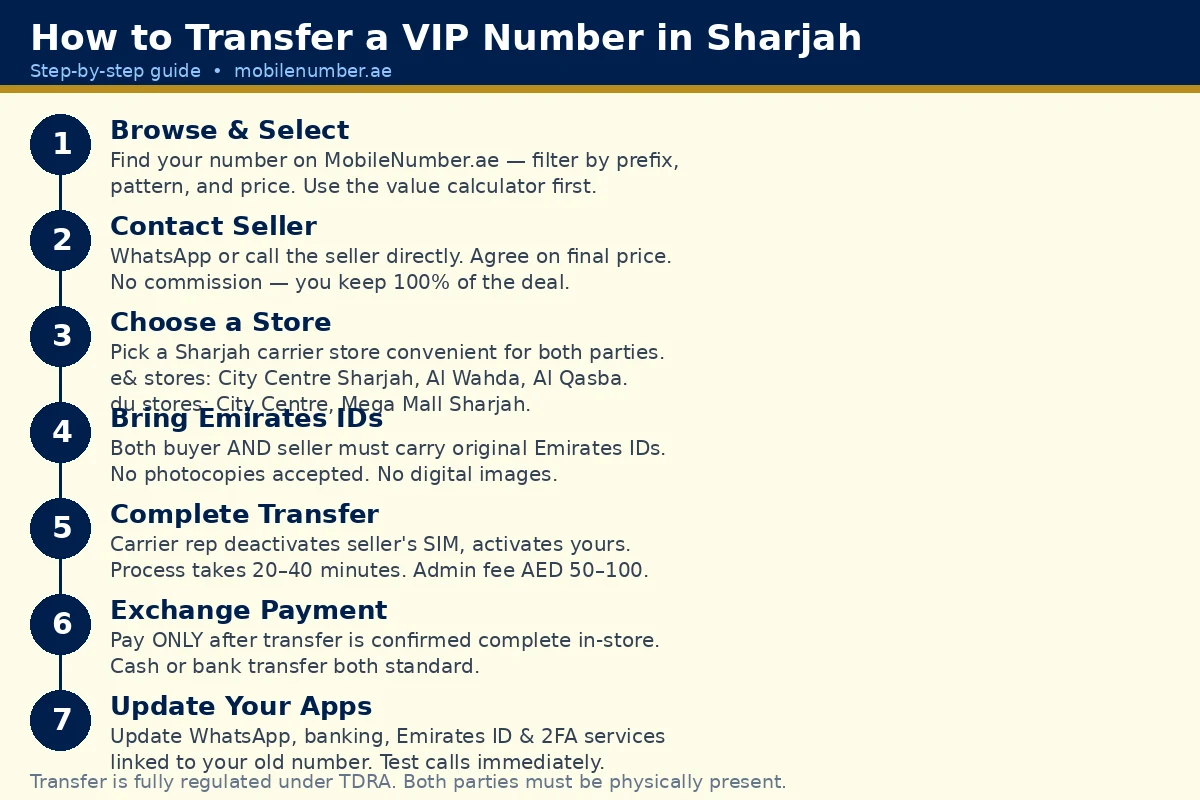
Experienced Sharjah buyers therefore negotiate the meeting before the money. Offering two or three concrete windows up front removes the step that most often stalls a deal, and East Coast buyers in Khor Fakkan, Kalba or Dibba Al-Hisn should say so early, because the mountain drive changes what counts as a convenient hour. Everything that happens at the counter itself is documented in our ownership transfer guide, and porting the line to another carrier afterwards is covered separately in our MNP guide.
Who Is Buying, and What For
Sharjah’s commercial demand comes from a wider base of smaller buyers than the capital’s, and it is concentrated in three areas.
Industry and the free zones
Hamriyah Free Zone and the Sharjah Airport International Free Zone together host thousands of manufacturing, logistics and trading companies, and the industrial corridor running toward Emirates Road houses thousands more. In this environment a number appears on a shipping manifest, a procurement email and the side of a truck, often on the same day. What it has to survive is being copied by someone in a hurry.
Education
Sharjah has the highest concentration of universities in the country, and around them sits an economy of tutoring businesses, educational consultancies and student housing operators. Their marketing is word-of-mouth almost by definition — a number gets passed from one student to another verbally — which puts an unusual premium on a line that can be repeated correctly the first time.
Private healthcare
The emirate’s private clinics and hospitals serve both a large resident population and patients from the northern emirates. A clinic’s number is dialled by people who are anxious and in a hurry, which is the hardest test a phone number faces and the strongest argument for a clean repeated tail.
What none of these sectors is buying is status. The number is infrastructure, and it is priced as infrastructure.
Numerology in a Majority South Asian Emirate
Sharjah’s demographic makeup is unlike the capital’s, and its digit preferences follow from it rather than from any general UAE pattern. Three things stand out.
Nine, and why it is the emirate’s quiet favourite
Nine reads as completeness and fulfilment across Islamic, Hindu and East Asian traditions simultaneously. In an emirate whose largest and most active buyer communities are South Asian, that overlap is not a coincidence — it is the reason nine-heavy numbers find buyers here at every price level rather than only at the top.
Seven, and the combinations it makes
Seven has deep Quranic resonance — seven heavens, the seven verses of Al-Fatiha, the seven circuits of the Kaaba — and Sharjah’s predominantly Muslim population reads it as auspicious without needing it explained. What is specific to this emirate is the combinations: numbers alternating sevens and nines draw interest from Emirati, Pakistani, Indian and Arab buyers at the same time, which is a wider pool than any single-digit preference reaches.
Understatement as a preference in itself
This is the part outsiders miss. Sharjah buyers, consistent with the emirate’s broader cultural posture, tend to prefer a number that reads as considered over one that reads as loud. A clean memorable sequence will find a buyer here faster than a visually complex number at the same price — the opposite of how the top of the Dubai market behaves.
786 is the emirate’s other defining preference, and it is covered earlier in this guide because it behaves like a supply problem rather than a taste.
Where Sharjah Buyers Get It Wrong
Sharjah’s mistakes are different from the capital’s because the buyer is usually spending business money on a working tool rather than personal money on a statement.
Buying a pattern that does not survive being spoken
The commonest and least obvious error. A number can look excellent written in neat groups of four and be useless when a customer has to repeat it back over a bad line. Say a candidate out loud before you offer on it.
Judging the number by its highlight
A strong tail attached to six unrelated leading digits is still a number nobody memorises. Read the whole thing, and read the last four digits first.
Assuming a low price means a weak number, or the reverse
Neither holds. The cheapest part of the catalogue contains genuinely useful business lines, and the most expensive part contains numbers whose value depends entirely on one buyer’s taste. The value calculator is a better starting point than either assumption.
Leaving the handover to chance
Both parties have to attend together, the seller has to unlink services beforehand, and payment belongs at a specific point in the sequence and not before. All of it is in our ownership transfer guide — read it before you agree a meeting, not on the way to one.
Selling From Sharjah: Pricing for a Patient Market
Sharjah stock changes hands less often than Dubai stock, and a seller who misreads that ends up waiting for a buyer who was never coming at that price.
- The realistic buyer is a business, not a collector. Price against what a workshop or a trading office would consider a sensible line cost, not against the top of the national market.
- Time on the shelf costs more than a discount does. A number that sits unsold for months earns nothing while it waits; a slightly lower figure that moves in weeks is usually the better outcome.
- Say where the pattern sits. Sharjah buyers judge the last four digits first, and a listing that buries its strength in a long description gets skipped.
- If it is a 786, say so first. That buyer is searching for one thing and will not find you by accident.
Listings are created on the seller page; the valuation calculator is a better starting point than a neighbour’s anecdote, and buyer requests show what people are actively hunting for right now.
Frequently Asked Questions
Why is 786 so strongly associated with Sharjah?
786 is the Abjad sum of the Bismillah, and Sharjah has the largest and most active concentration of buyers who ask for it by name. The emirate did not create the pattern; it is simply where demand for it is densest.
Can a 786 number be created if demand rises?
No. A seven-digit number either contains the sequence or it does not, and no allocation policy or price level changes that. This is why waiting for a better 786 is not a strategy the way it is elsewhere in the catalogue.
Does where 786 sits in the number matter?
More than anything else on the listing. 786 in the final four digits is a different product from 786 buried in the middle of a number nobody reads that far into, and the price range across live listings reflects exactly that.
Can I buy from a Sharjah seller and use the number in Dubai?
Yes, with no step in between. The number is a national resource and carries no emirate marking; the seller’s location affects only where you meet to complete the handover.
How do I know whether a Sharjah listing is fairly priced?
Compare it against the live shelf rather than against a single other listing, and run it through the value calculator before you offer. One asking price is an opinion; the shelf is the market.
What should a small business look for in a line?
Something a customer can copy correctly from the side of a van at a traffic light. In practice that means a repeated tail or a round ending, and it means the number should be short to say rather than striking to look at.
Do East Coast sellers in Khor Fakkan or Kalba work differently?
The listing is identical; only the logistics change. Those towns are Sharjah territory on the Gulf of Oman, so agree the branch for the counter visit before you agree the price — the mountain drive changes what counts as a convenient hour for both sides.
Why do so few good Sharjah numbers come back to the market?
Because they are bought to be used rather than traded. A number painted on a van and printed on invoices for a decade is not an asset the owner is looking to flip, and that keeps the emirate’s resale supply thin.
Is a cheaper number automatically a weaker one?
No. The least expensive part of the catalogue contains genuinely useful business lines, and the most expensive part contains numbers whose value depends entirely on one buyer’s taste. Read the last four digits before you read the price.
Where do I complete the handover from Sharjah?
At a carrier counter with the seller present. Local service centres handle routine cases and Dubai’s flagship desks are 20 to 60 minutes away depending on the hour. The procedure itself is in our ownership transfer guide.
Starting Your Sharjah Search
Sharjah rewards buyers who know which of the two markets they are in. If you are after 786, you are choosing from a shelf that will not refill, and the placement of the digits matters more than anything else on the listing. If you are after a working business line, you have the widest and most forgiving part of the national catalogue in front of you.
Either way the route is the same: look at what is live on our Sharjah numbers page, check 786 candidates against the full shelf on the 786 numbers page, price with the valuation calculator instead of by feel, and settle the meeting before the money. The handover itself is set out in our ownership transfer guide.
Sellers start at the seller page — and in a market this patient, the listing that is priced right in week one is the one that moves.